
Elul 28, 5783; from sunset September 13, 2023, to sunset September 14, 2023
According to Jewish tradition, today is the fourth day of creation…
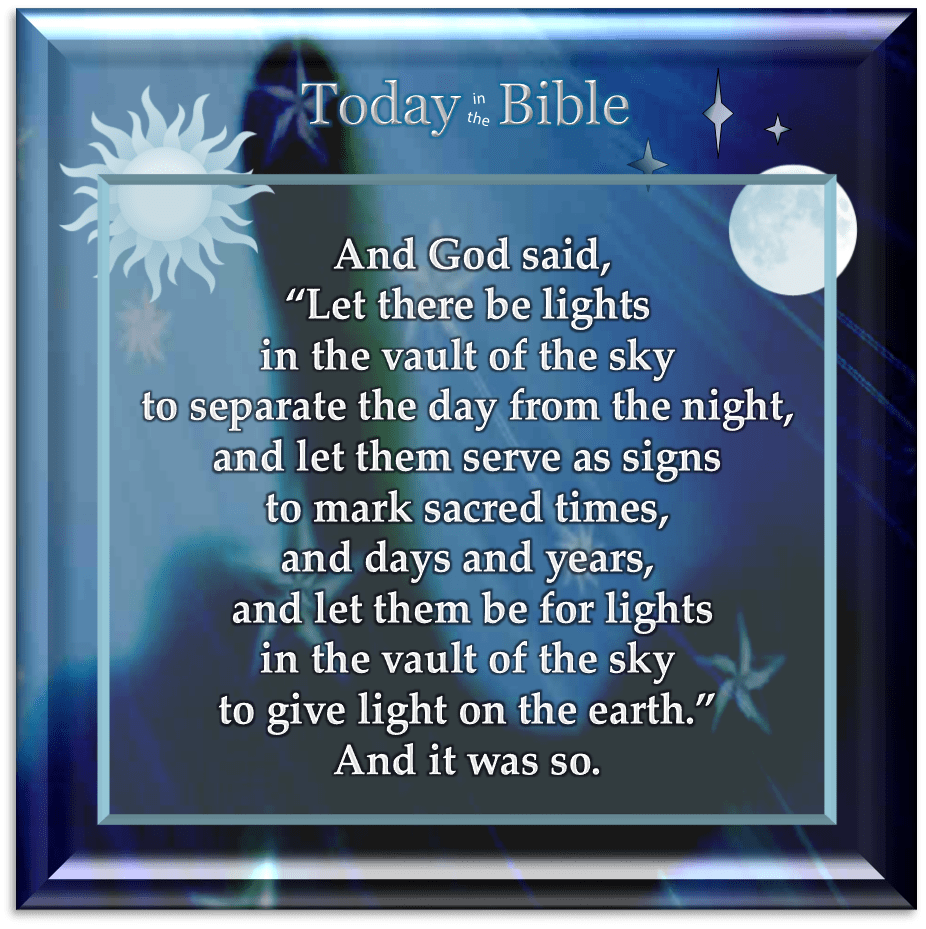
Then God said, “Let there be lights in the firmament of the heavens to divide the day from the night; and let them be for signs and seasons, and for days and years; and let them be for lights in the firmament of the heavens to give light on the earth;” and it was so.
Then God made two great lights: the greater light to rule the day, and the lesser light to rule the night. He made the stars also. God set them in the firmament of the heavens to give light on the earth, and to rule over the day and over the night, and to divide the light from the darkness. And God saw that it was good.
So the evening and the morning were the fourth day. – Genesis 1:14-19 (NKJ)
So God made the Sun, Moon, and stars and placed them in the expanse of the heavens…which He had already created. That’s the thing about God, He first creates a home and then He places His creation in that home. Jesus tells us He has gone ahead of us to do the same thing.
“Let not your heart be troubled; believe in God, believe also in Me. In My Father’s house are many dwelling places; if it were not so, I would have told you; for I go to prepare a place for you. And if I go and prepare a place for you, I will come again, and receive you to Myself; that where I am, there you may be also.” – John 14:1-3 (NAS)
In Revelation 21, John tells us about that new home. A new Heaven and a new Earth and a new Jerusalem — in which there is no need for the light of the Sun or the Moon. But for now, in this world, He created Light (“or” – אוֹר) on day one and separated it from Darkness (“Choshech” – חשׁךְ). Three days later, He created bodies of light, the luminaries, and goes on to explain that these luminaries are to be used to give light upon the Earth and to organize time. Maybe that’s why the light of the Sun and the Moon aren’t needed in the new Heaven and Earth…time no longer needs to be organized…we will be in eternity.
The Hebrew calendar uses the Earth, Moon, Sun, and stars as its guide. One revolution of the Earth equals one day. Each sunset begins a new day; it’s not some random point in the middle of the night – you don’t need a clock for that. Each cycle of the Moon is one month. You don’t need to put a calendar on the wall, just look up at the sky and check the phase of the Moon. Each time the Earth revolves around the Sun is one year. The kochavim, the stars – the constellations, will tell you what point of the year you are in.
God tells us that He also created the luminaries for signs. In Hebrew the word for signs is “otot” (“oat-oat” – א֗ת֗ת). It is defined as “a sign, mark, token, ensign, standard, miracle, miraculous sign, proof, or warning.” In the Apostolic Scriptures the Greek word “sēmeíon” (“say-mi-on” – σημεῖον) is used. Sēmeíon is defined as: “a sign (typically miraculous), given especially to confirm, corroborate or authenticate.” Sēmeíon emphasizes the end-purpose which exalts the one giving it. It is used dozens of times in the Apostolic Scriptures for what authenticates the Lord and His eternal purpose, especially by doing what mere man cannot replicate or take credit for.
In astrology, when someone asks, “What’s your sign?” They want to know what constellation the Sun was passing through on the day you were born. Astrology is the belief that the position of celestial bodies have an influence on human affairs and the natural world; but that’s a twisting of what God says He created them for. Yes, they are for signs, but they themselves do not influence events. The Bible is sprinkled with references to signs that occur in the heavens. Many are listed in the prophets, the gospels tell of signs in the heavens, the book of Revelation does too.
Finally, the luminaries were put into place to mark the “mo’adim.” This word is often translated as “seasons,” but it is actually derived from the root word יעד (y’d) which means to appoint, betrothe, assemble, meet, or set. Related words include:
- edah — (“aye-dah” – עֵדַה), meaning congregation.
- mo’ed — (“moe-aid” – מוֹעֵד), meaning an appointed place.
- mo’ad — (“mo-ahd” – מוֹעָד), meaning a place of assembly.
- mu’adah — (“moo-ah-dah” – מוּעָדׇה) which is used only once in the Bible to refer to appointed cities.
Why, then, is this word normally translated as “seasons?” That’s a good question. The word mo’adim is also used in Leviticus 23. That chapter contains a listing of God’s self-proclaimed Holy Days; times when He commands His people to assemble for a holy meeting. Just as we learned about signs as being a reason for the Sun, Moon, and stars…so, too, they exist for the LORD’s Appointed Times. Many of these Appointed Times also coincide with the agricultural harvests in Israel. Perhaps that is the reason that mo’adim is often translated as seasons?
So, God made the Sun, Moon, and stars to divide between the day and the night, and to be for signs and for appointed times and for days and for years – and to give light upon the face of the Earth. Since this blog revolves around the biblical calendar, and since the luminaries are an integral part of the biblical calendar, we’ve added special posts for how the luminaries are used to determine the days, months, and years mentioned in the Bible.
Did you know that our posts are categorized and tagged by content?
When you visit our home page at https://todayinthebible.com and select any post,
you can find the associated categories and tags just to the right of the title.
Simply click on any tag and you will be taken to all related posts.

© 2026 Today in the Bible

 Today in the Bible
You must be logged in to post a comment.