
Tishrei 1, 5784; from sunset September 15, 2023, to sunset September 16, 2023

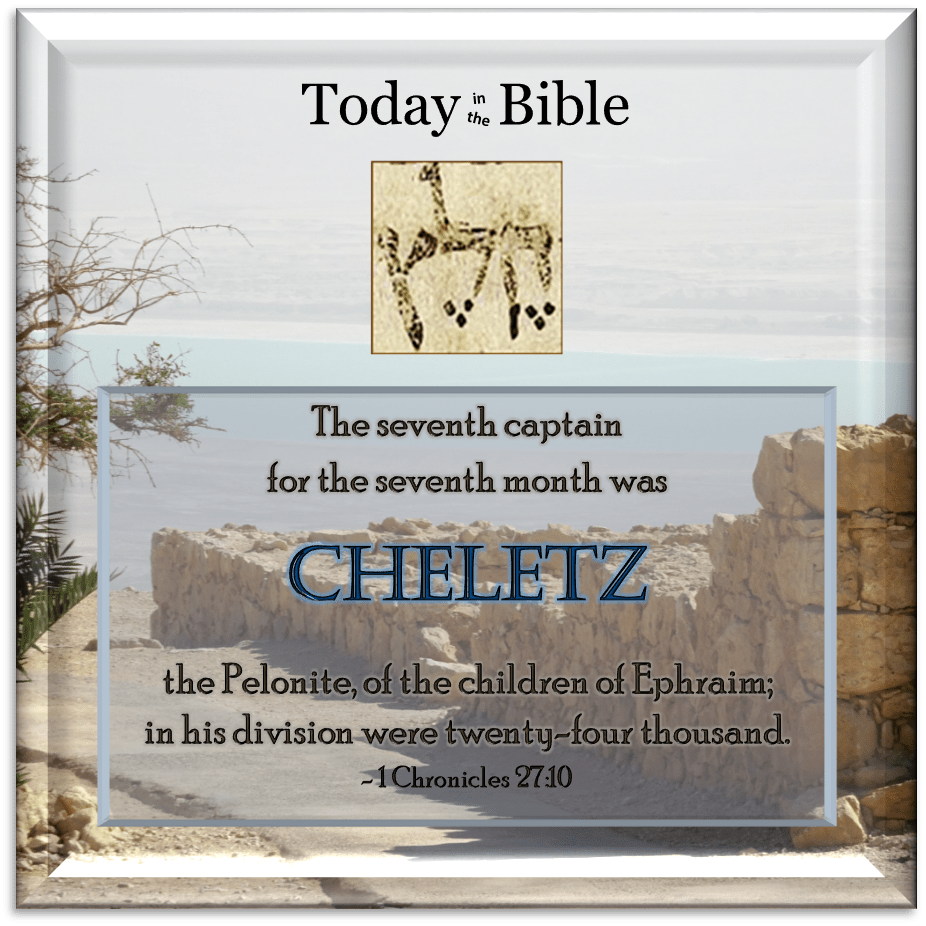
This is an image of the name Cheletz as seen in the Aleppo codex, one of the oldest, most complete manuscripts of the Hebrew Scriptures; written over one thousand years ago.
Captain for the Seventh Month
In 1 Chronicles 27 we find a listing of military commanders organized by King David. Each captain was responsible for guarding the kingdom for one month of the year. Today, Cheletz begins his watch. (Cheletz is often transliterated as “Helez.”)
And the children of Israel, according to their number, the heads of fathers’ houses, the captains of thousands and hundreds and their officers, served the king in every matter of the military divisions. These divisions came in and went out month by month throughout all the months of the year, each division having twenty-four thousand. – 1 Chronicles 27:1
The seventh captain for the seventh month was Helez the Pelonite, of the children of Ephraim; in his division were twenty-four thousand. – 1 Chronicles 27:10
Cheletz is also listed among David’s mighty men in 1 Chronicles 11.
Now the mighty men of the armies were Asahel the brother of Joab, Elhanan the son of Dodo of Bethlehem, Shammoth the Harorite, Helez the Pelonite… – 1 Chronicles 11:26-27 (NAS)
And is probably the same guy known as Cheletz the Paltite mentioned in 2 Samuel 23:
Asahel the brother of Joab was among the thirty; Elhanan the son of Dodo of Bethlehem, Shammah the Harodite, Elika the Harodite, Helez the Paltite, Ira the son of Ikkesh the Tekoite, – 2 Samuel 23:24-26 (NAS)
Cheletz (חֶלֶץ) is pronounced like “Kheletz.” In the Hebrew language, the combination of the sounds “k” and “h” is used frequently and usually transliterated as “ch.” It makes the same sound as the “ch” does in the name “Bach.” Translators regularly change the “ch” to a simple “h” to make it easier for us Westerners to pronounce.
Cheletz comes from the root-word חלץ (chltz). The TWOT lexicon lists two separate sets of word groups that come from חלץ חלץ I and חלץ II, though to me they seem to be related.
חלץ I: verb – meaning “to draw off, take off, withdraw; to rescue, be rescued (only in poetry).” Other words stemming from this root are:
chalitzah (חֲלִיצָה): noun – what is stripped off a person, as plunder, in war.
machalatzah (מַחֲלָצָה): noun – a robe of state
חלץ II: verb – meaning “to equip for war, put on a warrior’s belt, gird or arm oneself, make ready for battle, invigorate, make strong.” The widest usage of this root is the meaning “to arm” or “equip for war.” It is used to describe Israel preparing themselves to invade the Promised Land as armed soldiers, and also the soldiers of: David, Jehoshaphat, Pekah, and the king of Moab.
chalitzah (חֲלִיצָה): noun – a belt. A soldier’s (hero’s) belt with which he girded himself. Since this was the symbol of the soldier’s prowess in battle, its removal was proof that he was defeated. The belt-wrestling which was practiced in the Old Testament world is reflected in the two passages where this noun is used. In 2 Samuel 2:21 where a belt-wrestling joust is in progress Abner tries in vain to get Asahel to take on a young man and “take his belt.” In Judges 14:19 Samson takes on thirty Philistines and strips them of their belts.
Ephesians 6:14 says, “Stand firm then, with the belt of truth buckled around your waist.” When viewed in the light of the word chalitzah, it takes on a deeper meaning. If removing one’s chalitzah meant that the solider was defeated, then Paul is saying to the Ephesians that removing the “belt of truth” is what may defeat them. In Revelation, Jesus applauds the church of Ephesus for their perseverance:
To the angel of the church in Ephesus write: The One who holds the seven stars in His right hand, the One who walks among the seven golden lampstands, says this: “I know your deeds and your toil and perseverance, and that you cannot endure evil men, and you put to the test those who call themselves apostles, and they are not, and you found them to be false; and you have perseverance and have endured for My name’s sake, and have not grown weary. – Revelation 2:1-3 (NAS)
chalatzayim (חֲלָצַיִם): noun – loins – as the seat of vigor and place from which one’s seed comes. Several usages stress the girding of the loins.
Chalitzah is also the word used to refer to the ceremony performed in antithesis to the levirate marriage described in Deuteronomy 25:5-10. It not only pertains to the drawing off of the shoe, but perhaps also to the “seed” that will be “drawn off” – i.e. not allowing his brother’s name to live on in Israel by not producing an heir in his name.
If brothers dwell together, and one of them dies and has no son, the widow of the dead man shall not be married to a stranger outside the family; her husband’s brother shall go into her, take her as his wife, and perform the duty of a husband’s brother to her. And it shall be that the firstborn son which she bears will succeed to the name of his dead brother, that his name may not be blotted out of Israel.
But if the man does not want to take his brother’s wife, then let his brother’s wife go up to the gate to the elders, and say, `My husband’s brother refuses to raise up a name to his brother in Israel; he will not perform the duty of my husband’s brother.’
Then the elders of his city shall call him and speak to him. But if he stands firm and says, `I do not want to take her,’ then his brother’s wife shall come to him in the presence of the elders, remove (chalatz) his sandal from his foot, spit in his face, and answer and say, ‘So shall it be done to the man who will not build up his brother’s house.’
And his name shall be called in Israel, ‘The house of him who had his sandal removed (chalutz).’ – Deuteronomy 25:5-10 (NKJ)
This ceremony, that many of us today may find extremely weird, could actually be an allusion to eternal life…a “living on.” Many people believe the first of Tishrei will be the day of Jesus’ return, when “He will send forth His angels with a great trumpet and they will gather together (perhaps, “draw off” – “chalatz”) His elect from the four winds,” (Matthew 24:31). Is it a coincidence that Cheletz is the man King David chose to watch over the kingdom for the seventh month? The day when our Warrior King will come and “draw us off…to rescue us” from the snare of the enemy! We are the booty, we are the plunder of the great spiritual war that has been raging for millennia. We are the seed of Abraham. We will live on.
Did you know that you can view any of our posts whenever you’d like?
Visit our home page at https://todayinthebible.com
where you can find them organized by month
in the “Archives” section on the right side of the page.

© 2026 Today in the Bible

 Today in the Bible
You must be logged in to post a comment.