Tishrei 22, 5784; from sunset October 6, 2023, to sunset October 7, 2023
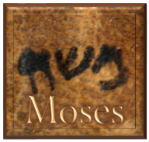
This is the name “Mosheh” (מֺשֶׁה – Moses) as seen in the Dead Sea Scrolls, written over two thousand years ago.
Shortly before his death, Moses repeated the Torah to the people. It was recorded for us as the book of Deuteronomy. In it, he leaves special instructions for what to do on Shemini Atzeret on every seventh year.
And Moses commanded them, saying: “At the end of every seven years, at the appointed time in the year of release, at the Feast of Tabernacles, when all Israel comes to appear before the LORD your God in the place which He chooses, you shall read this law before all Israel in their hearing.
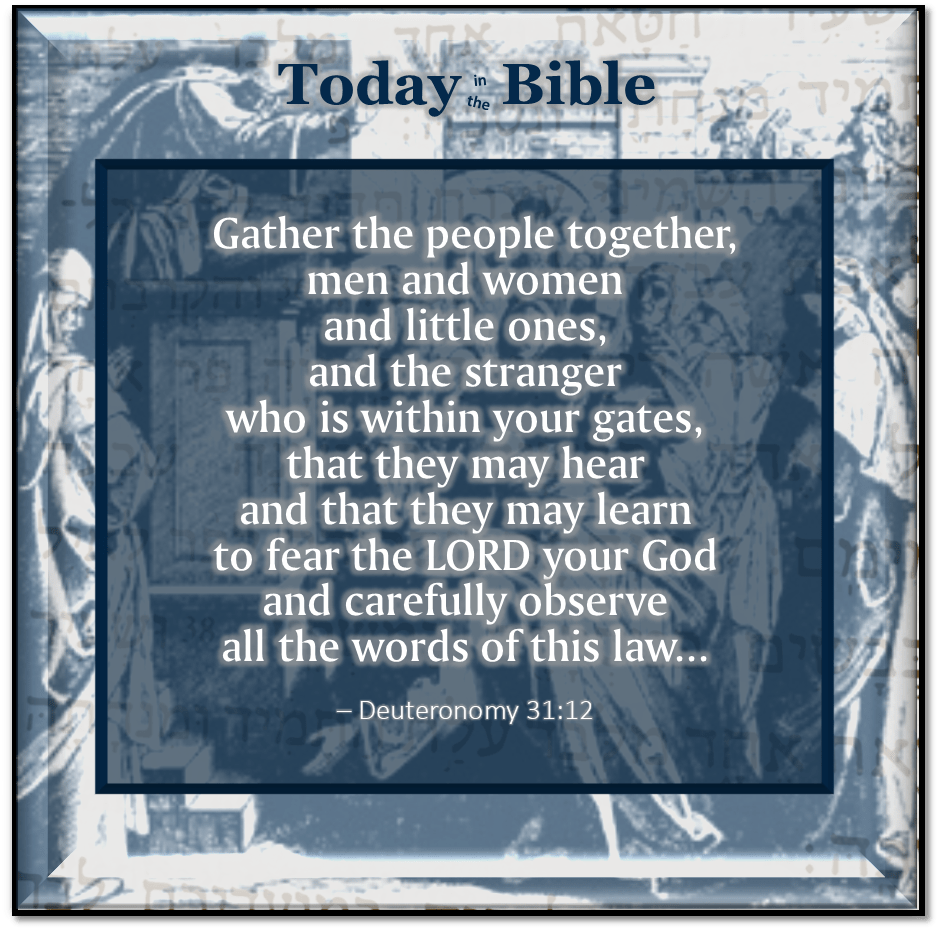
“Gather the people together, men and women and little ones, and the stranger who is within your gates, that they may hear and that they may learn to fear the LORD your God and carefully observe all the words of this law, and that their children, who have not known it, may hear and learn to fear the LORD your God as long as you live in the land which you cross the Jordan to possess.” – Deuteronomy 31:10-13 (NKJ)
Today the custom of “Simchat Torah” (which means “Rejoicing of the Torah”) is celebrated. It has been shaped and molded over hundreds of years and takes on different forms depending upon what part of the world and what sect of faith is observing it. Its main function is to celebrate God’s gift of the Torah.
After the end of the Babylonian captivity, a group of men (who became known as the Great Assembly) determined that the best way of preventing another exile was to teach the Torah to the people on a regular basis. The Torah, in this instance, is defined as the Books of Moses (also known as the Pentateuch) and consists of the books of Genesis, Exodus, Leviticus, Numbers, and Deuteronomy. The solution was to split up the Torah into portions which are taught on a weekly basis in the synagogue. The portions are generally set up on a one-year or three-year cycle. Today, most congregations follow the one-year cycle which splits the Torah into 54 portions. Each portion is known as a parshah.
Simchat Torah may consist of calling up members of the congregation to read from the Torah, even special children readings may be included. When the Torah scrolls are removed from the Ark, they are paraded around the congregation with dancing and singing. One particularly beautiful tradition is to conclude the reading of the book of Deuteronomy and then immediately “roll back the scroll” and begin again in Genesis with, “In the beginning…” In this way, the people are encouraged to never end their Torah studies…which seems fitting since this event occurs on the 8th day…a day representing eternity.
Then Moses climbed Mount Nebo from the plains of Moab to the top of Pisgah, across from Jericho. There the LORD showed him the whole land– from Gilead to Dan, all of Naphtali, the territory of Ephraim and Manasseh, all the land of Judah as far as the Mediterranean Sea, the Negev and the whole region from the Valley of Jericho, the City of Palms, as far as Zoar.
Then the LORD said to him, “This is the land I promised on oath to Abraham, Isaac and Jacob when I said, ‘I will give it to your descendants.’ I have let you see it with your eyes, but you will not cross over into it.”
And Moses the servant of the LORD died there in Moab, as the LORD had said. He buried him in Moab, in the valley opposite Beth Peor, but to this day no one knows where his grave is. Moses was a hundred and twenty years old when he died, yet his eyes were not weak nor his strength gone. The Israelites grieved for Moses in the plains of Moab thirty days, until the time of weeping and mourning was over.
Now Joshua son of Nun was filled with the spirit of wisdom because Moses had laid his hands on him. So the Israelites listened to him and did what the LORD had commanded Moses. Since then, no prophet has risen in Israel like Moses, whom the LORD knew face to face, who did all those signs and wonders the LORD sent him to do in Egypt– to Pharaoh and to all his officials and to his whole land. For no one has ever shown the mighty power or performed the awesome deeds that Moses did in the sight of all Israel. – Deuteronomy 34 (NIV)
In the beginning God created the heavens and the earth. Now the earth was formless and empty, darkness was over the surface of the deep, and the Spirit of God was hovering over the waters.
And God said, “Let there be light,” and there was light. God saw that the light was good, and he separated the light from the darkness. God called the light “day,” and the darkness he called “night.” And there was evening, and there was morning– the first day.
And God said, “Let there be a vault between the waters to separate water from water.” So God made the vault and separated the water under the vault from the water above it. And it was so. God called the vault “sky.” And there was evening, and there was morning– the second day.
And God said, “Let the water under the sky be gathered to one place, and let dry ground appear.” And it was so. God called the dry ground “land,” and the gathered waters he called “seas.” And God saw that it was good. Then God said, “Let the land produce vegetation: seed-bearing plants and trees on the land that bear fruit with seed in it, according to their various kinds.” And it was so. The land produced vegetation: plants bearing seed according to their kinds and trees bearing fruit with seed in it according to their kinds. And God saw that it was good. And there was evening, and there was morning– the third day.
And God said, “Let there be lights in the vault of the sky to separate the day from the night, and let them serve as signs to mark sacred times, and days and years, and let them be lights in the vault of the sky to give light on the earth.” And it was so. God made two great lights– the greater light to govern the day and the lesser light to govern the night. He also made the stars. God set them in the vault of the sky to give light on the earth, to govern the day and the night, and to separate light from darkness. And God saw that it was good. And there was evening, and there was morning– the fourth day.
And God said, “Let the water teem with living creatures, and let birds fly above the earth across the vault of the sky.” So God created the great creatures of the sea and every living thing with which the water teems and that moves about in it, according to their kinds, and every winged bird according to its kind. And God saw that it was good. God blessed them and said, “Be fruitful and increase in number and fill the water in the seas, and let the birds increase on the earth.” And there was evening, and there was morning– the fifth day.
And God said, “Let the land produce living creatures according to their kinds: the livestock, the creatures that move along the ground, and the wild animals, each according to its kind.” And it was so. God made the wild animals according to their kinds, the livestock according to their kinds, and all the creatures that move along the ground according to their kinds. And God saw that it was good. Then God said, “Let us make mankind in our image, in our likeness, so that they may rule over the fish in the sea and the birds in the sky, over the livestock and all the wild animals, and over all the creatures that move along the ground.” So God created mankind in his own image, in the image of God he created them; male and female he created them. God blessed them and said to them, “Be fruitful and increase in number; fill the earth and subdue it. Rule over the fish in the sea and the birds in the sky and over every living creature that moves on the ground.” Then God said, “I give you every seed-bearing plant on the face of the whole earth and every tree that has fruit with seed in it. They will be yours for food. And to all the beasts of the earth and all the birds in the sky and all the creatures that move along the ground– everything that has the breath of life in it– I give every green plant for food.” And it was so. God saw all that he had made, and it was very good. And there was evening, and there was morning– the sixth day. – Genesis 1 (NIV)
Another wonderful tradition is to encourage each other to continue reading the Torah. This is done after concluding the study of each book by saying…
Chazak, chazak vinitchazek!
Be strong, be strong, and may we be strengthened!
Did you know that you can view any of our posts whenever you’d like?
Visit our home page at https://todayinthebible.com
where you can find them organized by month
in the “Archives” section on the right side of the page.
© 2026 Today in the Bible
 Today in the Bible
You must be logged in to post a comment.