
Cheshvan 1, 5784; from sunset October 15, 2023, to sunset October 16, 2023

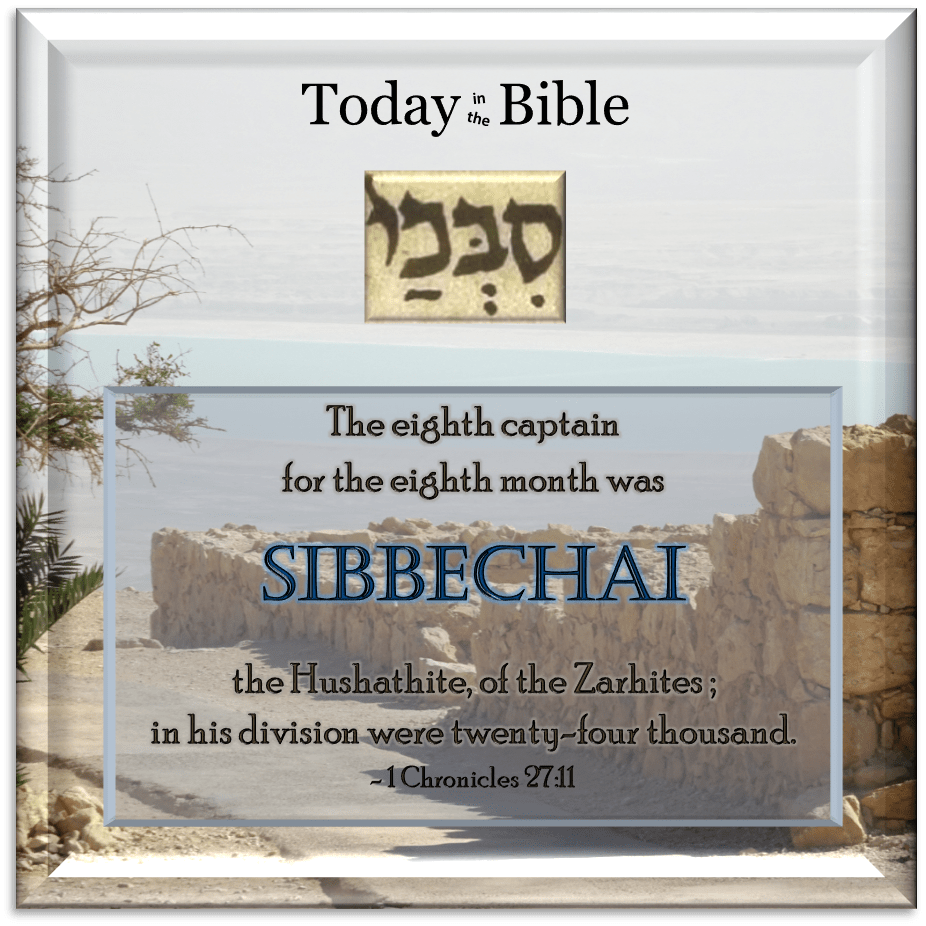
This is an image of the name Sibbechai as seen in the Aleppo codex, one of the oldest, most complete manuscripts of the Hebrew Scriptures; written over one thousand years ago.
Captain for the Eighth Month
In 1 Chronicles 27 we find a listing of military commanders organized by King David. Each captain was responsible for guarding the kingdom for one month of the year. Today, Sibbechai begins his watch.
And the children of Israel, according to their number, the heads of fathers’ houses, the captains of thousands and hundreds and their officers, served the king in every matter of the military divisions. These divisions came in and went out month by month throughout all the months of the year, each division having twenty-four thousand. – 1 Chronicles 27:1
The eighth (captain) for the eighth month was Sibbechai the Hushathite, of the Zarhites; in his division were twenty-four thousand. – 1 Chronicles 27:11
Sibbechai was from the city of Chushah. In Hebrew transliteration, words spelled with “ch” are not pronounced like the “ch” in “church” but, rather, like the “ch” in “Bach.” It’s not a sound that many feel comfortable making, so most translators soften the sound by simply transliterating it with the letter “h.” Thus, in the verses above, he is known as Sibbechai the Hushathite. The word “chushah” comes from a verb which means “to hurry or make haste.”
Sibbechai was a Zarhite; a descendant of Zarach (commonly translated as Zerah – another “ch” word transliterated with an “h”). Zarach was one of the twin sons born to Judah and Tamar. He was the grandson of Jacob, great grandson of Isaac, and great, great grandson of Abraham. Zarach means “to arise, rise, rise up, or shine.” Related words include “mizrach” meaning the place of the sunrise. The story of Zarach’s birth is found in Genesis 38.
Sibbechai is listed among David’s mighty men in 1 Chronicles chapter 11.
Also the mighty warriors were Asahel the brother of Joab, Elhanan the son of Dodo of Bethlehem, Shammoth the Harorite, Helez the Pelonite, Ira the son of Ikkesh the Tekoite, Abiezer the Anathothite, Sibbechai the Hushathite, Ilai the Ahohite, – 1 Chronicles 11:26-29 (NKJ)
Sibbechai’s claim to fame is recorded in two places in the Scriptures. Most scholars agree that both of these verses are referencing the same battle; one time it is called Gob and the other, Gezer. Apparently, these cities are near each other, and it is assumed the clash occurred somewhere between the two. Sibbechai killed Saph, aka Sippai, who was the son of Goliath.
Now it happened afterward that there was again a battle with the Philistines at Gob. Then Sibbechai the Hushathite killed Saph, who was one of the sons of the giant. – 2 Samuel 21:18 (NKJ)
Now it happened afterward that war broke out at Gezer with the Philistines, at which time Sibbechai the Hushathite killed Sippai, who was one of the sons of the giant. And they were subdued. – 1 Chronicles 20:4 (NKJ)
The name Sibbechai comes from the verb-root “savak” (סָבַךְ) meaning “to interweave.” The sense of interweaving in this word is of a natural origin. Thorns and thickets tend to grow densely together, their branches naturally interweaving with each other. This makes it difficult to move through a thicket. The nouns “sevach” (סְבַךְ) and “sevoch” (סְבֹךְ), both meaning “thicket,” also come from this root.
Thorns and thickets are nasty and prickly but that means they can also provide protection. When grazing in an open field, livestock are open to attack. For millennia, shepherds have built enclosures made from thorn bushes, using the natural building blocks afforded them to house their flocks at night, keeping them safe from predators.
I’m picturing Sibbechai as providing that sort of protection to the Kingdom during his watch over the month of Cheshvan. Sleep soundly little flock.
Did you know that you can view any of our posts whenever you’d like?
Visit our home page at https://todayinthebible.com
where you can find them organized by month
in the “Archives” section on the right side of the page.

© 2026 Today in the Bible

 Today in the Bible
You must be logged in to post a comment.