Kislev 28, 5784; from sunset December 10, 2023, to sunset December 11, 2023
The word for lamp in Hebrew is ner – נֵר (pronounced like “nare”). The word nir – נִיר (pronounced like “neer”) is another word for lamp. Both Ner and nir refer to small bowl-shaped objects which act as a reservoir for oil. A wick is then added and lit to provide light. Lamps are common household objects and have been around for millennia. Archaeologists like to find them when excavating because the style of the lamp can help to date other finds in the same stratum.
The word menorah – מְּנוֹרָה (pronounced like “meh-no-rah”) comes from the same root as ner and nir. When the letter mem (מ) is prefixed to a verb, it denotes an agent or instrument of the action of that verb. When mem is prefixed to a noun, it is used in a similar way but indicates a special place. This is known as a mem-preformative noun. There is one other way the letter mem is used at the beginning of a word and that is as an inseparable preposition meaning “from, out of, by, by reason of, at, because of, or more than.”
In the case of our word, the mem-preformative noun fits the bill. A menorah is the stand upon which a lamp is placed; i.e., “a special lamp place.” Sometimes the word menorah is translated as “candlestand,” but “lampstand” is actually a better translation.
In the Bible, the word menorah is found forty-two times and used almost exclusively to signify the lampstand in the Tabernacle or Temple. In Exodus chapter 25, after Moses, Aaron, Joshua, and the seventy elders eat a covenant meal with God, Moses alone was called up to the mountain where God gave him specific instructions for how to construct the menorah.
“You shall also make a lampstand of pure gold; the lampstand shall be of hammered work. Its shaft, its branches, its bowls, its ornamental knobs, and flowers shall be of one piece. And six branches shall come out of its sides: three branches of the lampstand out of one side, and three branches of the lampstand out of the other side. Three bowls shall be made like almond blossoms on one branch, with an ornamental knob and a flower, and three bowls made like almond blossoms on the other branch, with an ornamental knob and a flower– and so for the six branches that come out of the lampstand.
“On the lampstand itself four bowls shall be made like almond blossoms, each with its ornamental knob and flower. And there shall be a knob under the first two branches of the same, a knob under the second two branches of the same, and a knob under the third two branches of the same, according to the six branches that extend from the lampstand. Their knobs and their branches shall be of one piece; all of it shall be one hammered piece of pure gold.
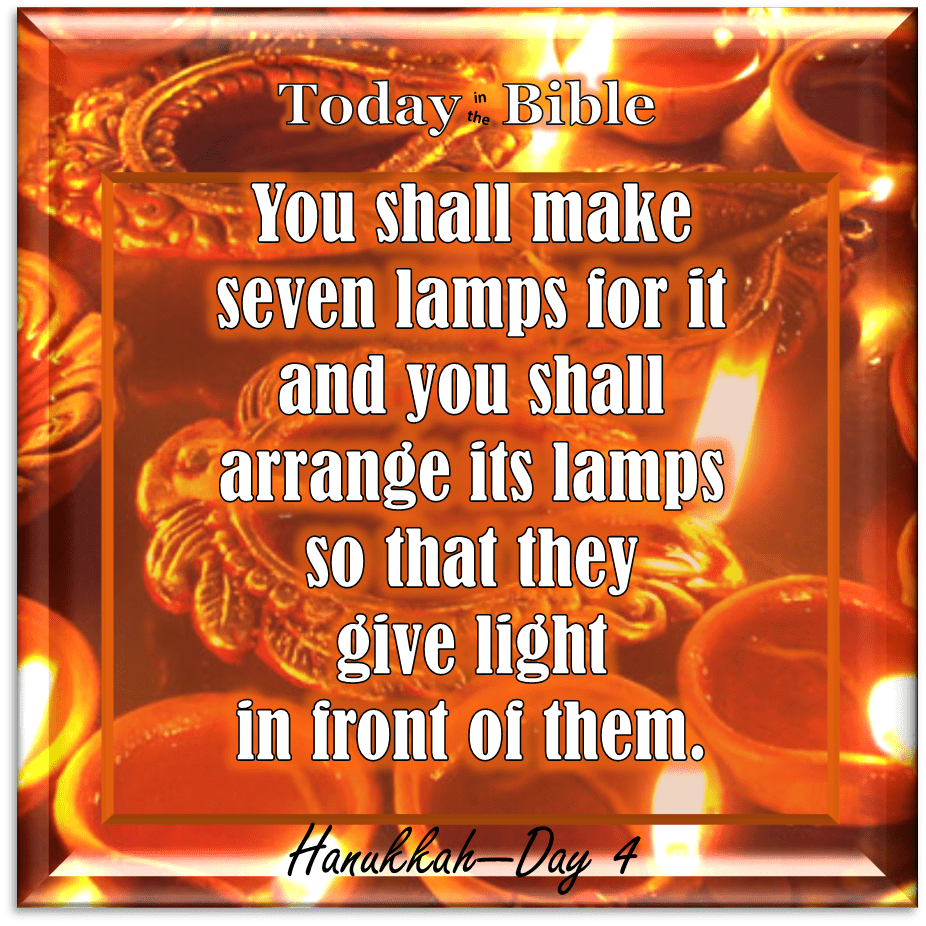
“You shall make seven lamps for it, and they shall arrange its lamps so that they give light in front of it.” – Exodus 25:31-37 (NKJ)
A careful reading of these verses shows us the difference between the lamps and the lampstand. Verse 31 begins with the description of the lampstand itself; verse 37 describes the lamps which are placed upon its branches.
A menorah is a lampstand which can have any number of lamps associated with it. THE Menorah in the Tabernacle or Temple held seven lamps. During Hanukkah, we use a menorah with nine lamps. The Temple Menorah had seven lamps because that was what God commanded Moses to make. The Hanukkah menorah has four lamps on either side of the center lamp. The eight lights on the side represent the eight days that the one cruse of oil burned. The center light is called the “shamash” which means “servant.” It is used to ignite the other lights on the menorah.
A person may have a replica of the seven-branched Temple Menorah in their home as a remembrance of the Golden Menorah from the Holy Place; but it’s generally not lit or used for light. That is reserved for the Holy Place. The nine-branched menorah is used specifically for the celebration of Hanukkah. It is referred to as either a Hanukkah menorah or a hanukkiah.

Hanukkah – Day 4
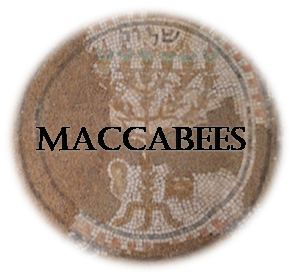
To see all of our posts revolving around the history of the Maccabees, just click on the image above.
© 2026 Today in the Bible
 Today in the Bible
You must be logged in to post a comment.