Tevet 18, 5784; from sunset December 29, 2023, to sunset December 30, 2023
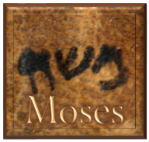
This is the name “Mosheh” (מֺשֶׁה – Moses) as seen in the Dead Sea Scrolls, written over two thousand years ago.
We’ve been following the Israelites as they construct the furnishings for the Tabernacle. They started bringing together the supplies needed to make the Tabernacle in the autumn and worked through the winter to make everything on the list. Today we’ll learn about the altar of burnt offering, the “mizbach ha’olah.”
The altar of burnt offering is sometimes translated as the “altar of the holocausts.” The first time I saw this it startled me. I looked up the meaning of holocaust and found out that it is derived from the ancient Greek, “holokaustos.” This is a translation of the Hebrew word, “olah,” meaning “a whole burnt sacrifice offered to God.” A whole burnt offering is wholly sacrificed and not shared with the priest or the offeror – it is all given up to God. Olah comes from a Hebrew verb that means “to go up.”
As we’ve studied previously, all of the furnishings for the Holy Place and the Holy of Holies were made of “zahav tahor” – pure gold. The mizbach ha’olah was located in the court of the Tabernacle – outside of the holy places. This is also reflected in the type of metal used in its furnishings; no longer are they made of “zahav tahor,” but of “nechoshet” – bronze, copper.
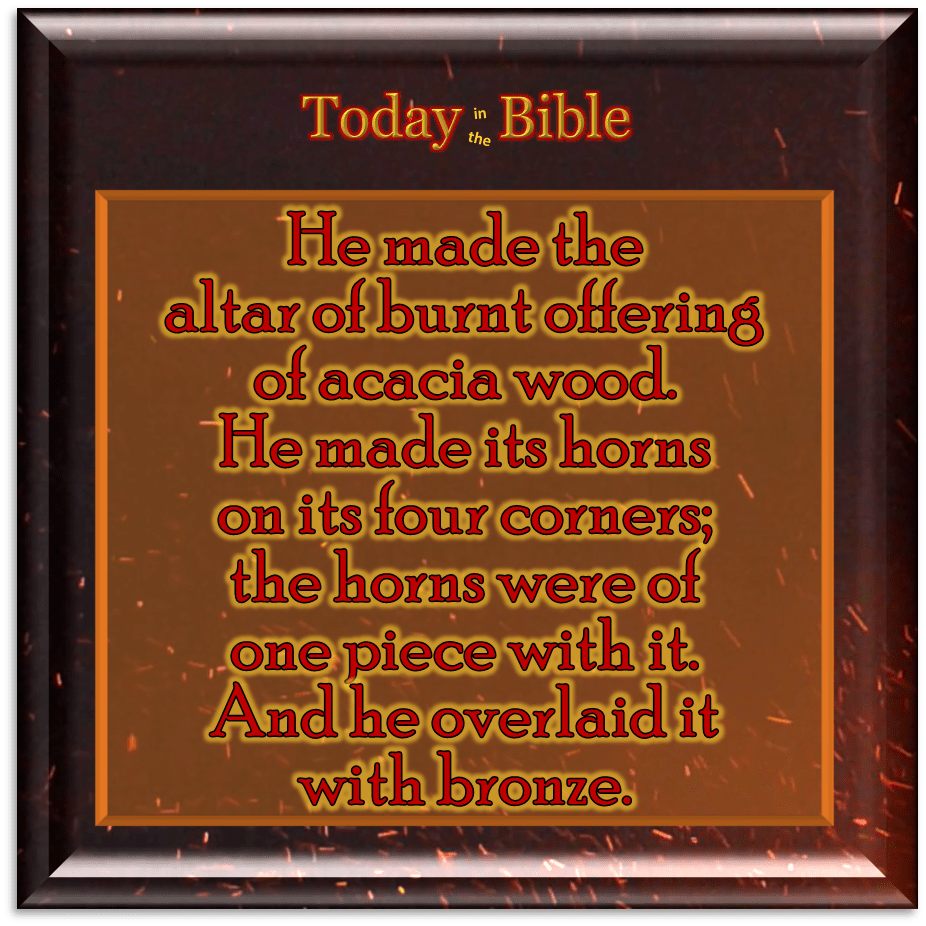
He made the altar of burnt offering (mizbach ha’olah) of acacia wood; five cubits was its length and five cubits its width– it was square– and its height was three cubits. He made its horns on its four corners; the horns were of one piece with it. And he overlaid it with bronze.
He made all the utensils for the mizbach: the pans, the shovels, the basins, the forks, and the firepans; all its utensils he made of bronze. And he made a grate of bronze network for the mizbach, under its rim, midway from the bottom.
He cast four rings for the four corners of the bronze grating, as holders for the poles. And he made the poles of acacia wood, and overlaid them with bronze. Then he put the poles into the rings on the sides of the mizbach, with which to bear it. He made the mizbach hollow with boards. – Exodus 38:1-7 (NKJ)
As we all know, the term holocaust was later chosen to describe the Nazi killing program. In the extermination camps, the bodies of the victims were consumed whole in a crematorium or even in open fires – just as the whole burnt offerings – they ascended to God.
The majority of Jews who died in the Holocaust were of Ashkenazi descent. According to Wikipedia, the term “Ashkenazi” refers to Jewish settlers who established communities along the Rhine River in Western Germany and in Northern France dating to the Middle Ages. In Genesis chapter ten, Ashkenaz is listed as the great grandson of Noah (Noah-Japheth-Gomer-Ashkenaz).
The name Ashkenaz is a combination of two Hebrew words.
אשכנז
| נזה | כ | אש |
| nazah | k | ash |
| this is a verb which means “to sprinkle” | this letter is used as an inseparable preposition meaning, “like or as” | ash or esh means “fire” |
The name “Ashkenaz” means “Fire-Like Sprinkles.”

To read all of our posts on the building of the Tabernacle, click on the image above.
© 2026 Today in the Bible
 Today in the Bible
You must be logged in to post a comment.