
Shevat 1, 5784; from sunset January 10, 2024, to sunset January 11, 2024

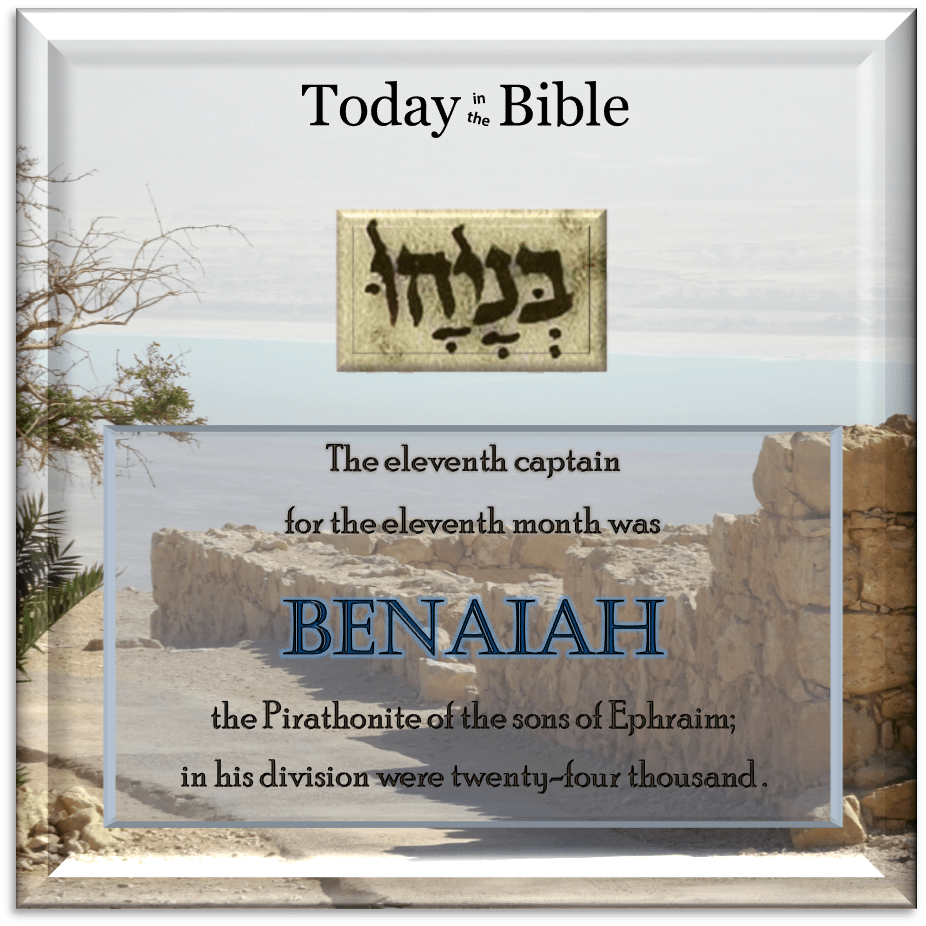
This is the name “Benaiah” as it was written in the Aleppo Codex, or “Crown of Aleppo” – one of the oldest, most complete copies of the Hebrew Scriptures, written over one thousand years ago.
Benaiah Takes Command
It’s a new month and that means a new military commander. King David set up a military guard that rotated every month. Each month had a leader and 24,000 men. Many of David’s “Mighty Men” were given the honor of being the captain of one month of each year. Benaiah is one of them (2 Samuel 23:30, 1 Chronicles 11:26). He is the second man named Benaiah that David chose as his monthly commander; the other was captain over the third month, Sivan, and he was the son of Jehoiada, the priest.
And the children of Israel, according to their number, the heads of fathers’ houses, the captains of thousands and hundreds and their officers, served the king in every matter of the military divisions. These divisions came in and went out month by month throughout all the months of the year, each division having twenty-four thousand. – 1 Chronicles 27:1 (NKJ)
The eleventh for the eleventh month was Benaiah the Pirathonite of the sons of Ephraim; and in his division were 24,000. – 1 Chronicles 27:14
The name Benaiah may mean the “Son (Ben) of the Lord (iah),” or it could mean “Built Up (banah) of the Lord (iah).” The majority of Bible dictionaries choose the second option. There may also be an ancient connection between these two words as the son was seen as the one who builds up the family.
The name Benaiah is among the most popular in the Bible. There are at least twelve different individuals with this name. Our Benaiah is one of David’s thirty, and though the Bible doesn’t recount his exploits, he still earned the respect of David and was appointed to watch over the kingdom for this month.
He was from a town named Pirathon in the hills of Ephraim. There is some uncertainty around the meaning of the name Pirathon. Some believe it means “summit” and other believe it means “prince” or “Little Pharaoh” – associating it with the Hebrew word for Pharaoh.
Did you know that you can view any of our posts whenever you’d like?
Visit our home page at https://todayinthebible.com
where you can find them organized by month
in the “Archives” section on the right side of the page.

© 2026 Today in the Bible

 Today in the Bible
You must be logged in to post a comment.