Shevat 15, 5784, from sunset January 24, 2024, to sunset January 25, 2024
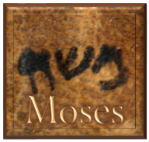
This is the name “Mosheh” (מֺשֶׁה – Moses) as seen in the Dead Sea Scrolls, written over two thousand years ago.
Tu B’Shevat
And when you enter the land and plant all kinds of trees for food, then you shall count their fruit as forbidden. Three years it shall be forbidden to you; it shall not be eaten. But in the fourth year all its fruit shall be holy, an offering of praise to the LORD. And in the fifth year you are to eat of its fruit, that its yield may increase for you; I am the LORD your God. – Leviticus 19:23-25 (NAS)
The words translated as “count their fruit as forbidden” in these verses is literally “to count as uncircumcised the foreskin of its fruit” in Hebrew. The King James, New King James, and New Jerusalem versions of the Bible actually use “uncircumcised” in their translations of this verse.
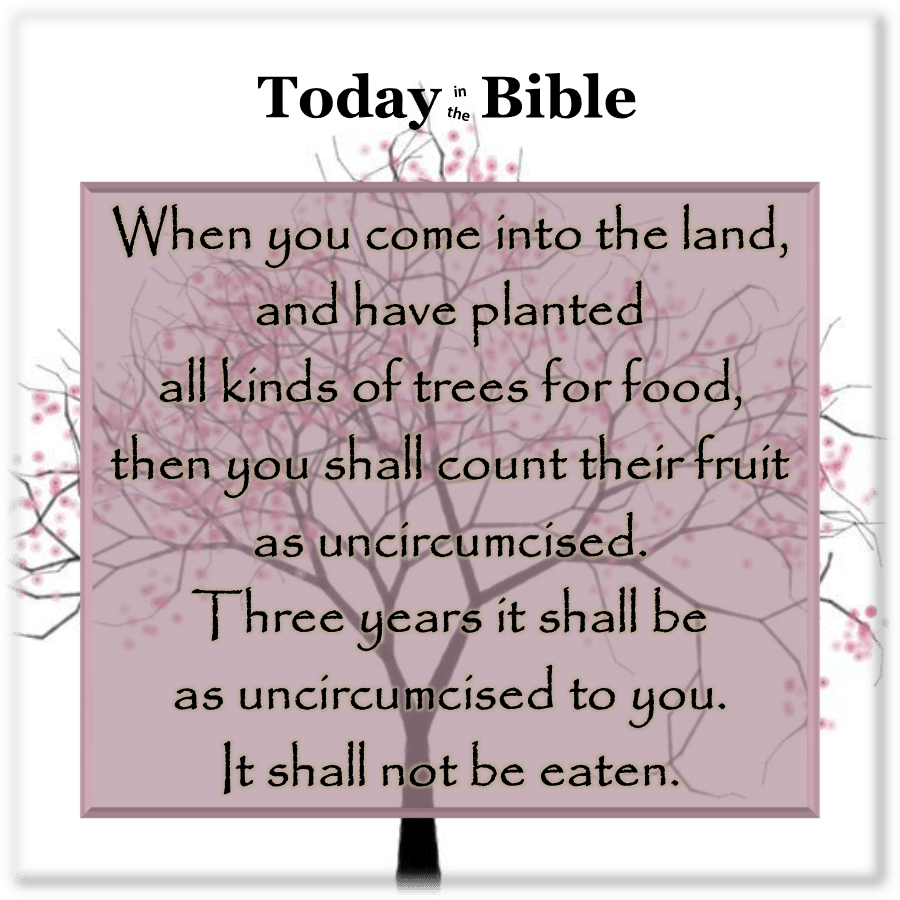
When you come into the land, and have planted all kinds of trees for food, then you shall count their fruit as uncircumcised. Three years it shall be as uncircumcised to you. It shall not be eaten. – Leviticus 19:23 (KJV & NKJ)
Once you have entered the country and planted any kind of fruit tree, you will regard its fruit as uncircumcised. For three years you will count it as uncircumcised and it will not be eaten. – Leviticus 19:23 (NJB)
עָרְלָה עָרל
The verb behind the translations is “aral,” meaning “to be uncircumcised.” It is a denominative verb, which is a fancy way of saying that it is a verb derived from a noun; the noun being “orlah” – meaning foreskin (i.e. uncircumcised). Reading right to left, the first letter of these words is silent, which means it can carry the sound of any vowel. In this case, one word carries the vowel sound of our letter “a” and the other carries the vowel sound of our letter “o.” You can see the similarity of each word in the Hebrew. The denominative form of this root is only used twice in the Bible. Once in this verse and once in Habakkuk 2:16, where it is sometimes translated as “exposed” or “naked.”
So how does being uncircumcised apply to fruit trees? The Holladay lexicon’s definition of this root word renders, “to leave the foreskin uncircumcised, i.e. leave unharvested.” In his book, The Heart of the Old Testament, Ronald Youngblood writes, “The rite of circumcision would become… a token of God’s solemn promise to bless His people numerically.” Going back to our verses in Leviticus 19, we can see “God’s solemn promise” for fruit trees also results in a numerical increase, “that its yield may increase for you.”
Why Tu Be’Shevat?
Once again God makes a commandment around eating the fruit of a tree…but this time it’s not about the “knowledge of good and evil” and we’re not in the garden of Eden. Rather, it’s how to determine when a tree is old enough to be tithed and then harvested. The commandment revolves around “years” – so there had to be a way to determine when the new year for trees begins.
A specific date for the new year of trees is not mentioned in the Bible; though the date chosen goes back at least two thousand years. The Mishnah makes mention of a debate between the rabbis Hillel and Shammai – the former chose the 15th as the proper day of observance and Shammai offered up the first of Shevat instead. Hillel prevailed and his date is still observed to this day.
The name Tu B’Shvat is derived from the Hebrew date of its observance. “Tu” stands for the Hebrew letters teit (ט) and vav (ו). Similar to Roman numerals, the letters in Hebrew are assigned a numerical value. When combined, these letters sum up 15 as their numerical values are 9 (ט) and 6 (ו).
Each tree is considered to have aged one year as of Tu B’Shevat (Shevat 15), so if you planted a tree on Shevat 14, it begins its second year the next day, but if you plant a tree two days later, on Shevat 16, it does not reach its second year until the next Tu B’Shevat.
It is customary to eat a new fruit on this day, or to eat from the “Seven Species” (shivat haminim) described in the Bible as being abundant in the land of Israel. The Shivat Haminim are: wheat, barley, grapes (vines), figs, pomegranates, olives and dates (honey).
For the LORD your God is bringing you into a good land, a land of brooks of water, of fountains and springs, flowing forth in valleys and hills; a land of wheat and barley, of vines and fig trees and pomegranates, a land of olive oil and honey – Deuteronomy 8:7-8 (NAS)
Today, Tu B’Shevat is celebrated as a type of an Arbor Day. Many people plant trees or raise money to buy trees to be planted in Israel. In the 16th century, kabbalists developed a seder ritual similar to the Passover Seder, discussing the spiritual significance of fruits and of the shivat haminim.
Our Father seems to have a soft-spot in His heart for trees as He called out specifically not to cut down the trees surrounding a city when at war.
When you besiege a city a long time, to make war against it in order to capture it, you shall not destroy its trees by swinging an axe against them; for you may eat from them, and you shall not cut them down. For is the tree of the field a man, that it should be besieged by you? Only the trees which you know are not fruit trees you shall destroy and cut down, that you may construct siegeworks against the city that is making war with you until it falls. – Deuteronomy 20:19-20 (NAS)
It’s interesting that only the trees that are known to bear fruit shall be saved. The others may be destroyed. Being fruitful and multiplying are important to God and the commandment to do so goes way back to the creation narrative. This reminds me of when our Master was hungry and happened upon a fig tree without fruit…
Now in the morning, when He returned to the city, He became hungry. And seeing a lone fig tree by the road, He came to it, and found nothing on it except leaves only; and He said to it, “No longer shall there ever be any fruit from you.” And at once the fig tree withered.
And seeing this, the disciples marveled, saying, “How did the fig tree wither at once?”
And Jesus answered and said to them, “Truly I say to you, if you have faith, and do not doubt, you shall not only do what was done to the fig tree, but even if you say to this mountain, ‘Be taken up and cast into the sea,’ it shall happen. And all things you ask in prayer, believing, you shall receive.” – Matthew 21:18-22 (NAS)
The almond tree, which is not listed in the shivat haminim, typically begins to bloom around this time of year in Israel…sigh…here in the central U.S., we still have about three months before we begin seeing our trees in bloom 😐.
Then shall the trees of the forest sing for joy before the Lord, for He comes to judge the earth.
– 1 Chronicles 16:33
 Today in the Bible
You must be logged in to post a comment.