Shevat 17, 5784; from sunset January 26, 2024, to sunset January 27, 2024
International Holocaust Remembrance Day was founded by the United Nations in 2005. It commemorates the victims of the Holocaust where one third of the Jewish people were murdered by Nazi Germany. January 27th was chosen because that was the date the Auschwitz concentration camp was liberated by the Red Army in 1945. (Wikipedia)
Psalm 102 seems to have been composed specifically for the victims of the Holocaust. Today we remember those who were “appointed to death.”
Hear my prayer, O LORD, and let my cry come to You.
Do not hide Your face from me in the day of my trouble; incline Your ear to me; in the day that I call, answer me speedily.
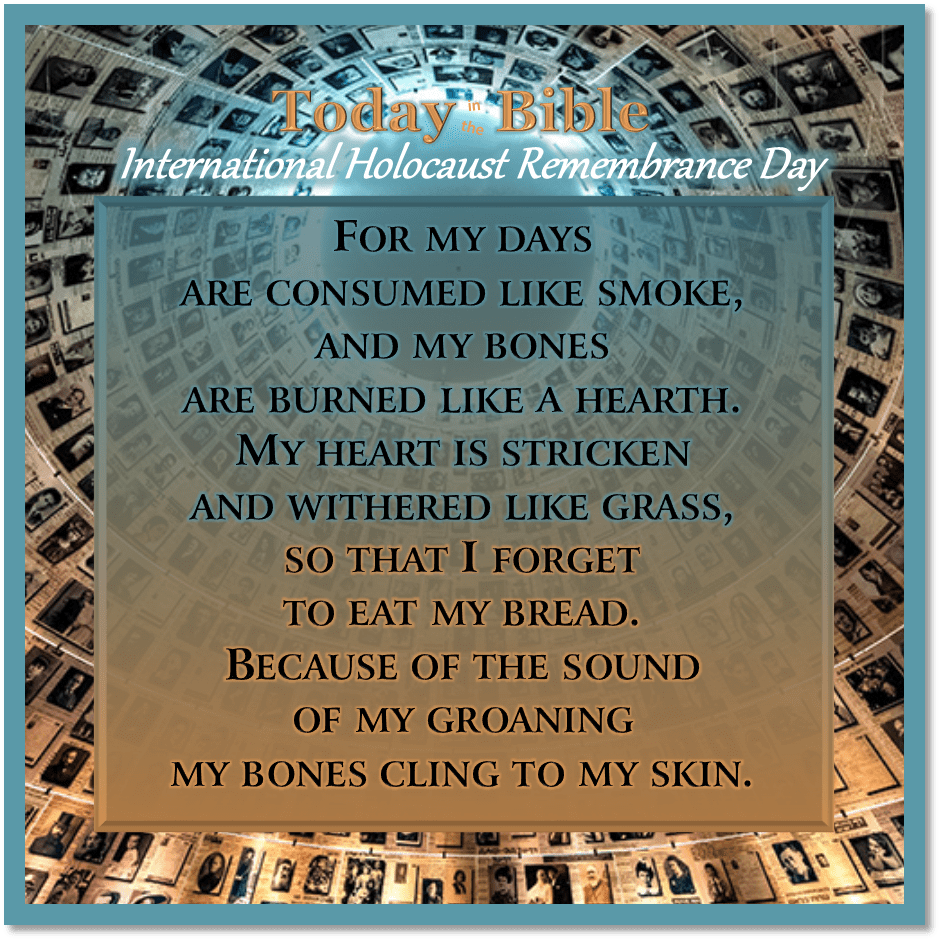
For my days are consumed like smoke, and my bones are burned like a hearth.
My heart is stricken and withered like grass, so that I forget to eat my bread.
Because of the sound of my groaning my bones cling to my skin.
I am like a marsh-bird of the wilderness; I am like an owl of the desert.
I lie awake and am like a sparrow alone on the housetop.
My enemies reproach me all day long, those who deride me swear an oath against me.
For I have eaten ashes like bread, and mingled my drink with weeping, because of Your indignation and Your wrath; for You have lifted me up and cast me away.
My days are like a shadow that lengthens, and I wither away like grass.
But You, O LORD, shall endure forever, and the remembrance of Your name to all generations.
You will arise and have mercy on Zion; for the time to favor her, yes, the appointed time, has come.
For Your servants take pleasure in her stones and show favor to her dust.
So, the nations shall fear the name of the LORD, and all the kings of the earth Your glory.
For the LORD shall build up Zion; He shall appear in His glory.
He shall regard the prayer of the destitute and shall not despise their prayer.
This will be written for the generation to come, that a people yet to be created may praise the LORD.
For He looked down from the height of His sanctuary; from heaven the LORD viewed the earth, to hear the groaning of the prisoner, to release those appointed to death, to declare the name of the LORD in Zion, and His praise in Jerusalem, when the peoples are gathered together, and the kingdoms, to serve the LORD.
He weakened my strength in the way; He shortened my days.
I said, “O my God, do not take me away in the midst of my days; Your years are throughout all generations.
Of old You laid the foundation of the earth, and the heavens are the work of Your hands.
They will perish, but You will endure; yes, they will all grow old like a garment; like a cloak You will change them, and they will be changed.
But You are the same, and Your years will have no end.
The children of Your servants will continue, and their descendants will be established before You.”
– Psalm 102
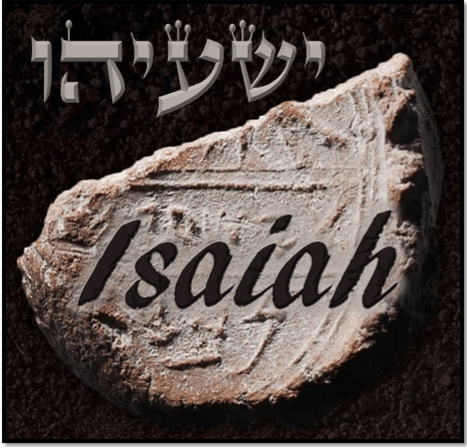
This is an image of the Isaiah bulla. A bulla is a clay seal which was impressed onto a cord tied around a document. These bullae were hardened when the Babylonians burned the Temple in Jerusalem. It was discovered in 2009 and, though portions of it are missing, the full inscription is believed to read: “Belonging to Isaiah [the] Prophe[t].” It is the first archaeological find offering proof of the prophet’s existence.
Yad Vashem
Yad Vashem is the name of the main Holocaust memorial and museum in Jerusalem. It originates in a verse found in the book of the prophet Isaiah:
[To] them will I give in my house and within my walls a [memorial] and a [name], better than sons and daughters; I will give them an everlasting [name], that shall not be cut off [from memory].
Naming the Holocaust memorial “yad vashem” [literally “a hand (yad) and a name (vashem)”] conveys the idea of establishing a national depository for the names of Jewish victims who have no one to carry their name after death. The original verse referred to eunuchs who, although they could not have children, could still live for eternity with the Lord. (Wikipedia)
Let’s look at this verse in context:
Thus says the LORD: “Keep justice, and do righteousness, for My salvation is about to come, and My righteousness to be revealed.
Blessed is the man who does this, and the son of man who lays hold on it; who keeps from defiling the Sabbath, and keeps his hand from doing any evil.”
Do not let the son of the foreigner who has joined himself to the LORD speak, saying, “The LORD has utterly separated me from His people”; nor let the eunuch say, “Here I am, a dry tree.”
For thus says the LORD: “To the eunuchs who keep My Sabbaths, and choose what pleases Me, and hold fast My covenant, even to them I will give in My house and within My walls a place (yad) and a name (vashem) better than that of sons and daughters; I will give them an everlasting name that shall not be cut off.” – Isaiah 56:1-5 (NKJ)
The majority of Jews who died in the Holocaust were of Ashkenazi descent. According to Wikipedia, the term “Ashkenazi” refers to Jewish settlers who established communities along the Rhine River in Western Germany and in Northern France dating to the Middle Ages. To learn more about the significance of the name Ashkenaz, please see our post “Altar of the Holocaust.”
Did you know that you can view any of our posts whenever you’d like?
Visit our home page at https://todayinthebible.com
where you can find them organized by month
in the “Archives” section on the right side of the page.

© 2026 Today in the Bible

 Today in the Bible
You must be logged in to post a comment.