
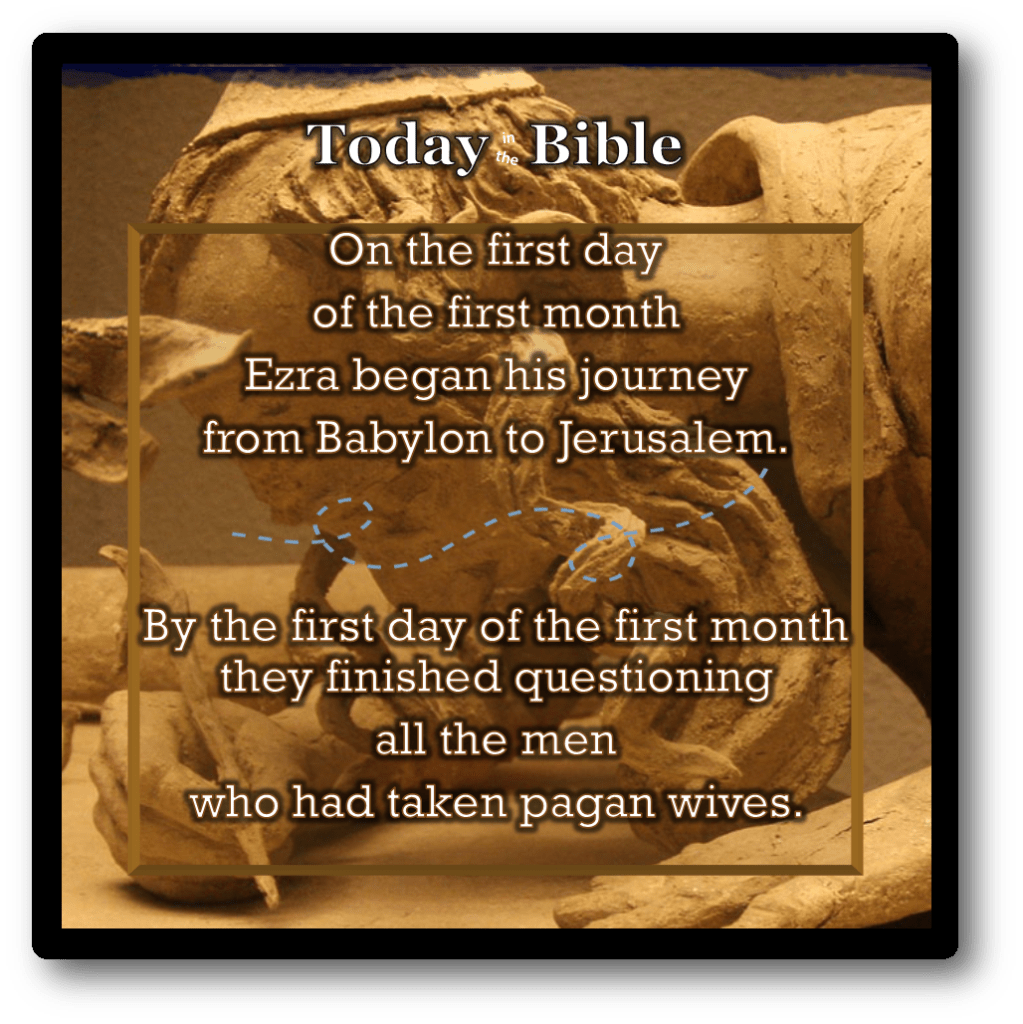
Nisan 1, 5784; from sunset April 8, 2024, to sunset April 9, 2024
This is the name “Ezra” (עֶזְרָא) the Scribe as seen in the Dead Sea Scrolls; written by a scribe over two thousand years ago.
Nisan 1 is mentioned twice in the book of Ezra. First – in chapter one. This is the day that Ezra left Babylon on a four-month-long journey to Jerusalem in order to restore the house of LORD after its destruction by Nebuchadnezzar. He had the full support of Artaxerxes and was armed with silver and gold; food, drink, animal offerings, and a heart to seek the Law of the LORD – to do it and teach it.
On the first day of the first month he began his journey from Babylon, and on the first day of the fifth month he came to Jerusalem, according to the good hand of his God upon him. For Ezra had prepared his heart to seek the Law of the LORD, and to do it, and to teach statutes and ordinances in Israel. This is a copy of the letter that King Artaxerxes gave Ezra the priest, the scribe, expert in the words of the commandments of the LORD, and of His statutes to Israel:
Artaxerxes, king of kings, To Ezra the priest, a scribe of the Law of the God of heaven: Perfect peace, and so forth. I issue a decree that all those of the people of Israel and the priests and Levites in my realm, who volunteer to go up to Jerusalem, may go with you. And whereas you are being sent by the king and his seven counselors to inquire concerning Judah and Jerusalem, with regard to the Law of your God which is in your hand; and whereas you are to carry the silver and gold which the king and his counselors have freely offered to the God of Israel, whose dwelling is in Jerusalem; and whereas all the silver and gold that you may find in all the province of Babylon, along with the freewill offering of the people and the priests, are to be freely offered for the house of their God in Jerusalem–now therefore, be careful to buy with this money bulls, rams, and lambs, with their grain offerings and their drink offerings, and offer them on the altar of the house of your God in Jerusalem. And whatever seems good to you and your brethren to do with the rest of the silver and the gold, do it according to the will of your God. Also the articles that are given to you for the service of the house of your God, deliver in full before the God of Jerusalem. And whatever more may be needed for the house of your God, which you may have occasion to provide, pay for it from the king’s treasury. And I, even I, Artaxerxes the king, issue a decree to all the treasurers who are in the region beyond the River, that whatever Ezra the priest, the scribe of the Law of the God of heaven, may require of you, let it be done diligently, up to one hundred talents of silver, one hundred kors of wheat, one hundred baths of wine, one hundred baths of oil, and salt without prescribed limit. Whatever is commanded by the God of heaven, let it diligently be done for the house of the God of heaven. For why should there be wrath against the realm of the king and his sons? Also we inform you that it shall not be lawful to impose tax, tribute, or custom on any of the priests, Levites, singers, gatekeepers, Nethinim, or servants of this house of God. And you, Ezra, according to your God-given wisdom, set magistrates and judges who may judge all the people who are in the region beyond the River, all such as know the laws of your God; and teach those who do not know them. Whoever will not observe the law of your God and the law of the king, let judgment be executed speedily on him, whether it be death, or banishment, or confiscation of goods, or imprisonment. Blessed be the LORD God of our fathers, who has put such a thing as this in the king’s heart, to beautify the house of the LORD which is in Jerusalem, and has extended mercy to me before the king and his counselors, and before all the king’s mighty princes. So I was encouraged, as the hand of the LORD my God was upon me; and I gathered leading men of Israel to go up with me. – Ezra 7:9-28
We’ll be following Ezra over the next four months as he makes his way to Jerusalem.
Second, Nisan 1 shows up in chapter ten. This occurred after Ezra and his caravan had returned to Jerusalem. After the Feast of Tabernacles, the people came to him and confessed that some of them had married pagan wives and had children with them…including some of the priests and Levites. The text tells us that the people began dealing with the matter of the foreign wives on the 20th day of the ninth month. It took a little over three months to sort through all of the men who had done so.
By the first day of the first month they finished questioning all the men who had taken pagan wives. And among the sons of the priests who had taken pagan wives the following were found of the sons of Jeshua the son of Jozadak, and his brothers: Maaseiah, Eliezer, Jarib, and Gedaliah. And they gave their promise that they would put away their wives; and being guilty, they presented a ram of the flock as their trespass offering. Also of the sons of Immer: Hanani and Zebadiah; of the sons of Harim: Maaseiah, Elijah, Shemaiah, Jehiel, and Uzziah; of the sons of Pashhur: Elioenai, Maaseiah, Ishmael, Nethanel, Jozabad, and Elasah. Also of the Levites: Jozabad, Shimei, Kelaiah (the same is Kelita), Pethahiah, Judah, and Eliezer. Also of the singers: Eliashib; and of the gatekeepers: Shallum, Telem, and Uri. And others of Israel: of the sons of Parosh: Ramiah, Jeziah, Malchiah, Mijamin, Eleazar, Malchijah, and Benaiah; of the sons of Elam: Mattaniah, Zechariah, Jehiel, Abdi, Jeremoth, and Eliah; of the sons of Zattu: Elioenai, Eliashib, Mattaniah, Jeremoth, Zabad, and Aziza; of the sons of Bebai: Jehohanan, Hananiah, Zabbai, and Athlai; of the sons of Bani: Meshullam, Malluch, Adaiah, Jashub, Sheal, and Ramoth; of the sons of Pahath-Moab: Adna, Chelal, Benaiah, Maaseiah, Mattaniah, Bezalel, Binnui, and Manasseh; of the sons of Harim: Eliezer, Ishijah, Malchijah, Shemaiah, Shimeon, Benjamin, Malluch, and Shemariah; of the sons of Hashum: Mattenai, Mattattah, Zabad, Eliphelet, Jeremai, Manasseh, and Shimei; of the sons of Bani: Maadai, Amram, Uel, Benaiah, Bedeiah, Cheluh, Vaniah, Meremoth, Eliashib, Mattaniah, Mattenai, Jaasai, Bani, Binnui, Shimei, Shelemiah, Nathan, Adaiah, Machnadebai, Shashai, Sharai, Azarel, Shelemiah, Shemariah, Shallum, Amariah, and Joseph; of the sons of Nebo: Jeiel, Mattithiah, Zabad, Zebina, Jaddai, Joel, and Benaiah. All these had taken pagan wives, and some of them had wives by whom they had children. – Ezra 10:17-44
To read all of our posts about Ezra, please click on the image above.

© 2026 Today in the Bible

 Today in the Bible
You must be logged in to post a comment.