
Nisan 13, 5784; from sunset April 20, 2024, to sunset April 21, 2024
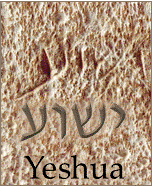
This is the name “Yeshua” (יֵשׁוּעַ – Jesus) as seen on the James Ossuary. Yeshua comes from the verb “yasha” meaning “to save or deliver.” Yeshua means “Salvation.”
Today in the Bible, we find Jesus and His disciples in Bethany at the home of Simon the leper. Matthew and Mark recount the story of the flask of fragrant oil being poured on His head on this day in his home. John, on the other hand, relates that it happened six days before the Passover at the home of Lazarus and that his sister, Mary, was the one who poured the oil. You can find this on our post for Nisan 9.
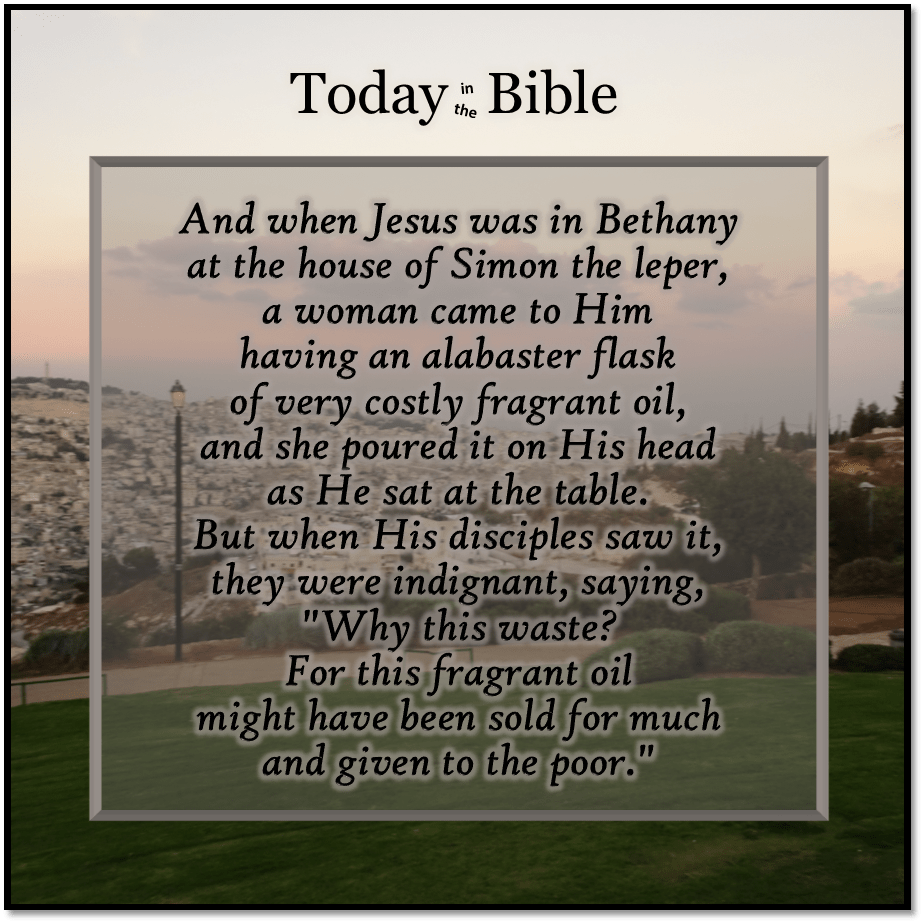
And when Jesus was in Bethany at the house of Simon the leper, a woman came to Him having an alabaster flask of very costly fragrant oil, and she poured it on His head as He sat at the table.
But when His disciples saw it, they were indignant, saying, “Why this waste? For this fragrant oil might have been sold for much and given to the poor.”
But when Jesus was aware of it, He said to them, “Why do you trouble the woman? For she has done a good work for Me. For you have the poor with you always, but Me you do not have always. For in pouring this fragrant oil on My body, she did it for My burial. Assuredly, I say to you, wherever this gospel is preached in the whole world, what this woman has done will also be told as a memorial to her.” – Matthew 26:6-13
Then Satan entered Judas, surnamed Iscariot, who was numbered among the twelve. So he went his way and conferred with the chief priests and captains, how he might betray Him to them. – Luke 22:3-4
…and [he] said, “What are you willing to give me if I deliver Him to you?” And they counted out to him thirty pieces of silver. – Matthew 26:14-15
So he promised and sought opportunity to betray Him to them in the absence of the multitude. – Luke 22:6
See also Mark 14:3-11
Luke, on the other hand, seems to recall a similar situation occurring outside of the Passover context earlier in Jesus’ ministry. It happened at the home of a Pharisee in Capernaum. He writes that a “sinful woman” performed the act of oil pouring.
And behold, a woman in the city who was a sinner, when she knew that Jesus sat at the table in the Pharisee’s house, brought an alabaster flask of fragrant oil, and stood at His feet behind Him weeping; and she began to wash His feet with her tears, and wiped them with the hair of her head; and she kissed His feet and anointed them with the fragrant oil.
Now when the Pharisee who had invited Him saw this, he spoke to himself, saying, “This Man, if He were a prophet, would know who and what manner of woman this is who is touching Him, for she is a sinner.”
And Jesus answered and said to him, “Simon, I have something to say to you.”
So he said, “Teacher, say it.”
“There was a certain creditor who had two debtors. One owed five hundred denarii, and the other fifty. And when they had nothing with which to repay, he freely forgave them both. Tell Me, therefore, which of them will love him more?”
Simon answered and said, “I suppose the one whom he forgave more.”
And He said to him, “You have rightly judged.”
Then He turned to the woman and said to Simon, “Do you see this woman? I entered your house; you gave Me no water for My feet, but she has washed My feet with her tears and wiped them with the hair of her head. You gave Me no kiss, but this woman has not ceased to kiss My feet since the time I came in. You did not anoint My head with oil, but this woman has anointed My feet with fragrant oil. Therefore I say to you, her sins, which are many, are forgiven, for she loved much. But to whom little is forgiven, the same loves little.”
Then He said to her, “Your sins are forgiven.”
And those who sat at the table with Him began to say to themselves, “Who is this who even forgives sins?”
Then He said to the woman, “Your faith has saved you. Go in peace.” – Luke 7:37-50 (NKJ)
To see all of our posts regarding “Yeshua” (יֵשׁוּעַ – Jesus), click on the image below.


© 2026 Today in the Bible

 Today in the Bible
You must be logged in to post a comment.