
Nisan 16, 5784; from sunset April 23, 2024, to sunset April 24, 2024
Esther is the Persian name of a Hebrew girl named “Hadassah.” Hadassah originates in the Hebrew “hadas” which means “myrtle.” The name Esther could either be from the Persian word for star (setareh) or the Median word for myrtle (astra). The myrtle tree produces a star-shaped flower which may be the connection between these words.
Today in the Bible, we believe this could be the night when the king of Persia could not sleep. There is a tradition in Judaism that agrees with this date; another places this story on Nisan 17. Let’s read the text and we’ll provide our theory below.
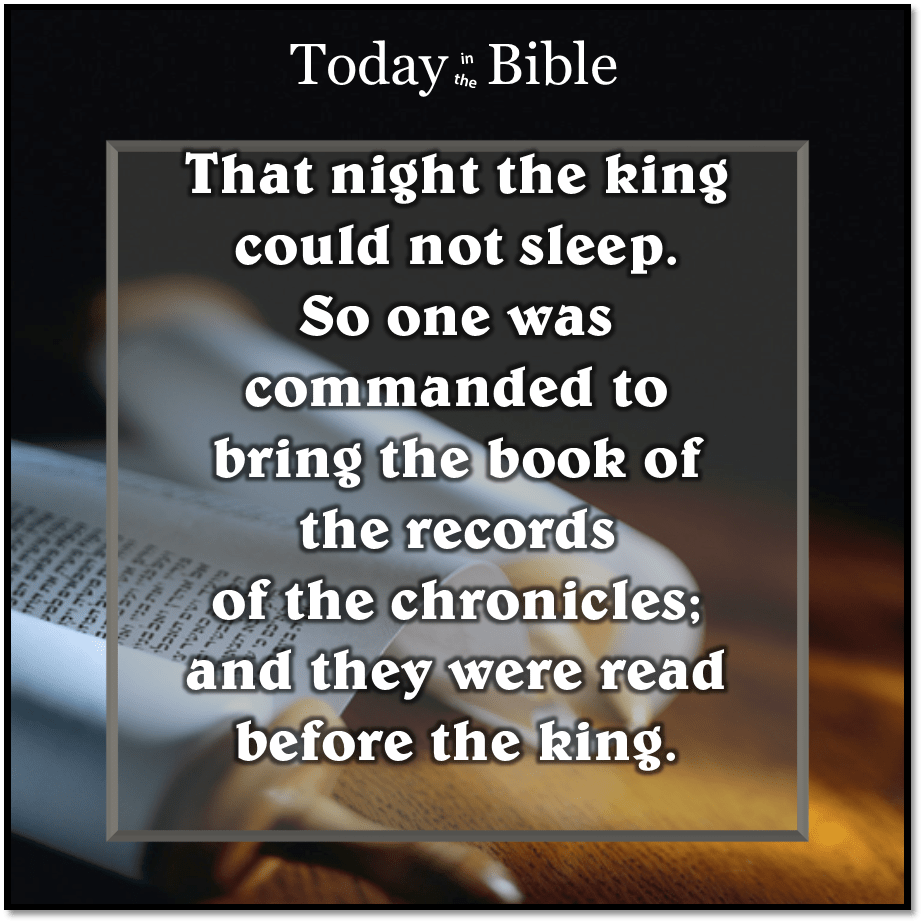
That night the king could not sleep. So one was commanded to bring the book of the records of the chronicles; and they were read before the king. And it was found written that Mordecai had told of Bigthana and Teresh, two of the king’s eunuchs, the doorkeepers who had sought to lay hands on King Ahasuerus.
Then the king said, “What honor or dignity has been bestowed on Mordecai for this?” And the king’s servants who attended him said, “Nothing has been done for him.”
So the king said, “Who is in the court?” Now Haman had just entered the outer court of the king’s palace to suggest that the king hang Mordecai on the gallows that he had prepared for him.
The king’s servants said to him, “Haman is there, standing in the court.” And the king said, “Let him come in.”
So Haman came in, and the king asked him, “What shall be done for the man whom the king delights to honor?” Now Haman thought in his heart, “Whom would the king delight to honor more than me?”
And Haman answered the king, “For the man whom the king delights to honor, let a royal robe be brought which the king has worn, and a horse on which the king has ridden, which has a royal crest placed on its head. Then let this robe and horse be delivered to the hand of one of the king’s most noble princes, that he may array the man whom the king delights to honor. Then parade him on horseback through the city square, and proclaim before him: `Thus shall it be done to the man whom the king delights to honor!’”
Then the king said to Haman, “Hurry, take the robe and the horse, as you have suggested, and do so for Mordecai the Jew who sits within the king’s gate! Leave nothing undone of all that you have spoken.” – Esther 6:1-10 (NKJ)
The book of Esther is unique in that the name of God is not mentioned anywhere in the entire book. But, as we’ve seen over the past few days, there are parallels to the story of Jesus leading up to His crucifixion — and now — His resurrection. So far we’ve noted…
- Haman plotted to kill Mordecai; the chief priests plotted to kill Jesus
- Haman issued a decree to kill the Jews; the chief priests issued a decree to seize Jesus
- Esther prepared for a feast; Jesus instructed His disciples to prepare the Passover Seder
- Esther invited the king and Haman to a feast, likely on the same day as the Feast of Unleavened Bread
- Haman prepared a “gallows” — literally a “tree” for Mordecai; a tree was prepared for Jesus
- And now, the king of Persia could not sleep; we believe on the same night that our King couldn’t “sleep” either
If we continue with our comparison, we see that the king of Persia had the chronicles read to him and was reminded of how Mordecai had saved his life. You could say that Mordecai performed an act of salvation. The king decreed that Mordecai should be honored and exulted for this act. Does this sound familiar? Our Father in Heaven, the King of the Universe, also remembered an act of salvation, by His Son, whose name literally means “Salvation” — “Yeshua.” He was remembered on this night and was resurrected from the dead – He could not “sleep.” He was exulted by appearing before His Father in heaven.
Mordecai was given a robe and a crown and paraded around on a horse. Jesus rode into Jerusalem as a King on a donkey and later He was mocked as a king and given a robe and a crown of thorns.
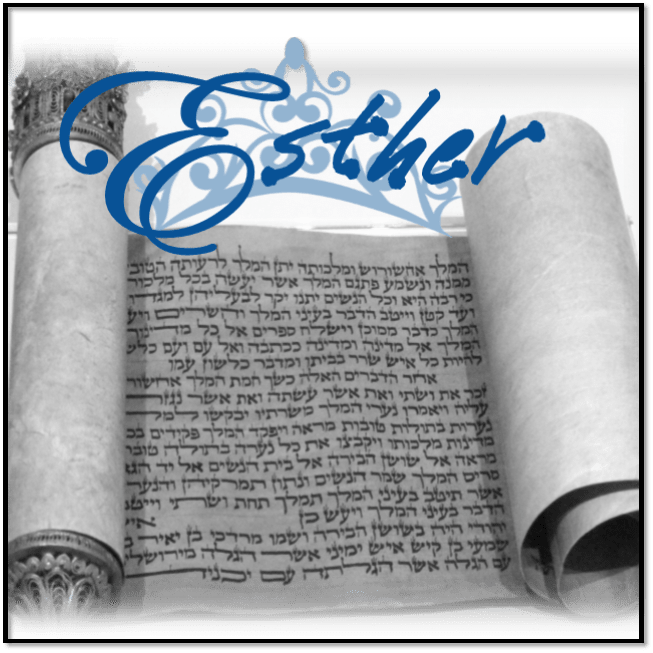
To read all of our posts about Esther, please click on the image above.

© 2026 Today in the Bible

 Today in the Bible
You must be logged in to post a comment.