
Nisan 24, 5784; from sunset May 1, 2024, to sunset May 2, 2024
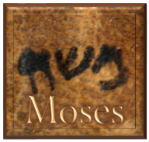
This is the name “Mosheh” (מֺשֶׁה – Moses) as seen in the Dead Sea Scrolls, written over two thousand years ago.
Today in the Bible is the traditional date for when the children of Israel came to the bitter waters of Marah. They had just crossed the sea and spent three days in the wilderness of Shur, searching for water. Now they’ve found some…but it was bitter…”marah.” It’s here that God reveals to Israel that He is the LORD who heals them…”ADONAI Rofecha.”
Then Moses led Israel from the Red Sea and they went into the Desert of Shur. For three days they travelled in the desert without finding water. When they came to Marah, they could not drink its water because it was bitter. (That is why the place is called Marah.)
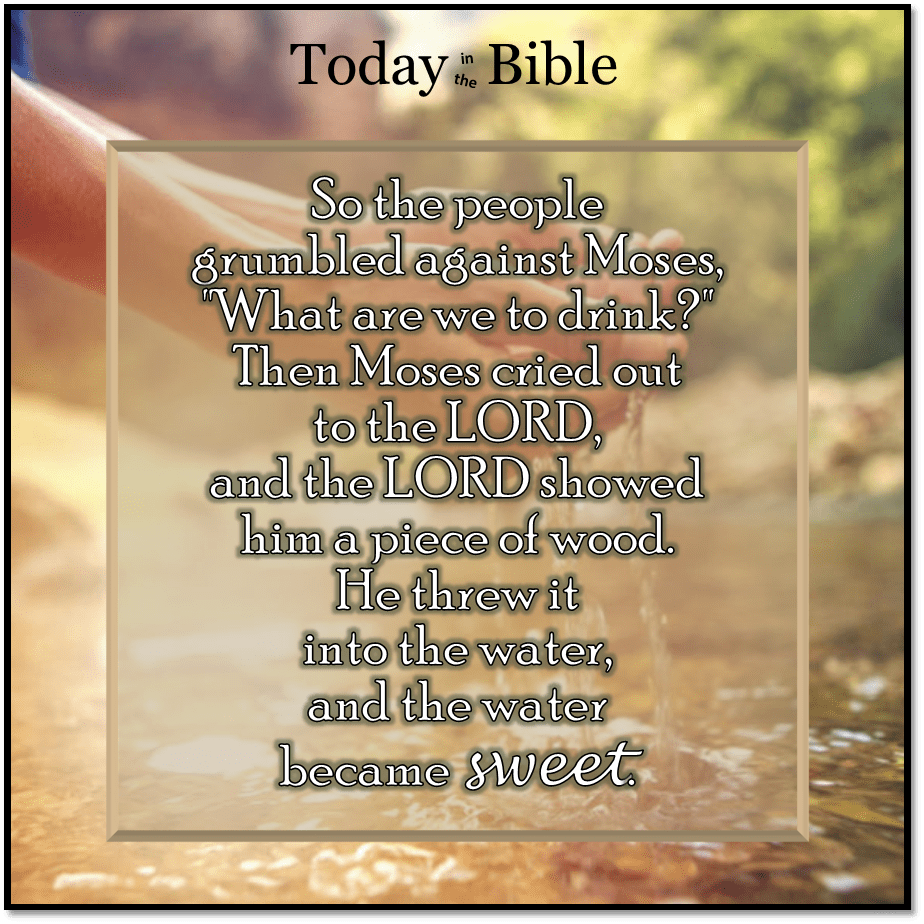
So the people grumbled against Moses, saying, “What are we to drink?” Then Moses cried out to the LORD, and the LORD showed him a piece of wood. He threw it into the water, and the water became sweet.
There the LORD made a decree and a law for them, and there he tested them. He said, “If you listen carefully to the voice of the LORD your God and do what is right in his eyes, if you pay attention to his commands and keep all his decrees, I will not bring on you any of the diseases I brought on the Egyptians, for I am the LORD, who heals you.”
Then they came to Elim, where there were twelve springs and seventy palm trees, and they camped there near the water. – Exodus 15:22-27 (NIB)
The “piece of wood” the LORD showed to Moses, in Hebrew, is “etz.” Etz is often translated as “tree.” What “etz” did the LORD show to Moses? We don’t know, but it makes us wonder if it has something to do with the “etz” that our Savior was crucified upon.
It’s interesting to note that there were twelve springs and seventy palms at Elim. The number twelve may be representative of the twelve tribes of Israel and the number seventy is often associated with “the nations.”
In searching the Scriptures for other references to bitter waters, there are several. How or if they are connected to this story, we don’t know. But let’s get familiar with them and see what we see. We’ll start with Numbers chapter five. It contains the Levitical procedure for what to do when a man suspects that his wife has been unfaithful to him. We’ll start with verse eleven:
And the LORD spoke to Moses, saying, “Speak to the children of Israel, and say to them: `If any man’s wife goes astray and behaves unfaithfully toward him, and a man lies with her carnally, and it is hidden from the eyes of her husband, and it is concealed that she has defiled herself, and there was no witness against her, nor was she caught–if the spirit of jealousy comes upon him and he becomes jealous of his wife, who has defiled herself; or if the spirit of jealousy comes upon him and he becomes jealous of his wife, although she has not defiled herself–then the man shall bring his wife to the priest. He shall bring the offering required for her, one-tenth of an ephah of barley meal; he shall pour no oil on it and put no frankincense on it, because it is a grain offering of jealousy, an offering for remembering, for bringing iniquity to remembrance. And the priest shall bring her near, and set her before the LORD.
`The priest shall take holy water in an earthen vessel, and take some of the dust that is on the floor of the tabernacle and put it into the water. `Then the priest shall stand the woman before the LORD, uncover the woman’s head, and put the offering for remembering in her hands, which is the grain offering of jealousy. And the priest shall have in his hand the bitter water that brings a curse. And the priest shall put her under oath, and say to the woman, “If no man has lain with you, and if you have not gone astray to uncleanness while under your husband’s authority, be free from this bitter water that brings a curse. But if you have gone astray while under your husband’s authority, and if you have defiled yourself and some man other than your husband has lain with you”–then the priest shall put the woman under the oath of the curse, and he shall say to the woman– “the LORD make you a curse and an oath among your people, when the LORD makes your thigh rot and your belly swell; and may this water that causes the curse go into your stomach, and make your belly swell and your thigh rot.”
Then the woman shall say, “Amen, so be it.”
`Then the priest shall write these curses in a book, and he shall scrape them off into the bitter water. And he shall make the woman drink the bitter water that brings a curse, and the water that brings the curse shall enter her to become bitter. Then the priest shall take the grain offering of jealousy from the woman’s hand, shall wave the offering before the LORD, and bring it to the altar; and the priest shall take a handful of the offering, as its memorial portion, burn it on the altar, and afterward make the woman drink the water.
`When he has made her drink the water, then it shall be, if she has defiled herself and behaved unfaithfully toward her husband, that the water that brings a curse will enter her and become bitter, and her belly will swell, her thigh will rot, and the woman will become a curse among her people. But if the woman has not defiled herself, and is clean, then she shall be free and may conceive children.
`This is the law of jealousy, when a wife, while under her husband’s authority, goes astray and defiles herself, or when the spirit of jealousy comes upon a man, and he becomes jealous of his wife; then he shall stand the woman before the LORD, and the priest shall execute all this law upon her. Then the man shall be free from iniquity, but that woman shall bear her guilt.’” – Numbers 5:11-31 (NKJ)
James, the brother of Jesus, mentions bitter waters when he addresses who should become teachers. The entire chapter revolves around taming one’s tongue, let’s read an excerpt:
“But no man can tame the tongue. It is an unruly evil, full of deadly poison. With it we bless our God and Father, and with it we curse men, who have been made in the similitude of God. Out of the same mouth proceed blessing and cursing. My brethren, these things ought not to be so.
“Does a spring send forth fresh water and bitter from the same opening? Can a fig tree, my brethren, bear olives, or a grapevine bear figs? Thus no spring yields both salt water and fresh.
“Who is wise and understanding among you? Let him show by good conduct that his works are done in the meekness of wisdom. But if you have bitter envy and self-seeking in your hearts, do not boast and lie against the truth.” – James 3:8-14 (NKJ)
Perhaps the bitter waters are meant to represent an image of our grumbling, jealousy, and cursing? All of this bitterness which originates from our tongues…our bitter, watery mouths? This is just a guess on our part, but it does seem as if the bitter waters are meant to provide us with a picture. God called Marah a place of testing. He made a statute and an ordinance.
There He made a statute and an ordinance for them. And there He tested them, and said, “If you diligently heed the voice of the LORD your God and do what is right in His sight, give ear to His commandments and keep all His statutes, I will put none of the diseases on you which I have brought on the Egyptians. For I am the LORD who heals you.” – Exodus 15:25-26 (NKJ)
Finally, in the book of Revelation, John reveals what will happen when the third angel blows its trumpet. In this case, the wormwood makes the waters bitter instead of sweet.
Then the third angel sounded: and a great star fell from heaven, burning like a torch, and it fell on a third of the rivers and on the springs of water. The name of the star is Wormwood. A third of the waters became wormwood, and many men died from the water, because it was made bitter. – Revelation 8:10-11 (NKJ)
These verses occur shortly after chapter seven where we find a great multitude standing before the throne dressed in white. One of the elders asks, “Who are these and where did they come from?” The answer, “these are the ones who came out of the great tribulation.” We find that they will thirst no more.
“They shall neither hunger anymore nor thirst anymore; the sun shall not strike them, nor any heat; for the Lamb who is in the midst of the throne will shepherd them and lead them to living fountains of waters. And God will wipe away every tear from their eyes.” – Revelation 7:16-17 (NKJ)
Did you know that you can view any of our posts whenever you’d like?
Visit our home page at https://todayinthebible.com
where you can find them organized by month
in the “Archives” section on the right side of the page.

© 2026 Today in the Bible

 Today in the Bible
You must be logged in to post a comment.