
Nisan 25, 5784; from sunset May 2, 2024, to sunset May 3, 2024
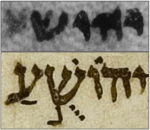
This is the name Yehoshua (Joshua); Joshua means “The LORD Saves.” The top image was written ~2,000 years ago and was found among the Dead Sea Scrolls. The bottom image was written ~1,000 years ago and is from the Aleppo Codex (the Crown of Aleppo). The top image was written on a scroll, possibly in Qumran, near the Dead Sea. The bottom is in a bound manuscript, written in Tiberias, near the Sea of Galilee, which later made its way to Aleppo (Syria). The Aleppo Codex is now housed in the Shrine of the Book alongside the Dead Sea Scrolls.
Today in the Bible, according to tradition, is the fourth day that the Israelites marched around the city of Jericho.
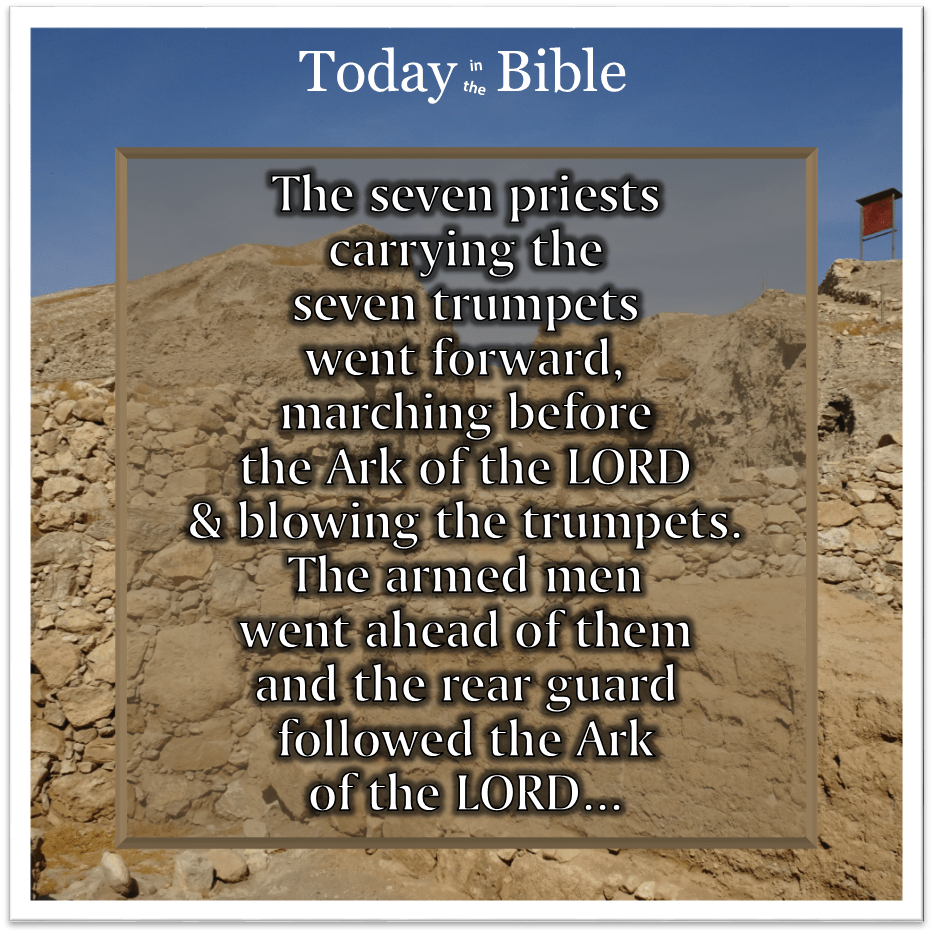
…the priests took up the ark of the LORD. The seven priests carrying the seven trumpets went forward, marching before the ark of the LORD and blowing the trumpets. The armed men went ahead of them and the rear guard followed the ark of the LORD, while the trumpets kept sounding…they marched around the city once and returned to the camp… – Joshua 6:12-14 (NIB)
When Joshua dispatched the spies to reconnoiter Jericho, Rahab hid them under some flax on the roof of her home. Flax is grown for a number of reasons. Flax seed is good to eat. Linseed oil is made from it. It is used to make linens. It is braided together to make ropes. After making a pact with the spies for the salvation of her family, Rahab, whose home was on the city wall, let them out of her window using one of those ropes.
Then she let them down by a rope through the window, for her house was on the city wall; she dwelt on the wall. – Joshua 2:15 (NKJ)
There’s also a possible tie-in (get it?) to Rahab’s name and that cord she hung through the window of her house (that was on the city wall). Though her name seems to come from a root word that means “wide or spacious,” when viewed in the pictographs of the ancient Hebrew letters – a beautiful portrait appears. In Hebrew, Rahab’s name is pronounced “Rachav,” with the “ch” making a sound like the “ch” in Bach. Below are the letters making up her name and their corresponding pictographs.
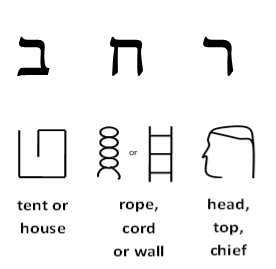
The letter transliterated as “R” is a picture of a person’s head – it carries the meanings of “head, top, or chief” among others.
The letter transliterated as “CH” has two pictures from ancient times. The one on the left is a picture of a rope or a cord and the one on the right is a picture of a wall.
The letter transliterated as “V” is a picture of a tent (floor plan) and is representative of a tent, house, or dwelling place. (It can also be transliterated as “B”)
One possible translation of these pictographs is “top or head of the wall house.” Now, this fits in very nicely with Rahab’s story as the Bible clearly states that “she dwelt on the wall.”
Even the pictograph of the cord or rope would fit nicely into the story since, “she let them down by a rope.”
One last cool thing about Rahab’s story. In Joshua 2:21, the text says, “And she bound the scarlet cord in the window.” The Hebrew word translated as “cord” in this verse is “tikvah.” Every other time this word appears in the Bible it is translated as “hope.” Joshua chapter 2 is the only place it is translated as “cord.” Perhaps Rahab gave the spies more than just a rope – or perhaps Rahab’s “hope” was in the agreement she made with the spies?
To read all of our posts about Joshua, please click on the image above.

© 2026 Today in the Bible

 Today in the Bible
You must be logged in to post a comment.