
Sivan 2, 5784; from sunset June 7, 2024, to sunset June 8, 2024
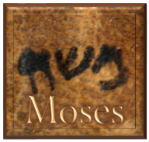
This is the name “Mosheh” (מֺשֶׁה – Moses) as seen in the Dead Sea Scrolls, written over two thousand years ago.
The Talmud provides us with a timeline (Shabbat 86b–88a) of the events occurring in Exodus 19. Yesterday the people of Israel arrived at Sinai. Today, God spoke to Moses from the mountain and told him that He wanted to make a covenant with them; He wanted to make them His “treasured possession.”
Then Moses went up to God, and the LORD called to him from the mountain and said, “This is what you are to say to the descendants of Jacob and what you are to tell the people of Israel:
‘You yourselves have seen what I did to Egypt, and how I carried you on eagles’ wings and brought you to myself.
Now if you obey me fully and keep my covenant, then out of all nations you will be my treasured possession. Although the whole earth is mine, you will be for me a kingdom of priests and a holy nation.’ These are the words you are to speak to the Israelites.” – Exodus 19:3-6 (NIV)
With these words God expressed His desire that Israel become His chosen people. The day is accordingly marked on Hebrew calendars as Yom HaMeyuchas, “The Day of Distinction.”
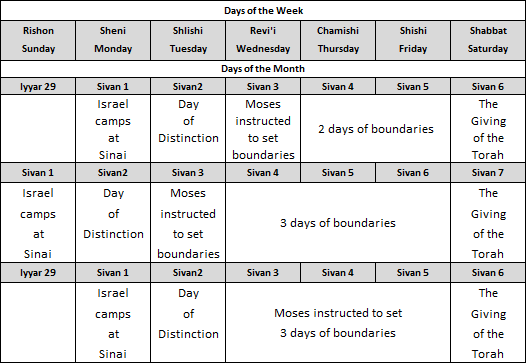
We are in the days leading up to Shavu’ot (aka Feast of Weeks or Pentecost). It has long been recognized as the day God gave Israel the covenant at Mount Sinai…the Ten Commandments. There have been disagreements on the dating of these events. We know that Israel arrived on the first day of the third month because the Bible tells us so. Some have taught that the Ten Commandments were given on the 7th day, but the majority of Israel observes the 6th day. One school of thought teaches that there were two days of boundaries and another, three days. The calendar widely observed today came together as a way of reconciling these opposing points of view so that there would be shalom…peace…unity. The chart below visualizes how we understand the conflict and the solution.
Gabe Greenberg calls today “The Biggest Little Holiday in the World.” Not only is it the day that God set Israel apart as His special treasure, but it is the one day that falls between the calendar we know – the arrival at Sinai on the new moon – and the reconciliation of opposing calendar views. This shows us what it means to be holy and set apart. Peace and reconciliation between brothers. Honoring and respecting opposing viewpoints. When the people stood before Sinai – they were “echad” – they were “one.” When the Holy Spirit descended upon the people on that first Shavu’ot after Jesus’ resurrection – they were “echad” – they were “one.” If we want to consider ourselves as God’s special treasure, then we need to be willing to work towards shalom and unity. The parable below provides us with a visual of what this shalom and unity may look like.
A king wanted his palace decorated, so he invited four famous artists, each to paint one wall of the palace. Three of the four worked assiduously to mix the paints and sketch out the drawings that would decorate their respective walls. The fourth sat by, seemingly idle, writing numbers in a note pad. As the three were finishing their work on their individual walls, the fourth finally stood up and arranged a series of mirrors on his wall. When the king arrived to judge the work, he awarded the prize to the fourth artist. He said that while the creativity and skill of each of the three artists were both evident and special, the work of the fourth artist was truly the most beautiful in that it reflected the glory and the grandeur of all that surrounded it.
By working out our differences, by listening and respecting opposing points of view while striving to show love and honor to each other – we too can reflect the glory and grandeur that God has placed within each one of us; which, in turn, reflects the glory and grandeur of God.
The word “segulah” is translated in the verses above as “treasured possession.” The word “segulah” only appears in its singular form…we are one treasure…not many individual treasures. Echad. Jesus’ prayer to our Father for unity among His followers mirrors the events at Sinai…He gave us the Word of the Father and He prayed for unity…and the Father answered His prayer by pouring out His Spirit on Shavu’ot when the believers had gathered together as one.
“I have given them Your word; and the world has hated them because they are not of the world, just as I am not of the world. I do not pray that You should take them out of the world, but that You should keep them from the evil one. They are not of the world, just as I am not of the world.
“Sanctify them by Your truth. Your word is truth. As You sent Me into the world, I also have sent them into the world. And for their sakes I sanctify Myself, that they also may be sanctified by the truth.
“I do not pray for these alone, but also for those who will believe in Me through their word; that they all may be one, as You, Father, are in Me, and I in You; that they also may be one in Us, that the world may believe that You sent Me.
“And the glory which You gave Me I have given them, that they may be one just as We are one: I in them, and You in Me; that they may be made perfect in one, and that the world may know that You have sent Me, and have loved them as You have loved Me.
“Father, I desire that they also whom You gave Me may be with Me where I am, that they may behold My glory which You have given Me; for You loved Me before the foundation of the world.
“O righteous Father! The world has not known You, but I have known You; and these have known that You sent Me. And I have declared to them Your name, and will declare it, that the love with which You loved Me may be in them, and I in them.” – John 17:14-26 (NKJ)
Segulah is used very sparingly in the Bible, only eight times. In addition to those mentioned above, the word made it into a Psalm reminiscing about the works of the LORD in the Exodus:
For the LORD has chosen Jacob to be his own, Israel to be his treasured possession. – Psalm 135:4 (NIV)
And Malachi tells us the “segulah” of the LORD will be recorded in His scroll of remembrance:
Then those who feared the LORD talked with each other, and the LORD listened and heard. A scroll of remembrance was written in his presence concerning those who feared the LORD and honored his name. “On the day when I act,” says the LORD Almighty, “they will be my treasured possession. I will spare them, just as a father has compassion and spares his son who serves him. And you will again see the distinction between the righteous and the wicked, between those who serve God and those who do not. – Malachi 3:16-18 (NIV)
It is very likely that this word was in mind in 1 Peter and Titus:
But you are a chosen people, a royal priesthood, a holy nation, God’s special possession, that you may declare the praises of him who called you out of darkness into his wonderful light. – 1 Peter 2:9 (NIV)
It teaches us to say “No” to ungodliness and worldly passions, and to live self-controlled, upright and godly lives in this present age, while we wait for the blessed hope– the appearing of the glory of our great God and Savior, Jesus Christ, who gave himself for us to redeem us from all wickedness and to purify for himself a people that are his very own, eager to do what is good. – Titus 2:12-14
In order to mirror the glory surrounding us, we must strive to live according to the Torah – the instructions – given to us by God; and dwell in unity with each other. The covenant does not depend upon our perfect observance, Jesus took care of that, but doing our best to live according to the word of God is what makes us distinct. It’s what makes us one with Him.
Did you know that our posts are categorized and tagged by content?
When you visit our home page at https://todayinthebible.com and select any post,
you can find the associated categories and tags just to the right of the title.
Simply click on any tag and you will be taken to all related posts.
© 2026 Today in the Bible
 Today in the Bible
You must be logged in to post a comment.