
Tammuz 3, 5784; from sunset July 8, 2024, to sunset July 9, 2024
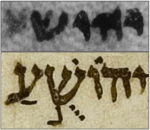
This is the name Yehoshua (Joshua); Joshua means “The LORD Saves.” The top image was written ~2,000 years ago and was found among the Dead Sea Scrolls. The bottom image was written ~1,000 years ago and is from the Aleppo Codex (the Crown of Aleppo). The top image was written on a scroll, possibly in Qumran, near the Dead Sea. The bottom is in a bound manuscript, written in Tiberias, near the Sea of Galilee, which later made its way to Aleppo (Syria). The Aleppo Codex is now housed in the Shrine of the Book alongside the Dead Sea Scrolls.
It was about four months ago that we remembered the day that Moses passed the torch to Joshua. It happened the day before Moses died. After the people mourned his death, we followed Joshua as he led them across the Jordan River. We remembered the day they were circumcised and their first Passover celebration in the Promised Land. That day, they ate the produce of the Land for the first time. The next day, the manna ceased to fall.
After this, Joshua set his sights on the city of Jericho. It was on the plains of Jericho where he met the commander of the Lord’s army. Then, for seven days, we walked around Jericho with the Israelites before the walls fell down and the city was defeated.
Since that time, the children of Israel have learned the dangers of keeping anything dedicated to the Lord. They’ve learned the victories they could achieve when they listened to and obeyed their God. And they put the city of Ai to ruins.
After all of this, they cut a covenant with the inhabitants of Gibeon and today, according to tradition, they were called upon by the Gibeonites to come to their aid.
Now it came to pass when Adoni-Zedek king of Jerusalem heard how Joshua had taken Ai and had utterly destroyed it– as he had done to Jericho and its king, so he had done to Ai and its king– and how the inhabitants of Gibeon had made peace with Israel and were among them, that they feared greatly, because Gibeon was a great city, like one of the royal cities, and because it was greater than Ai, and all its men were mighty.
Therefore Adoni-Zedek king of Jerusalem sent to Hoham king of Hebron, Piram king of Jarmuth, Japhia king of Lachish, and Debir king of Eglon, saying, “Come up to me and help me, that we may attack Gibeon, for it has made peace with Joshua and with the children of Israel.” Therefore the five kings of the Amorites, the king of Jerusalem, the king of Hebron, the king of Jarmuth, the king of Lachish, and the king of Eglon, gathered together and went up, they and all their armies, and camped before Gibeon and made war against it.
And the men of Gibeon sent to Joshua at the camp at Gilgal, saying, “Do not forsake your servants; come up to us quickly, save us and help us, for all the kings of the Amorites who dwell in the mountains have gathered together against us.” So Joshua ascended from Gilgal, he and all the people of war with him, and all the mighty men of valor.
And the LORD said to Joshua, “Do not fear them, for I have delivered them into your hand; not a man of them shall stand before you.” Joshua therefore came upon them suddenly, having marched all night from Gilgal. So the LORD routed them before Israel, killed them with a great slaughter at Gibeon, chased them along the road that goes to Beth Horon, and struck them down as far as Azekah and Makkedah.
And it happened, as they fled before Israel and were on the descent of Beth Horon, that the LORD cast down large hailstones from heaven on them as far as Azekah, and they died. There were more who died from the hailstones than the children of Israel killed with the sword.
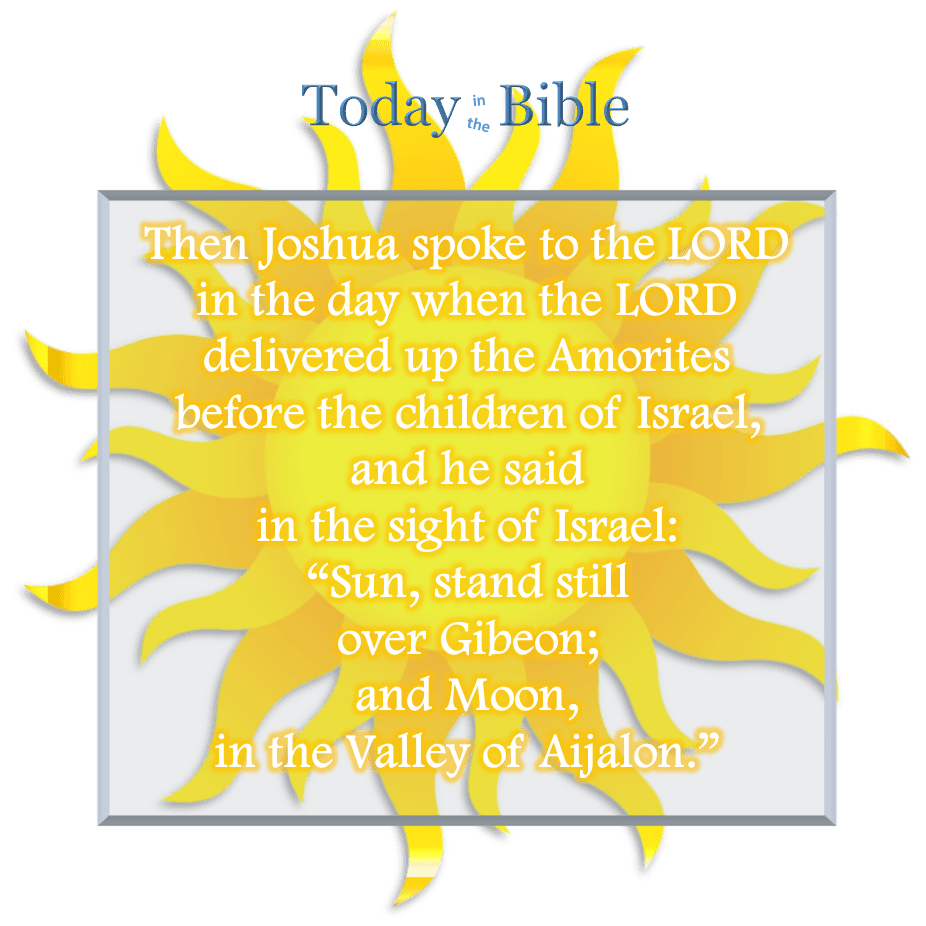
Then Joshua spoke to the LORD in the day when the LORD delivered up the Amorites before the children of Israel, and he said in the sight of Israel: “Sun, stand still over Gibeon; and Moon, in the Valley of Aijalon.”
So the sun stood still, and the moon stopped, till the people had revenge upon their enemies. Is this not written in the Book of Jasher? So the sun stood still in the midst of heaven, and did not hasten to go down for about a whole day. And there has been no day like that, before it or after it, that the LORD heeded the voice of a man; for the LORD fought for Israel. – Joshua 10:1-14 (NKJ)
Why did Joshua make this particular request? Some scholars say that he needed more daylight to finish fighting the Amorites…and that may be so; but we wonder if there’s more to it.
The word translated as “still” in Joshua 10:13 comes from the Hebrew verb root “damam.” This verb means “to be silent, still, or wait.” Other words stemming from this root are:
- demamah – a whisper
- dummah – one who is silenced, destroyed
After understanding the greater meaning of this word; maybe we can take a second look at these verses and see if there is more to the story. What gods did the Amorites worship? A sun god? A moon god? Is that why Joshua made this particular request? Our research found that the Amorites worshipped the same gods as the Akkadians and Sumerians. These included a sun god named “Shamash” (in Hebrew “shemesh” means “sun”) and a moon god they called “Sin.”
When we looked at the story of Jericho (Yericho) earlier this spring, we considered the possibility that God took aim at that city because they worshipped a moon god which they called “Yarikh.” Jericho is one of the oldest cities in the world and has the oldest known defensive wall. We considered that, when God brought Israel out of Egypt, He took aim at the Egyptian gods by way of the plagues. Perhaps our Father was continuing on where He left off in Egypt? Was He continuing to prove His sovereignty to Israel? Jericho’s defensive wall was nothing to Him. Yarikh was nothing to Him. Was He proving His authenticity as the One, True God?
Today’s battle took place near (or perhaps “on”) the summer solstice, the time of year when the sun is at its strongest. Yet it was no match for the God of Israel who demonstrated His control over it. In addition, by stilling the sun, Israel’s God continued to establish His power by preventing that “moon god” from shining. He also threw down hailstones, taking a swipe at Adad, the god of storms. In addition to Shamash, there was a god named Nergal who was affiliated with the sun (in its destructive capacity) – Nergal was also the god of plagues and war. This warrior god was no match for our God.
In another interesting twist to this story, Joshua was fighting the Amorites. The name Amorite is spelled using the same letters that form the Hebrew verb-root “amar.” Amar means “to say or speak.” Was Joshua asking God to “damam” the “amar?” To “silence” the “speakers?” To “destroy” the “Amorites?”
It makes sense that God would act upon Joshua’s request in order to disqualify other “gods.” If you think about other miracles recorded in the Bible, you can make an argument that they are all about showing us who the real God is. The plagues in Egypt, Elijah calling down fire from heaven, Jesus’ miracles and His resurrection from the dead. We believe that this whole story has something to do with Joshua’s God proving that the other “gods” in Canaan aren’t real…He is the One, True God of all.
To read all of our posts about Joshua, please click on the image above.

© 2026 Today in the Bible

 Today in the Bible
You must be logged in to post a comment.