

Tammuz 13, 5784; from sunset July 18, 2024, to sunset July 19, 2024
This is an image of a portion of the wall rebuilt by Nehemiah and company.
Sometime between the months of Nisan (the first month) and Av (the fifth month) – Nehemiah returned to Jerusalem, about 13 years after Ezra did. It took Ezra four months to make the journey – with a large group of people. Nehemiah likely made the journey in less time, for the king had sent captains of the army and horsemen with him.
The Bible doesn’t give us a date for his arrival in Jerusalem. We believe he may have arrived sometime during the middle of the month before the work on the restoration of the wall began. The text says he rested three days before taking his secret night ride around the city to inspect the damaged walls. In my mind, he must have needed the light of a full or nearly full moon in order to do this quietly, without a torch. This would place his night ride near the middle of the month. The verses below take us from the time he went before the king to make his request to return to Jerusalem (Nisan) – to when he arrived in Jerusalem (Tammuz?)
And I said to the king, “If it pleases the king, and if your servant has found favor in your sight, I ask that you send me to Judah, to the city of my fathers’ tombs, that I may rebuild it.”
Then the king said to me (the queen also sitting beside him), “How long will your journey be? And when will you return?” So it pleased the king to send me; and I set him a time.
Furthermore I said to the king, “If it pleases the king, let letters be given to me for the governors of the region beyond the River, that they must permit me to pass through till I come to Judah, and a letter to Asaph the keeper of the king’s forest, that he must give me timber to make beams for the gates of the citadel which pertains to the temple, for the city wall, and for the house that I will occupy.” And the king granted them to me according to the good hand of my God upon me.
Then I went to the governors in the region beyond the River, and gave them the king’s letters. Now the king had sent captains of the army and horsemen with me.
When Sanballat the Horonite and Tobiah the Ammonite official heard of it, they were deeply disturbed that a man had come to seek the well-being of the children of Israel.
So I came to Jerusalem and was there three days. – Nehemiah 2:5-11 (NKJ)
Often-times the meanings of the names of people and places in the Bible are woven into the story being told. We believe this is the case with Nehemiah. Sometime last winter, in the month of Kislev (around December on our calendar), the dire living conditions of the inhabitants of Jerusalem became known to Nehemiah (Nehemiah chapter 1). God laid it on his heart to do something about it. Nehemiah wept and mourned, fasted and prayed, and repented of his sins and those of his people. A few months later God made an opportunity for him to go before the king and request the time and resources to rebuild Jerusalem. Let’s take a look at the name of Nehemiah in Hebrew and in the ancient picture language to see if we can find a connection between his name and his story.
נְחֶמְיָה
The name Nehemiah transliterated from Hebrew is Nechemyah. The “ch” in Hebrew is pronounced like the “ch” in the word “Bach.” To pronounce his name, you would say: “Neh-khem-yah.” Nehemiah is a combination of two Hebrew words: נחם and יה.
נחם
The verb-root “nacham” means “to be sorry, to repent, to regret, to be comforted, or to comfort.” Most frequently this word is translated as “to repent;” second most common is “to comfort” or “to be comforted.” Additional words stemming from this root are:
- nocham = sorrow, repentance
- nichum = comfort, compassion
- nechamah = comfort
- tanchum = consolation
The root also occurs in other Biblical proper names such as Nahum, Menehem, and Capernaum (meaning, “Village of Consolation”).
The TWOT lexicon states that the origin of this root seems to reflect the idea of “breathing deeply,” hence the physical display of one’s feelings, usually sorrow, compassion, or comfort. The first chapter of Nehemiah tells us that when he heard of the state of disrepair of the city and the dire living conditions of those in Jerusalem, he wept, mourned, fasted, and prayed for days. Nehemiah embodied the origin of his name; “sighing or breathing deeply, the physical display of one’s feelings.”
The second part of Nechemyah is…
יה
“Yah” is a truncated form of God’s Holy name, which consists of the letters – י ,ה ,ו ,ה – when spelled in its entirety. Yah is mainly found when praising God in the Psalms; otherwise, it is used only four other places in scripture.
So, the name Nehemiah means something like “Comfort (Nechem) of the LORD (Yah).”
Nehemiah in the Picture Language
All of the letters we use in Hebrew today were originally pictures. Below are the pictographs for the three letters which comprise the main root of Nehemiah’s name, along with their meanings.

The first letter, “nun” (pronounced like “noon”), was originally a picture of a seed sprout. It carries the meanings of “seed, life, abundance, off-spring, and continuation.”

The second letter, “cheit” (pronounced like “khate”), was originally a picture of a tent wall. It is associated with the ideas of “a wall, divide, inside, outside, and separation.”

The third letter, “mem,” was originally a picture of waves of water. It carries the meanings of “water, mighty (like the sea), chaos, flowing, and blood.” The swelling and crashing of the waves in the sea can be seen as chaotic and representative of sin or sinfulness. (The letter mem takes on the appearance of the first letter shown above when it occurs at the beginning or in the middle of a word; the second letter shown is called “mem sofit” and is only found when it is the last letter of a word.)

So, let’s take a look at the picture painted by the root “nacham.” We can see a “wall” in the middle of Nehemiah’s name. It is separating “life” (the seed sprout) and “chaos or sinfulness” (the waves of water).
One could look at this picture and see a symbol of holiness. Prior to its destruction, the Temple was the home of the Living God, which had been located within the walls of Jerusalem. It was a place where anyone who wanted to enter had to immerse themselves. They had to “wash off” the sin and death that had contaminated them in the course of everyday life. Eternal life and sinfulness, which causes death, cannot be mixed.
The verb-root “nacham” also means to be sorry, to repent. The people of the exile were sorry and ready to repent of their sins. The rebuilding of the wall is symbolic of the people’s repentance, their desire to be a holy nation again. To be holy simply means to be separate, to be set apart…just like a wall separates. Their desire – to repent of their sinful ways and follow the commandments of the LORD – is their wall, their holiness. By doing so, they were separating themselves from chaos, from sinfulness.
This reminds me of the little skit we’ve all seen, there’s an angel on one shoulder saying, “don’t do it” and the devil on the other shoulder saying, “go ahead, do it, it’s ok.” The waves are the devil, the seed sprout is the angel, and the wall is our mind.
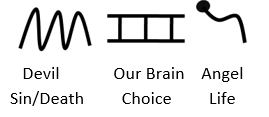
Moses said, “I set before you life and death, blessings and curses…choose life” (Deuteronomy 30:19-20). By choosing to obey the word of the LORD, we choose life. It’s our choice. We can choose life or death. We can choose blessings or curses. Nehemiah’s choice was repentance, as evident in his prayer below:
The words of Nehemiah the son of Hacaliah. Now it happened in the month Chislev, in the twentieth year, while I was in Susa the capitol, that Hanani, one of my brothers, and some men from Judah came; and I asked them concerning the Jews who had escaped and had survived the captivity, and about Jerusalem.
They said to me, “The remnant there in the province who survived the captivity are in great distress and reproach, and the wall of Jerusalem is broken down and its gates are burned with fire.”
When I heard these words, I sat down and wept and mourned for days; and I was fasting and praying before the God of heaven. I said, “I beseech You, O LORD God of heaven, the great and awesome God, who preserves the covenant and lovingkindness for those who love Him and keep His commandments, let Your ear now be attentive and Your eyes open to hear the prayer of Your servant which I am praying before You now, day and night, on behalf of the sons of Israel Your servants, confessing the sins of the sons of Israel which we have sinned against You; I and my father’s house have sinned. We have acted very corruptly against You and have not kept the commandments, nor the statutes, nor the ordinances which You commanded Your servant Moses. Remember the word which You commanded Your servant Moses, saying, ‘If you are unfaithful I will scatter you among the peoples; but if you return to Me and keep My commandments and do them, though those of you who have been scattered were in the most remote part of the heavens, I will gather them from there and will bring them to the place where I have chosen to cause My name to dwell.’ They are Your servants and Your people whom You redeemed by Your great power and by Your strong hand. O Lord, I beseech You, may Your ear be attentive to the prayer of Your servant and the prayer of Your servants who delight to revere Your name, and make Your servant successful today and grant him compassion before this man.” Now I was the cupbearer to the king. – Nehemiah 1 (NAU)
And though it took a while to get there, the end result was a completed wall and a rebuilt Temple, a restoration of the dwelling place of God. Of course, we can see this as a picture of the work of our Messiah. He showed us the way of life and blessings. He perfectly lived out the word of God. He showed us how to live a holy life. He loved the LORD, His God with all of His heart, soul, and might…and He loved His neighbor as Himself.
This is the intention of the law and the prophets (Matthew 22:36-40).
In just a few short weeks, Nehemiah will have inspected the walls and gates, gone before the elders to plead his case, and begun the restoration of the walls and gates. We intend to work our way through the meanings of the names of the men and women who devoted their labor into making that a reality. It took 52 days to complete the restoration; we’ll take 52 days to study it…hope you’ll join us!
To read all of our posts on Nehemiah, click on the image above.

© 2026 Today in the Bible

 Today in the Bible
You must be logged in to post a comment.