
Tammuz 15, 5784; from sunset July 20, 2024, to sunset July 21, 2024
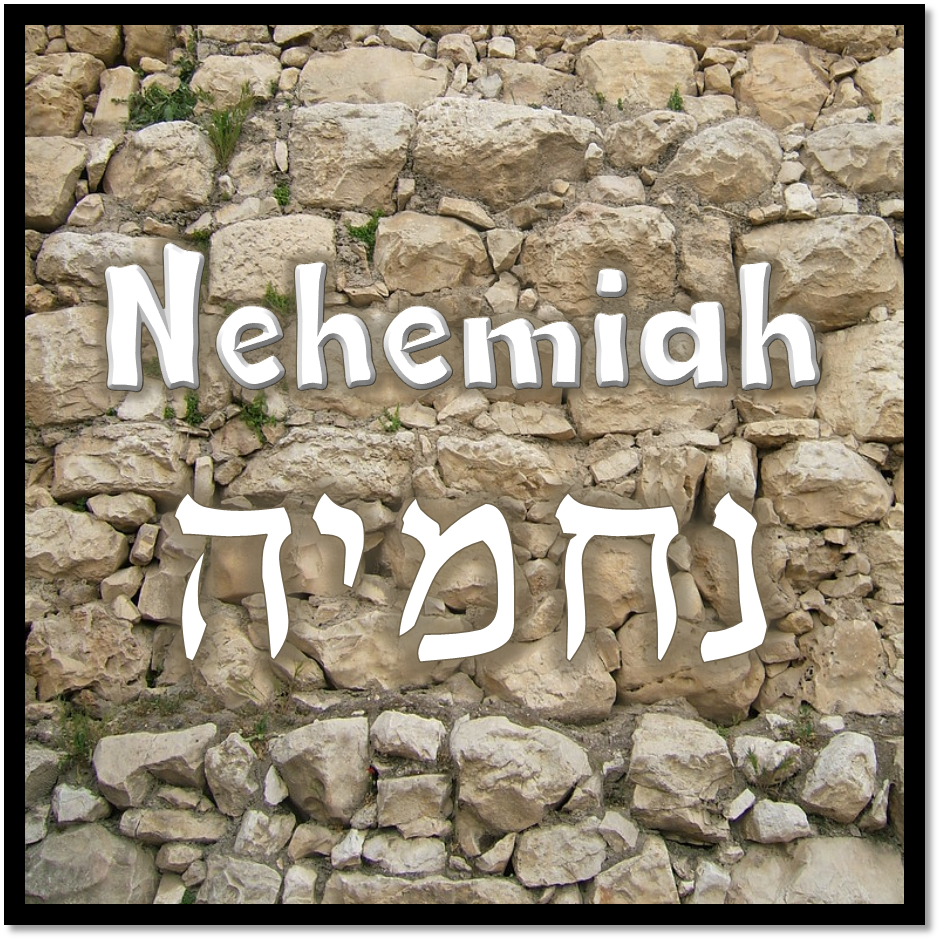
This is an image of a portion of the wall rebuilt by Nehemiah and company.
Today in the Bible, after Nehemiah arrived in Jerusalem from Susa and rested for three days, he made a secret night-time tour of the city walls to view their condition. The Bible does not give us a date for this event; however, it does give us a date for the completion of the wall, Elul 25, and it tells us that it took 52 days to complete the restoration. Working backwards, we arrive at the date of Av 4 for the beginning of the restoration work.
We’ve chosen to place Nehemiah’s night-time inspection around the Full Moon, a couple of weeks before Av 4. If you remember, the cycle of the Moon is used to define a month in the Bible. This is a system of timekeeping that God set up on the fourth day of creation. Each phase of the Moon indicates which day of the month it is. The lunar cycle takes roughly 29 ½ days to complete. This means that a biblical month is 29 or 30 days long. The Full Moon would then occur either on the 14th or 15th day of the month. If you look up at the sky tonight, there is a Full Moon. Using the lunar cycle is how we can place biblical dates on the Gregorian calendar we use today.
So why then? Why did we pick the Full Moon? If Nehemiah wanted to do this secretly, the Full Moon would provide ample light to inspect the walls without calling attention to himself by using a torch. Again, this date is just a guess, the important thing is to recall Nehemiah’s heart for the Holy City. Over the next two months we’ll shine a spotlight on Nehemiah and the men and women who worked together to restore its walls and gates.
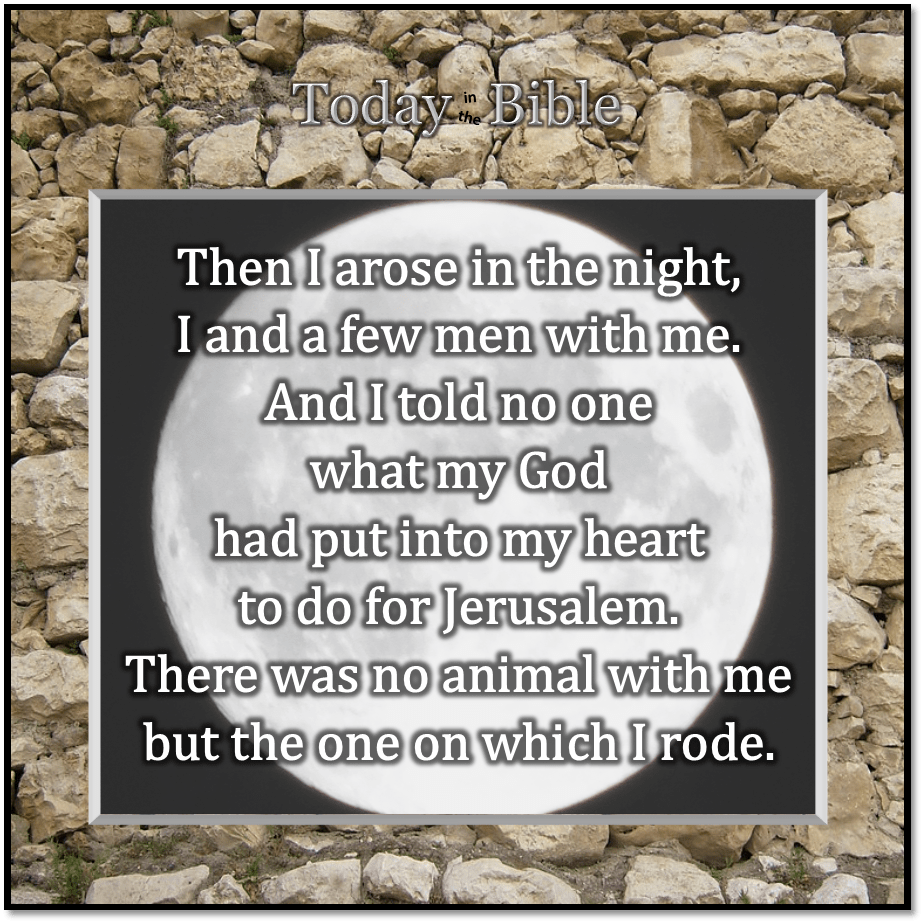
Then I arose in the night, I and a few men with me. And I told no one what my God had put into my heart to do for Jerusalem. There was no animal with me but the one on which I rode. I went out by night by the Valley Gate to the Dragon Spring and to the Dung Gate, and I inspected the walls of Jerusalem that were broken down and its gates that had been destroyed by fire.
Then I went on to the Fountain Gate and to the King’s Pool, but there was no room for the animal that was under me to pass.
Then I went up in the night by the valley and inspected the wall, and I turned back and entered by the Valley Gate, and so returned.
And the officials did not know where I had gone or what I was doing, and I had not yet told the Jews, the priests, the nobles, the officials, and the rest who were to do the work. – Nehemiah 2:12-16 (ESV)
As we follow Nehemiah’s story, we’ll begin to focus more heavily upon the Hebrew. We’ve already studied the meaning of Nehemiah’s name, today we’ll take a look at a couple of other words.
“And I told no one what my God had put into my heart to do for Jerusalem.”
אֱלֹהַי
“Elohai” – “My God”
The word “Elohai” is the construct form of the word “Elohim.” It is found in the first-person singular. What does all of that mean? Well, let’s break it down. Elohim is the masculine plural form of the word God/god. The word for “God” is commonly used in the masculine plural throughout the Bible. It is normally translated into English in the singular form, “God.” What does the construct form mean? It means that the word is found in a form which indicates it is constructing a relationship between that word and another. Oftentimes an indicator that the construct form is being used can be found when the English word “of” is present. In this case, it’s constructing a relationship between God and the first-person singular…or “me.” Nehemiah used the first-person singular form…”My God.” Or, to put it another way, the “God of Me.” That’s the first step in repentance, aligning yourself with God and making Him, not just “My God” but, the “God of Me.” Somehow it sounds different when put that way. The first chapter of Nehemiah takes place during the month of Kislev. Kislev is a winter month, usually November/December on our calendar. At that time Nehemiah had received word of the condition of the walls and gates of Jerusalem and the distress of the people who remained in the city after its destruction. Nehemiah went into a deep period of mourning, prayer, and repentance. It’s at this time that the LORD truly became “Elohai” to Nehemiah…the “God of Me.” The God I serve. The God I obey.
לִבִּי
“Libi” – “My Heart”
A couple of days ago we looked at the rebuilding of the walls and gates as a physical representation of repentance. A return to holiness. We revisited Nehemiah’s prayer in chapter one where he confessed his sins and displayed his remorse. It’s also at this time that Nehemiah first heard about the condition of the walls and gates. This was the moment when God began to lay it upon his heart to do something about them. The word “libi” is also found in the construct form. “My heart” or “Heart of Me.” In our story for today, Nehemiah confirmed this, “what my God had put into my heart.” Heart, in Hebrew, means more than just the blood-pumping organ which keeps us alive. It’s your inner man…your mind…your will…your emotions…your understanding…your essence. This is where God had placed Nehemiah’s desire to restore the walls and gates of the city. It was in the heart of him. At this point in today’s story, he had told no one. The secret (hidden) night-time ride, in a way, mirrored the word of God to Nehemiah which was still hidden away in the inner-most part of his heart. He had told no one, “the officials did not know where I had gone or what I was doing.”
שַׁעַר-הַגַּיְא
“Sha’ar-Haggai” – “Valley Gate”
Nehemiah exited the city through the Valley Gate. Also found in the construct form, these words could be translated as, “the gate of the valley.” Our map below shows its location, on the southwestern side of the city. The gate was the entrance into the Central Valley. Hebrew utilizes several different words for “valley,” depending upon what the physical attributes of the valley are. Gai indicates that the valley is an elongated, flat-bottomed depression.
עֵין הַתַּנִּין
“Ein HaTannin” – “Spring of Tannin”
As is the theme for all of our words today, “ein” is found in the construct form – “Spring of Tannin.” The word “ein” means a spring or a fountain. It is also used for the word “eye” (“ayin”) – the “watery” portion of the “landscape” of our face. The word “tannin” is an interesting one. We used the English Standard Version for our text today. It translates “Ein HaTannin” as “Dragon Spring.” Depending upon your version of the Bible, the “Spring of Tannin” may be translated as:
- the jackal’s well (American Standard Version)
- the Dragon’s Well (Complete Jewish Bible)
- the well of fig trees (Septuagint)
- the Dragon’s Fountain (New Jerusalem Bible)
- the Serpent Well (New King James)
- the snake-fountain (Rotherham Bible)
- or even the Well of the Crocodile (Hebrew World)
Tannin is a hard word to nail down. It can be translated as dragon, sea monster, serpent, whale, crocodile, or jackal. Sometimes it refers to sea creatures and sometimes to land creatures. It’s usually that context which drives the translation. The Septuagint seems to connect the name of this spring to the word “te’enah” which means “fig.” We did not place the Dragon Spring on the map as there does not seem to be a consensus of its location (just like we can’t seem to nail down its meaning!); but from Nehemiah’s words, it should be placed somewhere between the Valley Gate and the Dung Gate.
שַׁעַר הָאַשְׁפֹּת
“Sha’ar Ha’Ashpot” – “The Refuse Gate”
The name of this gate comes from a word having to do with fire and ashes. Though it is most often rendered as the “Dung Gate,” “Refuse Gate” may be a better translation. Once again, “sha’ar” is found in the construct form, “Gate of Refuse.”
שַׁעַר הָעַיִן
“Sha’ar Ha’Ayin” – “The Fountain Gate”
“Sha’ar” (gate) is also found in the construct form, “Gate of Ayin.” Ayin comes from the same word we studied under “Ein HaTannin.” Sometimes transliterated as “ein” and sometimes as “ayin,” both words originate in the same root. The New English Translation renders “Gate of the Well.” Almost all others translate as “Fountain Gate” or “Gate of the Fountain.”
בְּרֵכַת הַמֶּלֶךְ
“Berechat HaMelech” – “King’s Pool”
Once again, the word “pool” (“berechat”) is found in the construct form (“pool of”), making a literal translation of this as “Pool of the King.” The word “berachah” (pool) is spelled using the same Hebrew letters as the word “berachah” (blessing). The first “a” is held for a slightly longer moment when pronouncing “blessing” than it is when pronouncing “pool.” This is only apparent when the “nikkudim” (those little dots and dashes) are present. The Hebrew language has no letters for vowels like English does. The nikkudim are not present in the original Hebrew Scriptures. The vowel sounds were passed down by the oral traditions. A group called “The Masoretes” eventually formed a system of dots and dashes to indicate the correct pronunciation. The way a word is pronounced indicates the meaning of the word, a different pronunciation can indicate a different meaning. The Masoretes are known as the “Tradition Keepers,” as they kept the traditional pronunciation. Pool and blessing both stem from a verb-root meaning “to kneel, bless, praise, or salute.”
Melech is the word for “king.”
Well, that’s enough Hebrew for today. We intend to continue following Nehemiah and his companions as they work together to restore the walls and gates of the Holy City. We hope you’ll consider joining us on our journey as we dig into the Hebrew behind your translation.

To read all of our posts on Nehemiah, click on the image above.

© 2026 Today in the Bible

 Today in the Bible
You must be logged in to post a comment.