Have you ever noticed that sometimes the word “Lord” is spelled using all capital letters? LORD
And have you ever wondered why sometimes the word “God” is spelled using all capital letters? GOD
Well, there is a reason for both of these. They are meant to be a stand-in for our God’s Holy Name. So, why don’t we just use God’s Holy Name? Let’s harken back to the days of Moses, when God gave us this command:
וְלֹא תְחַלְּלוּ אֶת-שֵׁם קָדְשִׁי וְנִקְדַּשְׁתִּי בְּתוֹךְ בְּנֵי יִשְׂרָאֵל אֲנִי ה׳ מְקַדִּשְׁכֶם הַמּוֹצִיא אֶתְכֶם מֵאֶרֶץ מִצְרַיִם לִהְיוֹת לָכֶם לֵאלֹהִים אֲנִי ה׳
Velo techallelu et-shem kadoshi venikdashti betoch benei Yisra’el ani ADONAI mekadishchem hamotzi etchem me’eretz Mitzrayim lihiyot lachem l’Elohim ani ADONAI.
You shall not profane My holy name, but I will be hallowed among the children of Israel. I am the LORD who sanctifies you, who brought you out of the land of Egypt, to be your God: I am the LORD. – Leviticus 22:32-33 (NKJ)
What does it mean to profane something? Basically, it means to take something that is holy — something that is set apart — and make it common. In order to ensure that this does not happen to the name of the LORD, translators have instituted the practice of using LORD or GOD in all capital letters to represent God’s Holy Name. Sometimes you may see ADONAI instead. ADONAI is Hebrew for “My Lord.”
In addition to not spelling out God’s Holy Name, care should be taken not to speak “The Name” in just any old circumstance. In Judaism, it became tradition to only speak The Name on the Day of Atonement; a day considered to be the holiest day of the year. The Name was only spoken by the High Priest, a man considered to be the holiest man on Earth. And, The Name was only spoken in the Holy of Holies, the holiest place on Earth. In our day, there are some who insist upon speaking God’s Holy Name. The original Hebrew does not contain characters that represent vowel sounds. Although there are many who disagree, today it’s unclear how to correctly pronounce God’s Name. We look to Jesus as our example, He taught us to refer to God as our “Father” and to pray, “hallowed be Thy Name.” In casual conversation, one may use “Hashem” to refer to God. Hashem means “The Name” in Hebrew. In personal prayers, many prefer to use ADONAI.
The ancient Hebrew scribes took great care when writing out the word of the LORD. They constructed a Torah scroll in the same manner as the Tabernacle court. This was inspired by Exodus 36:8-38, where God explained to Moses how to build a place for Him to dwell. Basically, the text says the court of the Tabernacle should contain columns which are connected to curtains via hooks. The word used for column (amud) is the same word that is used to describe a column of print. The word used for curtain (yeri’ah) is the same word used to describe a sheet of parchment. The word used for hook (vav) is the same as the letter vav in the Hebrew alphabet. The Hebrew letters began as pictographs, and in the picture language, the letter vav was a hook, peg, or nail. If a vav is added to the beginning of a Hebrew word, it functions as a “hook” which connects one word to another. Its purpose is the same as our word “and” in English. How many times do you read in the Bible something like, “And the LORD said to Moses…”? Each one of those “ands” is the letter vav.
Each Torah scroll has 245 precisely ruled columns, each one forty-two lines in length. There are no chapter or verse markings and no capitalization or punctuation to indicate the end of one sentence and the beginning of the next. The only indication that you have reached the end of a book is four blank lines that are left between the end of one book and the beginning of the next. In most Torah scrolls all of these columns (of print), except for five, begin with the letter “vav” – a hook – which connects them to the curtains (parchment); just as in the Tabernacle.
The Tabernacle contained the Dwelling Presence of God, so it is fitting that the Torah scroll, which contains the Word of God, is constructed in a like manner. Each scroll is made with great care and lovingkindness; we should handle it with love and respect too; and now when we hold a Bible, we can visualize the Tabernacle in our hands.
What does this look like in our everyday lives? It can be little things, like not placing your Bible on the floor, not placing anything on top of it, or not reading it when you’re in the bathroom. Avoid placing The Name on an article of clothing which may get soiled and then washed and faded or torn. Or bigger things like disposing properly of a worn-out Bible. In Judaism, this means a proper “funeral.” Some communities place soiled or worn texts containing God’s Holy Name in a casket – Bibles, workbooks, anything containing The Name. The final resting place is known as a genizah. Even the prayers that are stuck in between the retaining blocks of the Wailing Wall in Jerusalem are gathered periodically and placed into a genizah.
In Hebrew Bibles, God’s Holy Name is spelled out in the original language. If the Hebrew Bible also contains a transliterated portion, the circumlocutions ADONAI, LORD, or GOD are used. If you want to refer to The Name using Hebrew letters, but don’t want to spell it out, using “ה׳” is an acceptable stand in for The Name (Hashem). It begins with the first letter of Hashem and a “garesh” is used to indicate the missing letters, similar to how an apostrophe is used in English.
Many biblical names have a portion of God’s Holy Name attached to them. Our series on the names of the men who participated in restoring the walls and gates of Jerusalem, as told in the book of Nehemiah, reveals name after name which do just that. None of the names, however, contain the complete Name of God. Many contain the first two letters only…Yah. The name Yah is found 50 times in the Bible to refer to God’s Name, all but four of those are found in the Psalms.
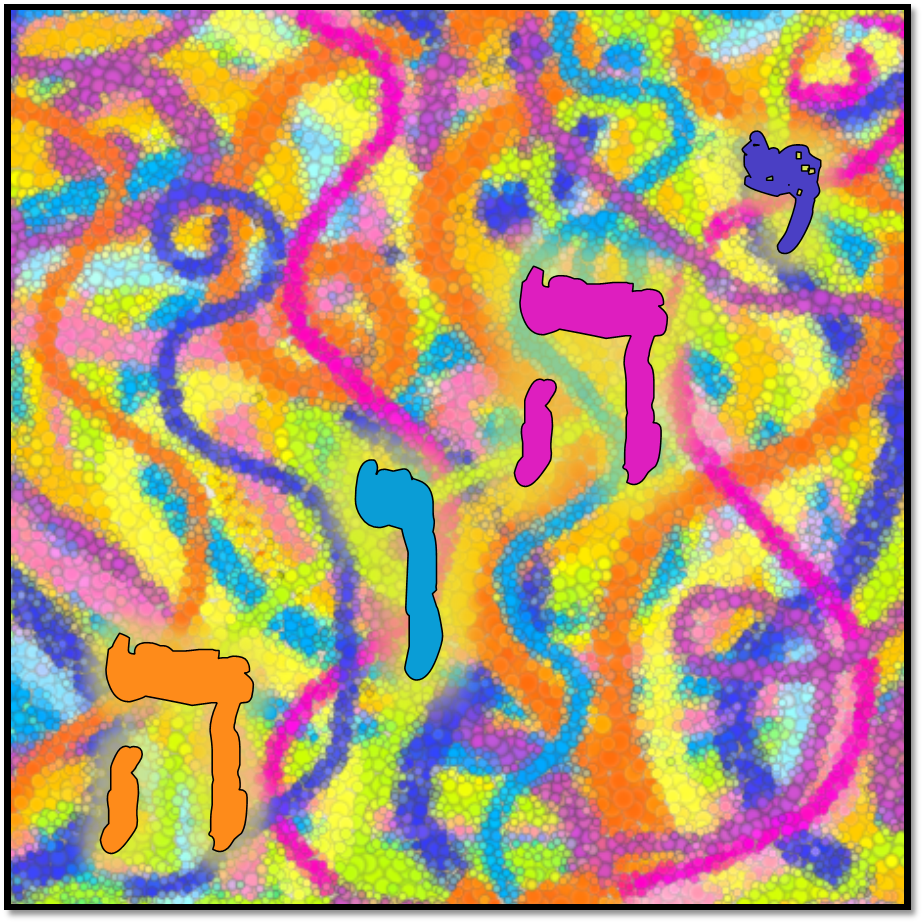
Another way that the Name of the LORD is protected is found in writing numbers. Similar to Roman numerals, the Hebrew letters may also be used to represent numbers. The first letter (א) is assigned a value of one, the second letter (ב)…two, etc. The 10th letter is “yod” (י) and, like our number “one,” it is used to make the numbers 11, 12, etc. The fifth letter ה represents the number 5. Following the pattern above, to write 15, you would use a י and a ה — the first two letters of God’s Holy Name. In order to avoid this scenario, a combination of the ninth letter (ט) and the sixth letter (ו) are used instead — nine and six total 15.
The original Hebrew text does not contain characters to indicate vowel sounds. Though there are many opinions, it’s not clear what vowel sounds, if any, should be included when pronouncing His Name. From the letters we do know, they tend to make breathy sounds. Let’s take a look at those letters.
| Letter Name | Hebrew Letter | Transliteration | Ancient Pictograph |
| Yod / Yud | י | y / i | hand / arm |
| He (“hey”) | ה | h | man with arms raised (an attention grabber) |
| Vav / Waw | ו | v / w / o / u | peg, nail, hook |
| He (“hey”) | ה | h | man with arms raised (an attention grabber) |
Using the pictographs, visually we can see a hand and a nail with an emphasis on calling it to our attention.
We’ve explored many ways to hallow the name of the LORD, but what is the best way? Well, if we return to our text above and, this time, include the verse immediately prior to it, God, Himself, tells us exactly how to hallow His Name.
“Therefore you shall keep My commandments, and perform them: I am the LORD. You shall not profane My holy name, but I will be hallowed among the children of Israel. I am the LORD who sanctifies you, who brought you out of the land of Egypt, to be your God: I am the LORD.” – Leviticus 22:31-33 (NKJ)
 Today in the Bible