
Av 4, 5784; from sunset August 7, 2024, to sunset August 8, 2024
(The fourth day of the fifth month)
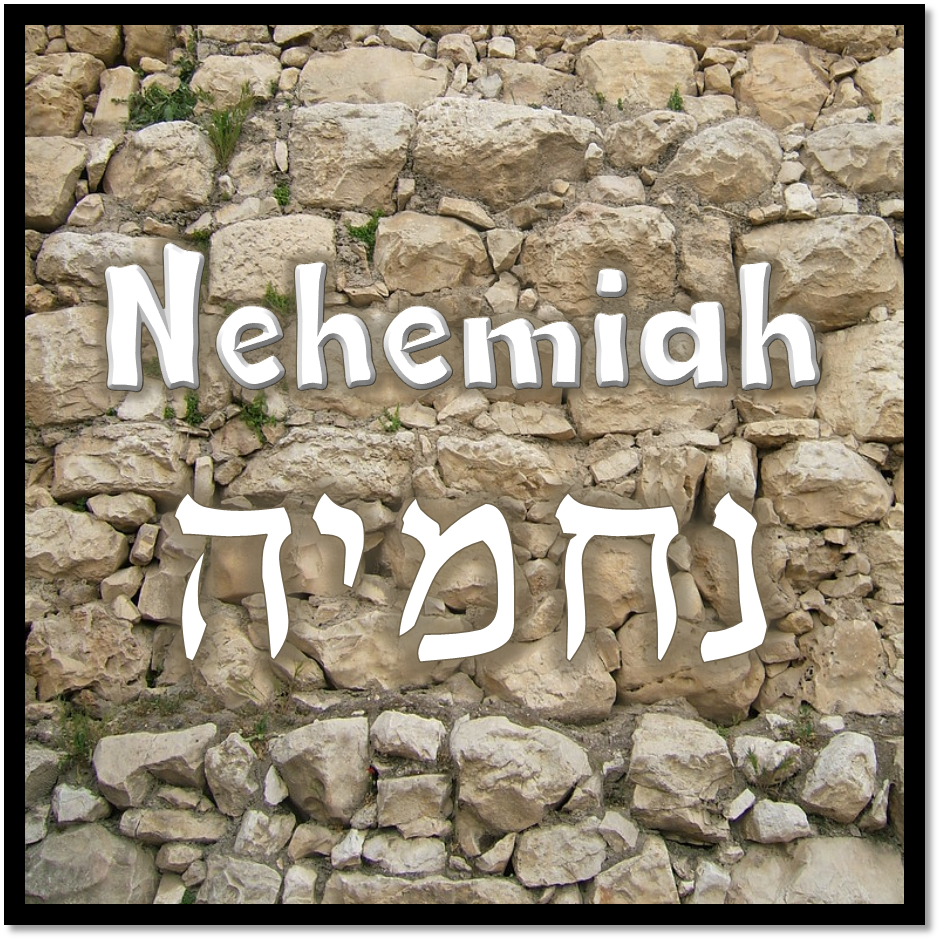
This is an image of a portion of the wall rebuilt by Nehemiah and company.
About 13 years after Ezra returned to Jerusalem, Nehemiah made the journey.
The Bible tells us that on the 25th day of the month of Elul, after 52 days of labor, the people completed rebuilding the city wall (Nehemiah 6:15). By subtracting 52 days from Elul 25, we end up here, on this day. Today in the Bible, we’ll begin working our way through the story of the men and women who worked alongside of Nehemiah to restore the walls and gates of Jerusalem. We begin with Eliashib, the high priest, and how the meaning of his name plays into the text.
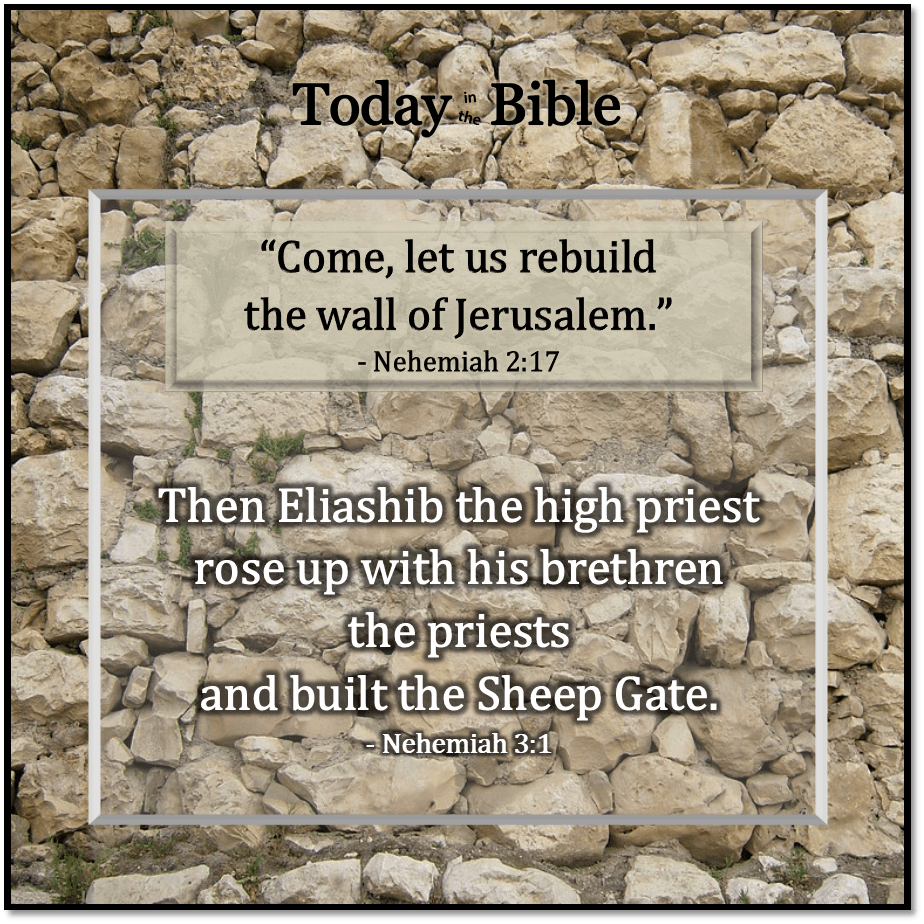
Then Eliashib the high priest rose up with his brethren the priests and built the Sheep Gate; they consecrated it and hung its doors. They built as far as the Tower of the Hundred, and consecrated it, then as far as the Tower of Hananel. – Nehemiah 3:1 (NKJ)
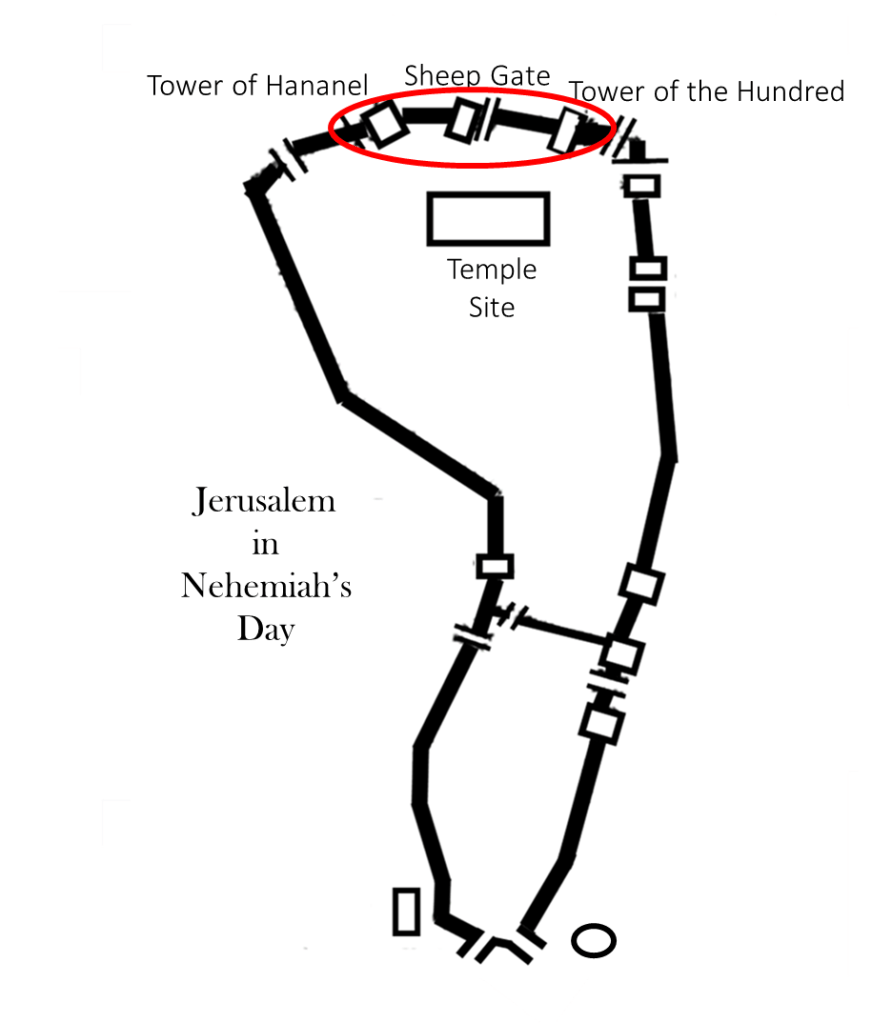
Throughout the text of Nehemiah, we’ll be looking at the meaning of the Hebrew names of the people and places in the story. Today, we’ll learn about the gate, the towers, and the name, Eliashib, the high priest.
שַׁעַר הַצֹּאן
Sha’ar Hatzon = Gate of Sheep
The restoration of the wall begins and ends with the Sheep Gate. The map above calls out its location. The priests restored the Sheep Gate, hung its doors, and then they consecrated it – they made it “kadosh” – they made it holy. It is the only gate designated so in Nehemiah’s story. The sheep chosen for sacrifice were brought in through this gate. One wonders if Jesus, in His role as our Passover Lamb, may have come through it at His triumphal entry into Jerusalem, just days before His sacrifice. We realize that many others believe He entered through the Golden Gate, but the Sheep Gate just seems to make sense. The fact is, the Bible does not say.
מִגְדַּל הַמֵּאָה
Migdal Hame’ah = Tower of the Hundred
It is not known how the Tower of the Hundred got its name. Some speculate that it referred to its height or the number of its steps, others that one hundred men could occupy it.
מִגְדַּל חֲנַנְאֵל
Migdal Chananel = Tower of Hananel
The Tower of Hananel (“Chananel” in Hebrew) means the “Tower of the Grace of God.” Besides its mention in Nehemiah, the Tower of Hananel is also referenced in Jeremiah 31:38 and Zechariah 14:10.
אֶלְיָשִׁיב
Elyashiv = Eliashib
The name of the High Priest at the return from exile was Eliashib. His name is a combination of two words. The first two letters, “El” mean “God.” The last portion of Eliashib comes from the verb-root “shuv” meaning “to return or restore.” This root is the core of the word for repentance. One who repents, returns…turns around, and brings themself back to the word of the LORD. Let’s pull apart Eliashib’s name to understand the individual pieces.
| Prefix/Suffix | Transliteration | Meaning |
| אל | El/el | God/god |
| Verb Root | Transliteration | Meaning |
| שוב | shuv | to return or restore |
Eliashib means “God Restores” or “God Returns.”
In our article for Tammuz 13, we looked at how the restoration of the wall of Jerusalem could be seen as a metaphor for repentance. Eliashib seems to be a fitting name for the priest in charge during the return of the exiles and the restoration of the city wall. However, later on in the book of Nehemiah, we learn that, instead of using the Temple storerooms for grain offerings, frankincense, tithes, etc., Elisashib gave them as a lodging place to Tobiah, the Ammonite, the one who tried to thwart the wall’s restoration and plotted against Nehemiah. This happened while Nehemiah was away in Susa. When he returned, he threw out Tobiah and all his belongings and had the storerooms cleansed and filled with their proper contents. (Nehemiah 13)
So, was Eliashib aptly named after all? Even though he was in cahoots with Tobiah (whose name means “The LORD is Good”) – Eliashib’s name really does tells the true story. Thankfully, it is “the LORD who restores” and, for that matter, it is “the LORD who is good!” Our God does not depend upon the righteousness of mankind and not one of us can measure up to Him.
We hope you’ll join us again tomorrow as we continue working our way through the story of the men and women who contributed their skills and labor to the restoration of the walls and gates of the Holy City. As always, you can find all of our articles on Nehemiah by clicking on the image below.
To read all of our posts on Nehemiah, click on the image above.

© 2026 Today in the Bible



You must be logged in to post a comment.