
Av 6, 5784; from sunset August 9, 2024, to sunset August 10, 2024
(The sixth day of the fifth month)
This is an image of a portion of the wall rebuilt by Nehemiah and company.
Today in the Bible, we’re continuing our look at the men and women who worked together to rebuild the wall of Jerusalem after it was destroyed by the Babylonians. Nebuchadnezzar’s army broke through the wall on the 9th of Tammuz, which led to the destruction of the Temple on the 9th of Av and the exile of the people. Now the remnant of those people, and their descendants, have returned and are rebuilding the broken wall of the city. The sons of Hassenaah were a part of the rebuilding process.
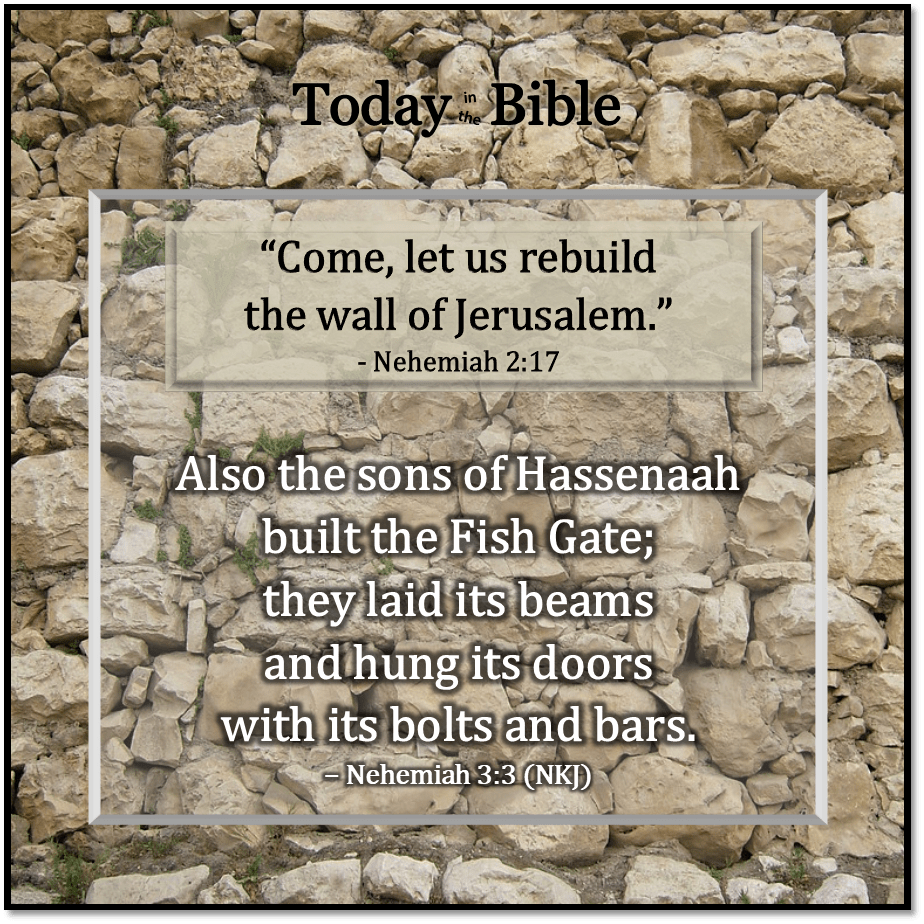
Also the sons of Hassenaah built the Fish Gate; they laid its beams and hung its doors with its bolts and bars. – Nehemiah 3:3 (NKJ)
Scholars connect the sons of Hassenaah in Nehemiah 3:3 with the list of returnees found in Ezra 2:35.
Now these are the people of the province who came back from the captivity, of those who had been carried away, whom Nebuchadnezzar the king of Babylon had carried away to Babylon, and who returned to Jerusalem and Judah, everyone to his own city… – Ezra 2:1 (NKJ)
…the people of Senaah, three thousand six hundred and thirty. – Ezra 2:35 (NKJ)
בְּנֵי הַסְּנָאָה
Benei Hassena’ah = Sons of Hassenaah
Hassennaah. What does it mean? It’s likely that Hassenaah is not the name of an individual, but rather of a location in Israel. In Hebrew, when a word begins with “ha” it usually means “the” or “of.” So we could read Nehemiah 3:3 as “the sons of the Senaah.” The location of Senaah is not certain, though it is thought to be somewhere north of Jerusalem and northwest of Jericho.
To further bolster the thought that Hassanaah may be a place rather than a person, many point to 1 Samuel 14:4 where a place called Seneh is mentioned.
And between the passes by which Jonathan sought to cross over to the Philistines’ garrison, there was a sharp crag on the one side, and a sharp crag on the other side, and the name of the one was Bozez, and the name of the other Seneh. – 1 Samuel 14:4 (NAS)
Oftentimes, in the Bible, there may be alternate spellings of people or places. Seneh and Hassenaah could possibly be the same place.
Hmmmm, so let’s see. A sharp crag named Seneh. Let’s pull on this ancient thread and see where it takes us.
סְנֶה
Seneh
This root is connected to a thorn bush. The word is also used for “the” burning bush of Moses fame. Others connect it to an acacia tree.
סִינַי
This word is Sinai. Some lexicons don’t even try to translate this word; others read “thorn, thorny” and understand that the yod (י) at the end of the word as a remnant of the LORD’s Holy Name which begins with that letter. They translate Sinai as the “LORD’s bush.” The final yod (י) could also put the word in a possessive form, making it “my” thorn.
שׂנא
This root (sana) means to hate, to be hated, hateful. There may be a connection between thorns and hatred…both cause pain.
In Hebrew, there are two letters that can make an “s” sound. The first one is called “samech” (ס – “sah-mehkh”) and the second one is called “sin” (שׂ – “seen”). Let’s take a look at these two letters in Ancient Hebrew.

In the ancient pictographs, “samech” is a picture of a thorn.

The picture for “sin” is a person’s two front teeth. This letter can make either an “s” sound or a “sh” sound. Many people feel that the letter above originally only made a “sh” sound. If you think about it, when you make a “sh” sound, your two front teeth are visible. However, the word “sin” means thorn. Sharp. Like a tooth. Shen means tooth.
Somewhere along the line it appears that these two letters may have become interchangeable. There seems to be a number of words that appear to be from the same parent root but switch out a samech for a sin or a sin for a samech. That may be what’s happening in the three words we looked at above. The TWOT lexicon translates “the sons of Hassenaah” as the “sons of the hated woman,” explaining that it refers to the poorer classes of Jerusalem. I guess they must see the “ah” ending of the word as being in its feminine form. Many feminine words in Hebrew end in “ah” – so if “sana” means “hate or hated,” then “sana’ah” may indicate a “hated woman” and “hassana’ah” could be “the hated woman.” Strongs sees this as well (#5570).
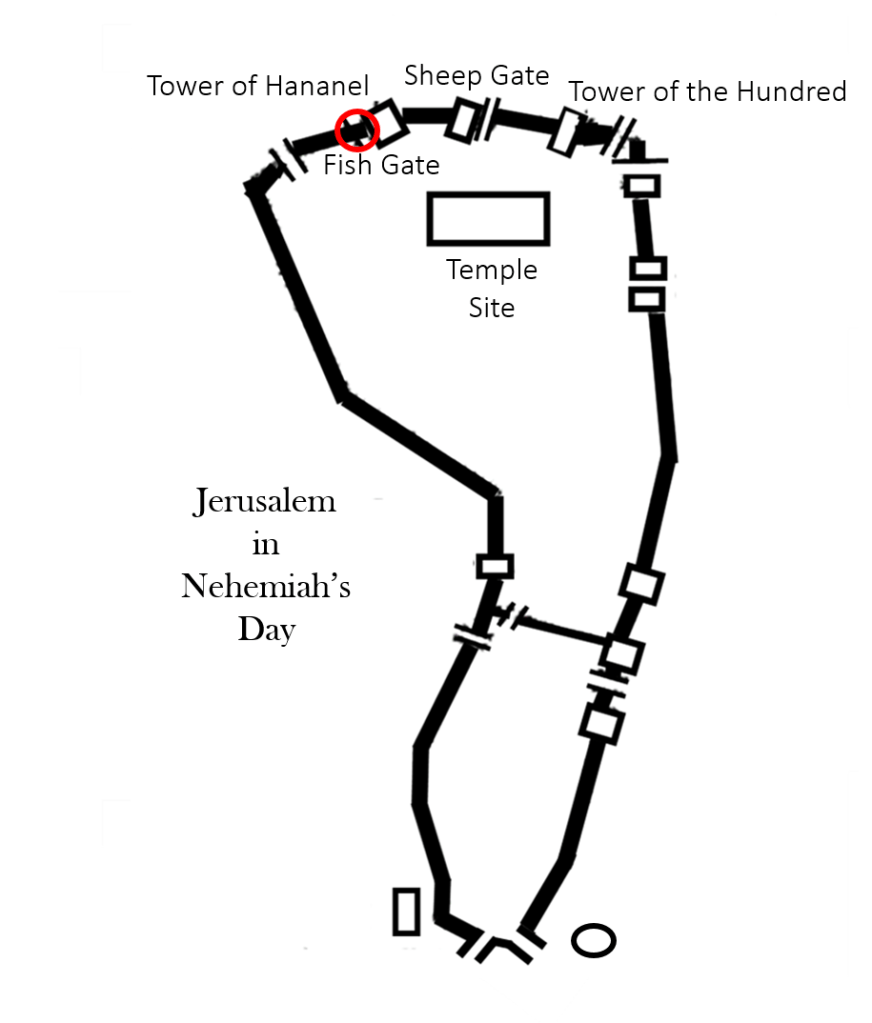
Whether “the sons of Hassenaah” are the sons of an individual named Hassenaah, a place named Hassenaah, or the poor people of Jerusalem – these were the men who rebuilt the Fish Gate.
שַׁעַר הַדָּגִים
Sha’ar Hadagim = Gate of the Fishes
A “dag” (pronounced like “dog”) is a fish. Dagim is the plural form of the word. The Fish Gate is mentioned four times in scripture. Its first mention is in 2 Chronicles 33:14 in reference to the work of King Manasseh.
After this he built a wall outside the City of David on the west side of Gihon, in the valley, as far as the entrance of the Fish Gate; and it enclosed Ophel, and he raised it to a very great height. Then he put military captains in all the fortified cities of Judah. – 2 Chronicles 33:14 (NKJ)
It is mentioned again in the prophetic book of Zephaniah, chapter 1 (which is worth reading in its entirety).
“And there shall be on that day,” says the LORD, “The sound of a mournful cry from the Fish Gate, a wailing from the Second Quarter, and a loud crashing from the hills. Wail, you inhabitants of Maktesh! For all the merchant people are cut down; all those who handle money are cut off. And it shall come to pass at that time that I will search Jerusalem with lamps, and punish the men who are settled in complacency, who say in their heart, `The LORD will not do good, nor will He do evil.’ – Zephaniah 1:10-12 (NKJ)
The Fish Gate is mentioned twice in the book of Nehemiah, once in the verse we’re looking at today and once in chapter twelve during the dedication of the wall – when the celebrants pass by the Fish Gate with singing and rejoicing.
To read all of our posts on Nehemiah, click on the image above.

© 2026 Today in the Bible

 Today in the Bible
You must be logged in to post a comment.