
Av 16, 5784; from sunset August 19, 2024, to sunset August 20, 2024
(The sixteenth day of the fifth month)
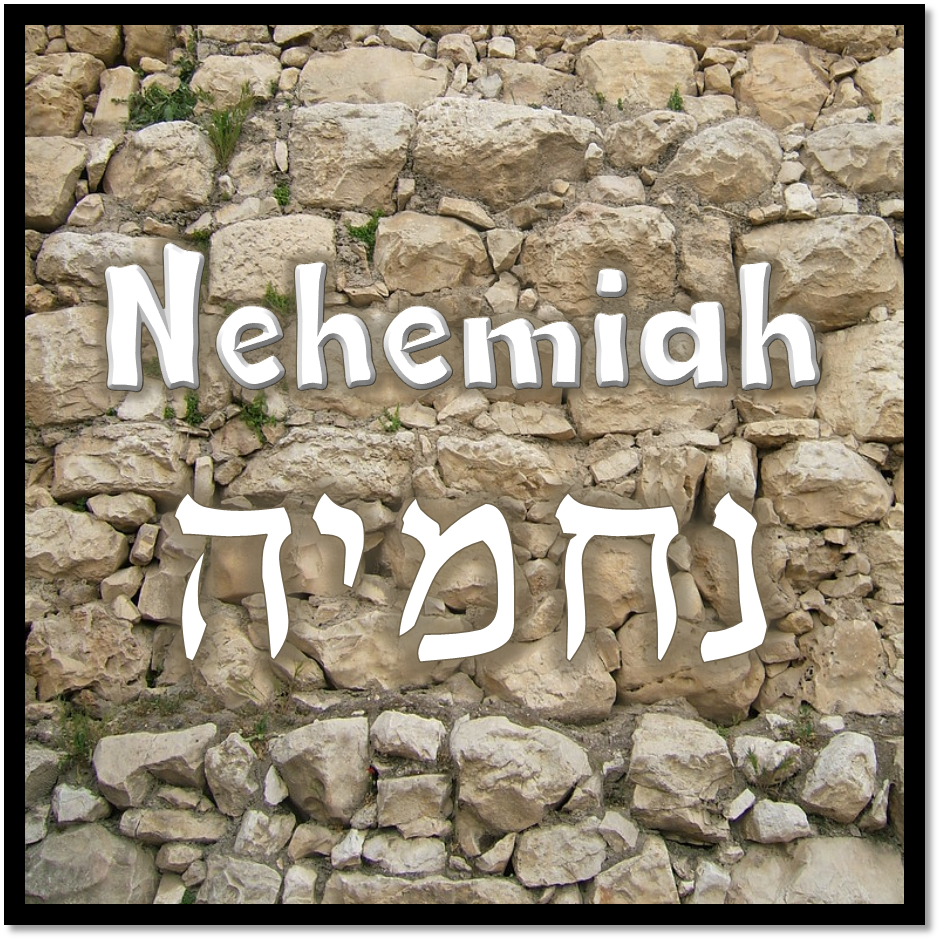
This is an image of a portion of the wall rebuilt by Nehemiah and company.
Today in the Bible, we’re meeting up with Jedaiah the son of Harumaph. He is one of the men that the Bible recorded as working to restore the wall of the Holy City. It took them 52 days to complete the mission. We’re in the midst of those days and have been studying through the Hebrew behind the names of those who gave their time to rebuild the wall.
And next unto them repaired Jedaiah the son of Harumaph, even over against his house. – Nehemiah 3:10a (JPS)
יְדָיָה
Yedayah = Jedaiah
The name “Jedaiah” is found 13 times in the Bible. Most of its occurrences are found in Nehemiah, though the son of Harumaph is only mentioned once…in our verse for today. Jedaiah comes from the verb root “yadah” (ידה) which means “to praise.” The name Judah comes from this same root. As we can see, Jedaiah is completed with our familiar “iah” ending, indicating an attachment to the Name of the LORD.
| Verb Root | Transliteration | Meaning |
| ידה | yadah | to confess, praise, give thanks |
| Prefix/Suffix | Transliteration | Comments |
| י | y, i | sometimes, just a “yod” (י), the first letter of God’s Holy Name, may serve as an indicator of its presence |
| ה | h | “yah” (יה) this combination of the 1st and 2nd letters of “The Name” is often translated as “iah” & is a very common name ending |
| ו | v, w, u, o | “yahu” (יהו) – the first three letters – is not quite as common but still found – as in “Elijah” – “Eliyahu” |
| ה | h | adding all four letters of “The Name” is not done |
These four letters represent God’s Holy Name. Many proper nouns use a combination of two or three of these letters as a prefix or a suffix to indicate an attachment to the Name of the LORD.
The name “Jedaiah” means “Praise of the LORD.”
Jedaiah was the son of Harumaph.
חֲרוּמַף
Charumaf = Harumaph
This name is Charumaf (kha-roo-maf). It was a bit of a mystery for us — trying to find the root of this name. Our first thought was exploring the verb-root “charam” (חרם), which means “to ban, to devote, to utterly destroy.” But then what about the “f” (or “ph” — ף) ending? Where does that come from? Not all Bible dictionaries offer a meaning for Harumaph so what were we going to have to offer you all for the meaning of this guy’s name? Thankfully, it was found in both Hitchcock’s and Smith’s Bible Dictionaries.
- Hitchcock’s = “Destruction”
- Smith’s = “Slit-Nosed”
Suddenly the verb-root “charam” (חרם) is looking like a possibility – at least according to Hitchcock. But how can these definitions be so different? The TWOT Lexicon offers us a clue, there are two separate meanings for “charam.”
charam (I) – to ban, devote, destroy utterly. This is used a lot in connection with the booty of war that was devoted to the LORD, rather than being to distributed among the soldiers, it was to be utterly destroyed. Other words from this root are:
- cherem – a devoted thing
- Chermon (aka Hermon – as in Mount Hermon) – the highest point in Israel which straddles its borders with Syria and Lebanon. Many believe it to be the site of Jesus’ transfiguration. That would certainly make it a devoted place. However, its devoted stature is not limited to the God of Abraham, Isaac, and Jacob. Hermon has been a place of religious significance and cultic activities for millennia. It was recorded as the site of the palace of Ba’al and there are many temples in the area. High places are like that; they are areas of worship. However, it’s not the high place that matters, it’s who is being worshipped there.
If Hermon is indeed the location of Jesus’ transfiguration, it may be that our Father chose this place to glorify His Son because of Ba’al. According to ancient lore, “Ba’al” was the son of “El.” “Ba’al” means “lord” and “el” means “god.” To ancient ears, “ba’al the son of el” means, “The lord, the son of god.”
Ba’al was a false son of god. In some of our articles, we’ve pondered the possibility that the purpose of the miracles in the Bible were to attest to the validity and the authority of the One True God. At the transfiguration of Jesus, our Father said these words, “This is My beloved Son, in whom I am well pleased. Hear Him.” (Mat 17:5 NKJ). To paraphrase, God said, “My Son is Yeshua (Jesus), not Ba’al.” Wasn’t this the point of the show down between Elijah and the prophets of Ba’al? Who is the real God? Maybe this is why Peter wanted to construct a sukkah or a booth there – it was a dwelling place for the real Son of God, not a palace for the false son of god. (Whoops, we’ve gotten off-track.)
charam (II) – to slit or mutilate. This is related to the Arab word meaning to slit or perforate the partition between the nostrils – as with a nose ring, an action that was specifically prohibited for the priests in Israel. Another word from this root is:
- cherem – a net (an object containing slits)
Knowing that there are two different sets of meanings for “charam” (חרם) helps us to understand the difference between Hitchcock’s and Smith’s definitions of Harumaph. However, Hitchcock’s definition still does not account for the “ph” sound at the end of the word. Smith seems to understand this name is a combination of “charam II” (slit – חרם) and “aph” (nose – אף).
“Harumaph” probably means “Slit Nose.”
To read all of our posts on Nehemiah, click on the image above.

© 2026 Today in the Bible

 Today in the Bible
You must be logged in to post a comment.