
Av 22, 5784; from sunset August 25, 2024, to sunset August 26, 2024
(The twenty-second day of the fifth month)
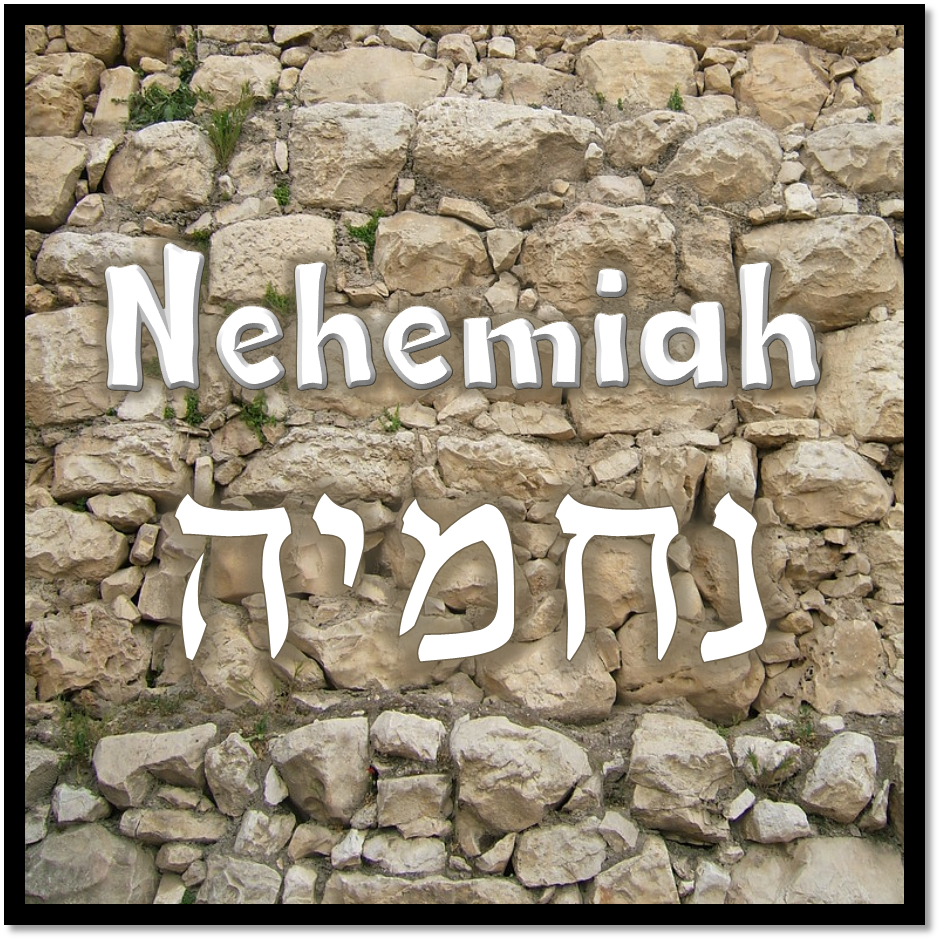
This is an image of a portion of the wall rebuilt by Nehemiah and company.
For fifty-two days, between the 4th of Av and the 25th of Elul, the men and women who had returned from the Babylonian captivity worked together to repair the walls and gates of Jerusalem. Today we’re taking a “look” at Shallun, son of Kol-Hozeh.
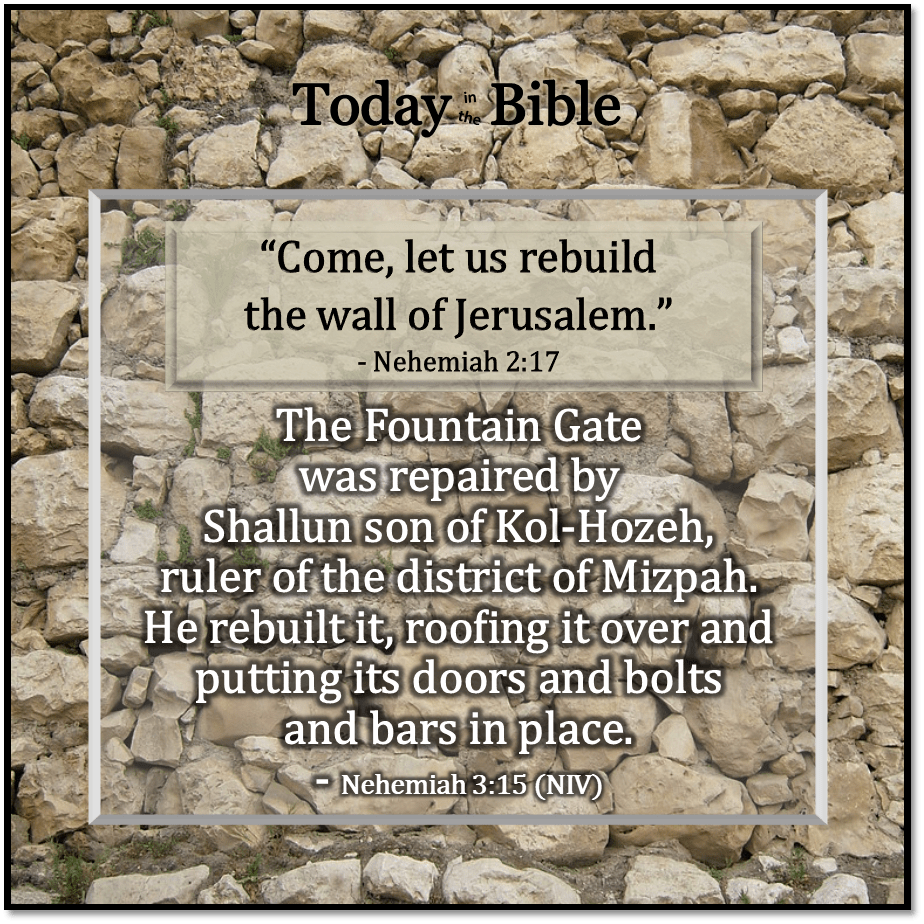
The Fountain Gate was repaired by Shallun son of Kol-Hozeh, ruler of the district of Mizpah. He rebuilt it, roofing it over and putting its doors and bolts and bars in place. He also repaired the wall of the Pool of Siloam, by the King’s Garden, as far as the steps going down from the City of David. – Nehemiah 3:15 (NIV)
שַׁלּוּן
Shallun
This word is very similar to the name Shallum that we studied earlier. The consensus for this name seems to be that it comes from the same root as Shallum – “shalem” (שלם), meaning “to be whole or complete.” Other words stemming from this root are peace, perfect, whole, full, recompense, retribution, etc. Some Bible dictionaries don’t translate this name – seeing a problem in switching the ending of the word from “m” to “n.” The name Shallun makes its one appearance in the Bible in our verse for today.
| Verb Root | Transliteration | Meaning |
| שלם | shalem | to be whole or complete |
| Word | Transliteration | Meaning |
| שִׁלּוּם | shillum | recompense, reward |
According to the Jones Dictionary of Old Testament Proper Names, “Shallun” means “Retribution“
Shallun was the son of Kol-Hozeh.
כָּל-חֹזֶה
Kol-Chozeh = Kol-Hozeh
The word “kol” (כָּל) in Hebrew means “all.” The root “chazah” (חזה) means “to look, see, behold, prophesy, or provide.” Other words from this root are vision, seer, and window.
| Root Word | Transliteration | Meaning |
| חזה | chazah | to look, see, behold, prophesy, or provide |
“Kol-Hozeh“ means “All-Seeing.”
מִצְפָּה
Mitzpah = Mizpah
Mizpah is a combination of the prefix “mem” (מ) and the verb root “tzapah” (צפה), meaning “to look out or about, to watch.” As its name suggests, this biblical town is found upon a high hill.
| Prefix | Transliteration | Function |
| מ | m | inseparable preposition meaning “from” – or – |
| מ | m | denotes an agent or instrument of the action of a verb – or – |
| מ | m | denotes a special place |
| Verb Root | Transliteration | Meaning |
| צפה | tzapah | to look out or about, to watch |
“Mizpah“ means “Watchtower” – a special place for watching.
שַׁעַר הָעַיִן
Sha’ar Ha’Ayin = Fountain Gate
The word “fountain” comes from the Hebrew word “ayin.” Ayin means eye. There is a second meaning for ayin which is “a spring or a fountain.” The connection between these two meanings is said to be something like this, “Whereas the spring is the watery portion of the landscape, so too, the eye is the watery portion of the landscape of one’s face.”
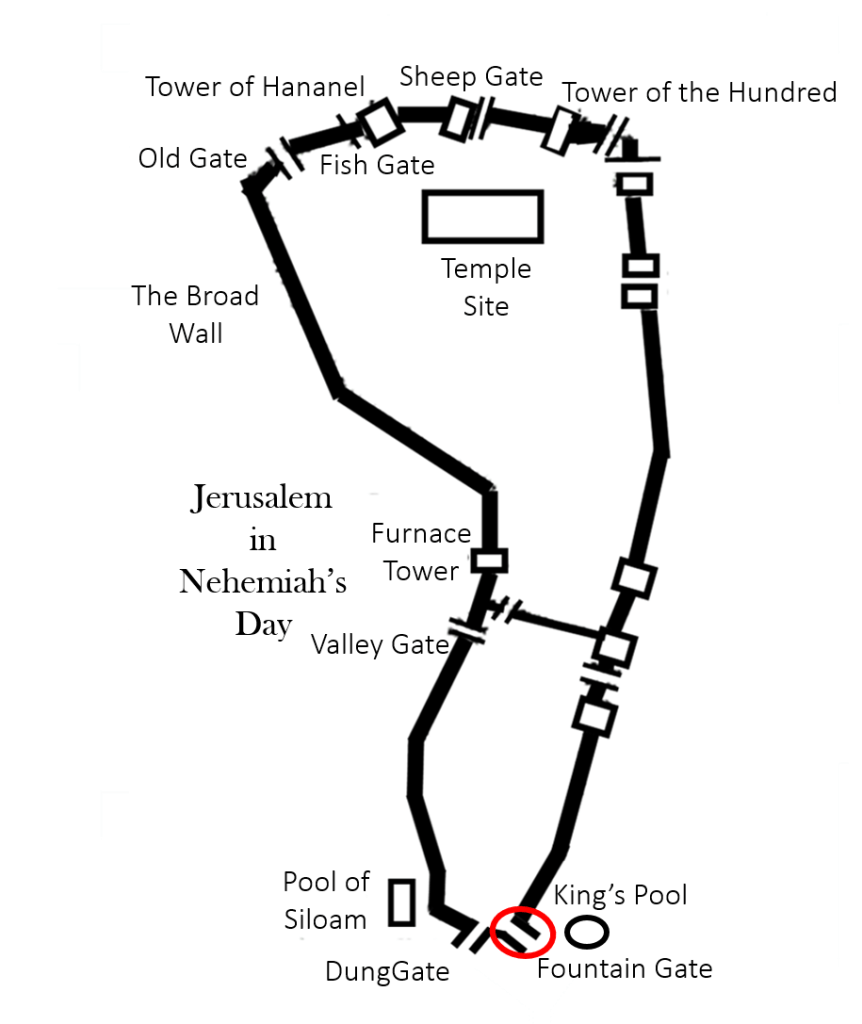
This gate is only mentioned in the book of Nehemiah. When he made his night ride to inspect the walls of Jerusalem, Nehemiah went down to inspect the Fountain Gate. It was so badly damaged that he couldn’t get through.
Then I went on to the Fountain Gate and to the King’s Pool, but there was no room for the animal under me to pass. – Nehemiah 2:14 (NKJ)
| Prefix | Transliteration | Function |
| ה | h | indicates the “definite article” (“the”); an example of the definite article would be if I asked you to bring me a spoon, you may assume that any old spoon would do; but if I asked you to bring me “the” spoon, you would assume that I wanted a specific spoon |
| if used in combination with another prefix it is found in second place; it may even be omitted and assumed to be present; in which case the vowel associated with the other prefix is changed to indicate the presence of the ה | ||
| ה | h | may also mean “of” |
| הֲ | ha | when associated with the “chataf patach” vowel point, this combination indicates an interrogative form, in other words, a question |
| Word | Transliteration | Meaning |
| עין | ayin (I) | eye |
| עין | ayin (II) | spring or fountain |
“Sha’ar Ha’Ayin” means “The Fountain Gate.”
בְּרֵכַת הַשֶּׁלַח
Berechat Hashelach = Pool of Siloam
The word “pool” comes from the root word “barak” (ברך). Siloam comes from the root “shelach” (שלח) meaning “to send out or let go.” Siloam is actually the Greek translation of the Hebrew shelach. Siloam means the same thing in Greek as shelach does in Hebrew. The NIV version of the Bible seems to be one of a very few that translates this as the Pool of Siloam in the book of Nehemiah. Most other translations read Shelah or Siloah.
| Verb Root | Transliteration | Meaning |
| ברך | barak | to kneel, bless, praise, salute, or curse (used euphemistically) |
| שלח | shalach | to send out or let go |
“Pool of Siloam” means something like “Pool of the Sent One.”
Eye Opening
In the restoration of the Fountain Gate and its surrounding area, we seem to have a bit of an “eye” thing going on. A “restoration of sight,” if you will.
- Kol-Hozeh – All-Seeing
- Mizpah – Watch Tower
- Fountain Gate – Ayin Gate (Eye, Spring)
The Pool of Siloam also has a special tie to “seeing.” It is familiar to most New Testament readers; we know it from the story of Jesus’ healing of the man who was blind since birth. This story probably happened near the Fountain (Ayin) Gate.
Now as Jesus passed by, He saw a man who was blind from birth. And His disciples asked Him, saying, “Rabbi, who sinned, this man or his parents, that he was born blind?”
Jesus answered, “Neither this man nor his parents sinned, but that the works of God should be revealed in him. I must work the works of Him who sent Me while it is day; the night is coming when no one can work. As long as I am in the world, I am the light of the world.”
When He had said these things, He spat on the ground and made clay with the saliva; and He anointed the eyes of the blind man with the clay. And He said to him, “Go, wash in the pool of Siloam” (which is translated, Sent). So he went and washed, and came back seeing. – John 9:1-7 (NKJ)
The Sent One sent the blind man to a pool named Sent.
If you finish reading John 9, you will see that others asked the man how could this be, how do you now see? Then they took him before the Pharisees who criticized Jesus for mixing clay and making an ointment on the Sabbath. In the end, the blind man could see that Jesus was the Son of God, the Pharisees could not. Jesus replies to them…
And Jesus said, “For judgment I have come into this world, that those who do not see may see, and that those who see may be made blind.” – John 9:39 (NKJ)
We can also bring Shallun into this story, his name means, “Retribution.” Retribution is defined as:
Re·tri·bu·tion – noun – punishment inflicted on someone as vengeance for a wrong or criminal act.
Our story starts off with the question, “Rabbi, who sinned, this man or his parents, that he was born blind?” Wasn’t the gist of their question about retribution? Why has this man been punished with blindness? Was it his own sins or the sins of his parents?
Jesus answered, “Neither this man nor his parents sinned, but that the works of God should be revealed in him. – John 9:3 (NKJ)
When Nehemiah first returned to Jerusalem, the Fountain (Ayin – Eye) Gate was so badly damaged that he couldn’t get through. Could this be a parallel to the Pharisees of Jesus’ time? We learned that the name Nehemiah comes from the root-word “nacham” (נחם) meaning “to be sorry, repent, regret, be comforted, comfort.” Could their “sight” (Ayin Gate) have been so badly damaged, that “repentance” (Nehemiah) couldn’t get through? We also looked at Nehemiah’s name in the picture language and considered the possibility that his name was a picture of a wall separating life and chaos. We viewed the rebuilding of the wall as a symbol of repentance, a restoration of holiness. Perhaps if the Pharisees had repented, their sight would have been restored and they would have recognized that the Messiah was in their midst.
To read all of our posts on Nehemiah, click on the image above.

© 2026 Today in the Bible

 Today in the Bible
You must be logged in to post a comment.