
Av 23, 5784; from sunset August 26, 2024, to sunset August 27, 2024
(The twenty-third day of the fifth month)
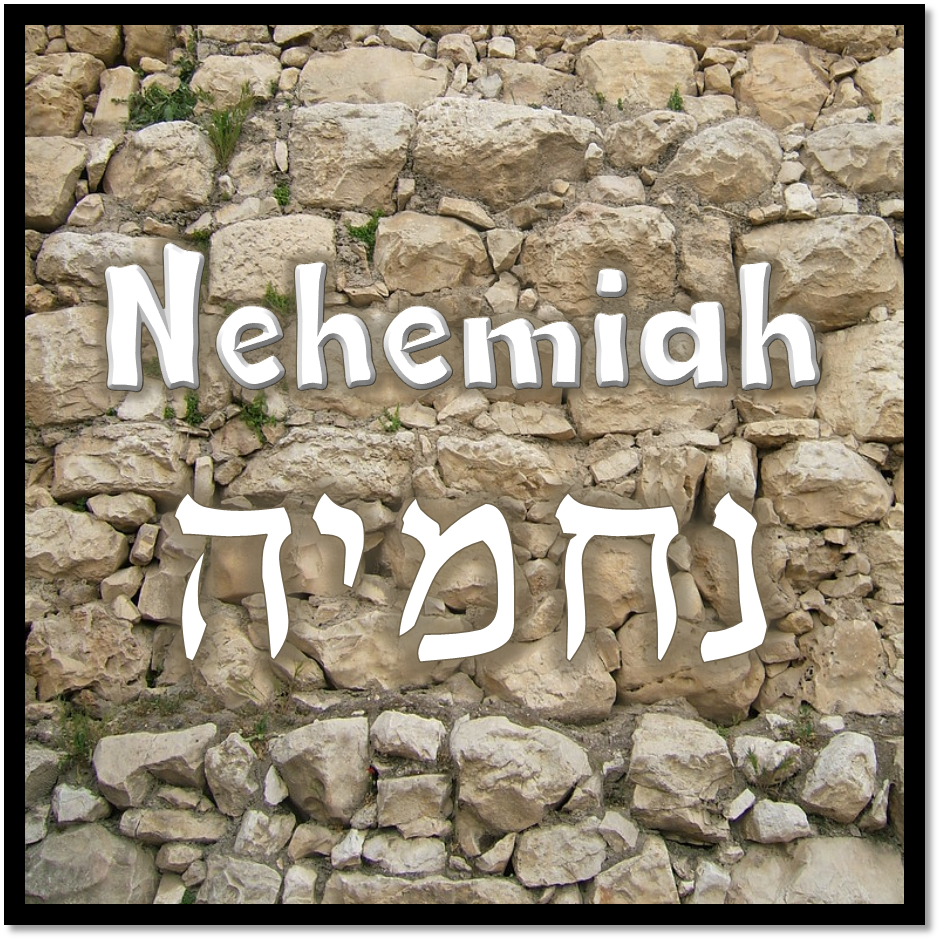
This is an image of a portion of the wall rebuilt by Nehemiah and company.
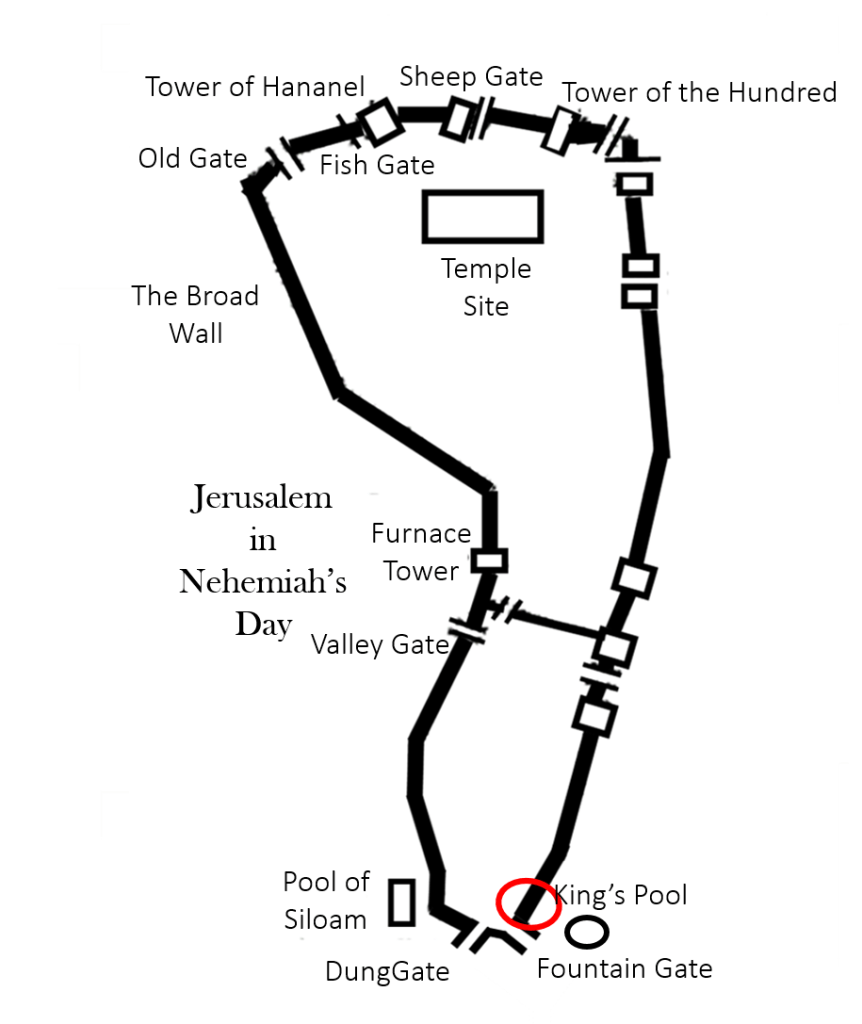
Today in the Bible we are meeting another man named Nehemiah. This Nehemiah is the son of Azbuk. The more famous Nehemiah is the son of Hachaliah (Neh. 1:1). Nehemiah, the son of Azbuk, worked to restore the wall in the area of the tomb of David and the King’s Pool. According to the Bible, we are currently in the midst of the 52 days that the children of Israel worked together to restore the walls and gates of the Holy City.
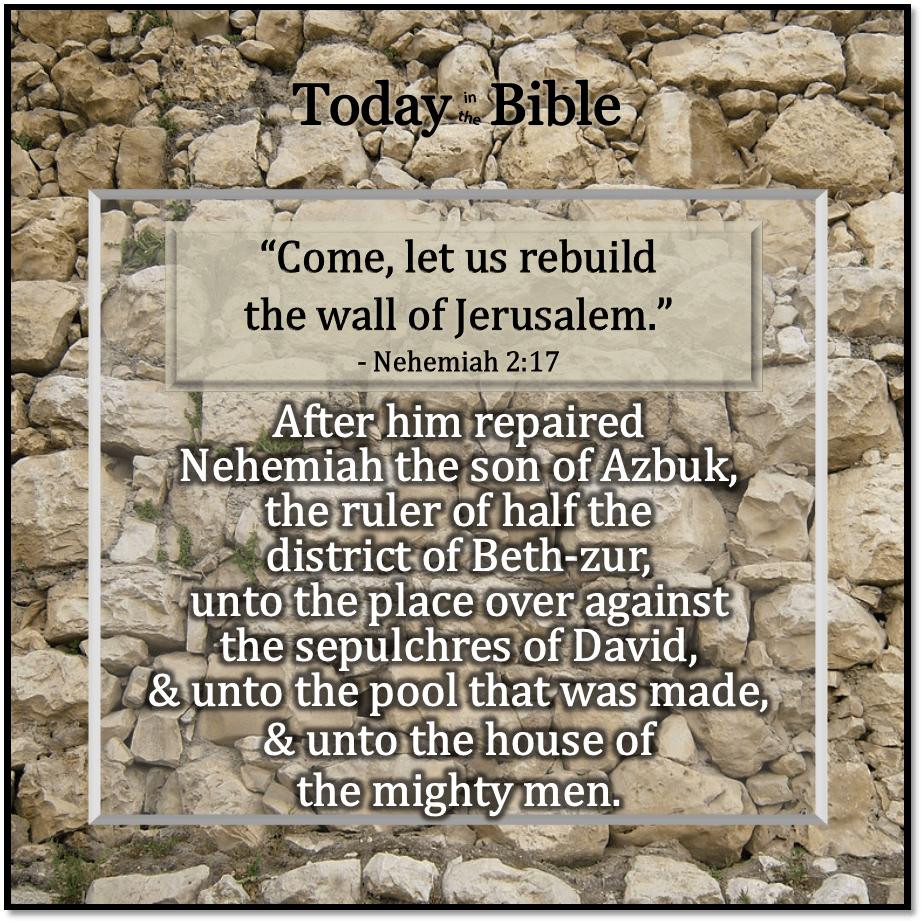
After him repaired Nehemiah the son of Azbuk, the ruler of half the district of Beth-zur, unto the place over against the sepulchres of David, and unto the pool that was made, and unto the house of the mighty men. – Nehemiah 3:16 (JPS)
נְחֶמְיָה
Nechemyah = Nehemiah
We’ve already studied the name of Nehemiah in depth in an earlier article. Today we’ll just make a quick review of the meaning of his name.
| Verb Root | Transliteration | Meaning |
| נחם | nacham | to be sorry, repent, regret, be comforted, to comfort |
| Prefix/Suffix | Transliteration | Comments |
| י | y, i | sometimes, just a “yod” (י), the first letter of God’s Holy Name, may serve as an indicator of its presence |
| ה | h | “yah” (יה) this combination of the 1st and 2nd letters of “The Name” is often translated as “iah” & is a very common name ending |
| ו | v, w, u, o | “yahu” (יהו) – the first three letters – is not quite as common but still found – as in “Elijah” – “Eliyahu” |
| ה | h | adding all four letters of “The Name” is not done |
These four letters represent God’s Holy Name. Many proper nouns use a combination of two or three of these letters as a prefix or a suffix to indicate an attachment to the Name of the LORD.
“Nehemiah” means “Comfort of the LORD.”
Nehemiah was the son of Azbuk.
עַזְבּוּק
Azbuk
The name Azbuk is only found once in the Bible. Not many Bible dictionaries have defined this name, and those that do, see multiple possibilities. Let’s explore the name of Azbuk.
It’s possible that the verb-root עזב (azab I), meaning “to leave, forsake, to be desolate” is the at the beginning of the name Azbuk. This root has two meanings: עזב (azab II) means “to restore or repair.” Azab is only defined as “to restore or repair” in one verse in the entire Bible — Nehemiah 3:8. That’s right, when we studied Uzziel and Hananiah just a few days ago, we could have said that they “azab”-ed Jerusalem as far as the Broad Wall.
Another possibility for the beginning of Azbuk’s name is the verb-root עזז (azaz), meaning “to be strong.”
The last part of Azbuk’s name is from the verb root בוק (buk), meaning “to be empty.”
Azbuk could be a combination of any of the following verb-roots:
| Root Word | Transliteration | Meaning |
| עזב | azab (I) | to leave, forsake, or loose |
| עזב | azab (II) | to restore, repair |
| עזז | azaz | to be strong |
| בוק | buk | to be empty |
“Azbuk“ could mean “Totally Desolate,” or “Strength Emptied.”
בֵּית-צוּר
Beit-Tzur = Beth-Zur
We ran into the word “beit” or “beth” just a couple of days ago. Beit means “house of.”
The word “zur” (צוּר) is a noun that means “rock.”
| Verb Root | Transliteration | Meaning |
| בֵּית | beit | house, tent, dwelling – of |
| צוּר | tzur | rock |
“Beth-Zur“ means “House of Rock.”
To read all of our posts on Nehemiah, click on the image above.

© 2026 Today in the Bible

 Today in the Bible
You must be logged in to post a comment.