
Av 24, 5784; from sunset August 27, 2024, to sunset August 28, 2024
(The twenty-fourth day of the fifth month)
This is an image of a portion of the wall rebuilt by Nehemiah and company.
Today in the Bible, the Levites lend their hand to the restoration of the wall of the Holy City. The Bible says it took just 52 days to complete the job. We’re in the midst of those days. Let’s see what we can learn about Rehum, the son of Bani, and Hashabiah who worked next to him.
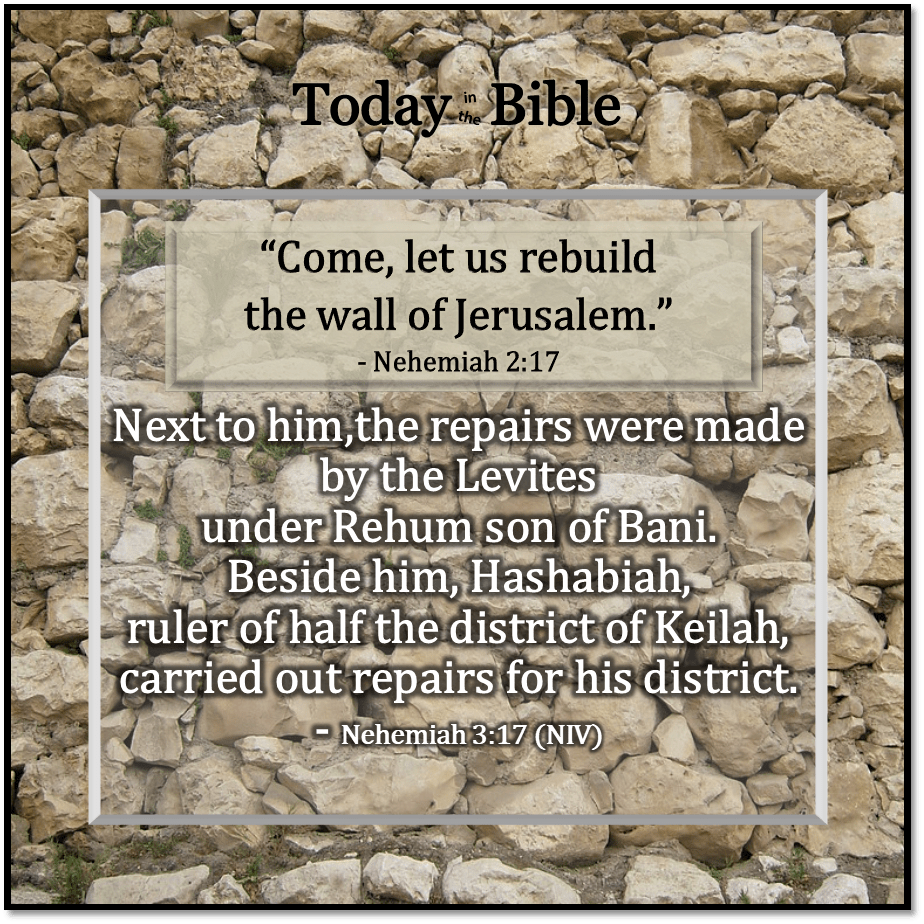
Next to him, the repairs were made by the Levites under Rehum son of Bani. Beside him, Hashabiah, ruler of half the district of Keilah, carried out repairs for his district. – Nehemiah 3:17 (NIV)
רְחוּם
Rechum = Rehum
Rehum comes from the verb root “racham” (רחם). Racham means “to love deeply or have mercy.” One of the words stemming from this root is “rechem,” meaning “womb.”
The name “Rehum” is found eight times in the Bible. A man named Rehum is recorded as returning from the Babylonian exile with Zerubabel (Ezra 2:2). We don’t know if it’s the Rehum that’s working on the wall in today’s verse or not; but it’s certainly possible. Nehemiah also lists a man named Rehum who was among the priests and Levites who returned with Zerubabel, but again, we don’t know if it’s the same person. Ezra chapter 4 also tells of a man named Rehum who is identified as a commander. He wrote a letter to King Artaxerxes speaking against the people of Jerusalem – definitely not our Rehum!
| Verb Root | Transliteration | Meaning |
| רחם | racham | to love deeply, have mercy, or be compassionate |
“Rehum” means “Beloved” or “Merciful.”
Rehum was the son of Bani.
בָּנִי
Bani
Bani comes from the verb-root “banah” (בנה), meaning “to build.” There doesn’t seem to be a better name for someone who is working to rebuild the wall!
The name Bani is found 15 times in the Bible. 2 Samuel 23 mentions a “Bani the Gadite” as one of David’s “thirty.” In addition, this name is found twice in 1 Chronicles, four times in Ezra, and eight times in Nehemiah. All eight of the mentions in Nehemiah are in verses associated with the Levites. We don’t know how many of these eight instances are referring to the father of Rehum, but it’s likely that some of them do since the Levites are mentioned as the ones making the repairs to this section of the wall.
| Root Word | Transliteration | Meaning |
| בנה | banah | to build |
“Bani“ means “Built.”
חֲשַׁבְיָה
Chashavyah = Hashabiah
This word is very similar to the name Hashabneiah that we studied earlier and it comes from the same root. That root is “chashab” (חשב) meaning “to think, plan, make a judgment, imagine, or count.” The ending of our word is our familiar “iah” – a shortened form of God’s Holy Name.
Hashabiah is also found 15 times in the Bible. It has seven appearances in 1 Chronicles, two in Ezra, and six in Nehemiah. Hashabiah is also mentioned many times in Nehemiah in the same verses where Bani and the Levites are mentioned. It’s likely that some of those references pertain to our Hashabiah, but we can’t say for sure.
| Verb Root | Transliteration | Meaning |
| חשב | chashab | to think, plan, make a judgment, imagine, or count |
| Prefix/Suffix | Transliteration | Comments |
| י | y, i | sometimes, just a “yod” (י), the first letter of God’s Holy Name, may serve as an indicator of its presence |
| ה | h | “yah” (יה) this combination of the 1st and 2nd letters of “The Name” is often translated as “iah” & is a very common name ending |
| ו | v, w, u, o | “yahu” (יהו) – the first three letters – is not quite as common but still found – as in “Elijah” – “Eliyahu” |
| ה | h | adding all four letters of “The Name” is not done |
These four letters represent God’s Holy Name. Many proper nouns use a combination of two or three of these letters as a prefix or a suffix to indicate an attachment to the Name of the LORD.
“Hashabiah “ means something like “Regarded by the LORD.”
קְעִילָה
Ke’ilah = Keilah
Keilah means “fortress.” It’s the name of a city in the lowlands (“Shephelah”) of Israel. Keilah is an ancient city and was already established in the days of Joshua. It’s listed among the cities allotted to Judah (Joshua 15:44). The bulk of its occurrences are found in 2 Samuel 23 — in the days of Saul and David, Keilah was under attack by the Philistines and David came to her rescue. Keilah was the last place that Jonathan and David met before Jonathan was killed.
To read all of our posts on Nehemiah, click on the image above.

© 2026 Today in the Bible

 Today in the Bible
You must be logged in to post a comment.