
Av 28, 5784; from sunset August 31, 2024, to sunset September 1, 2024
(The twenty-eighth day of the fifth month)
This is an image of a portion of the wall rebuilt by Nehemiah and company.
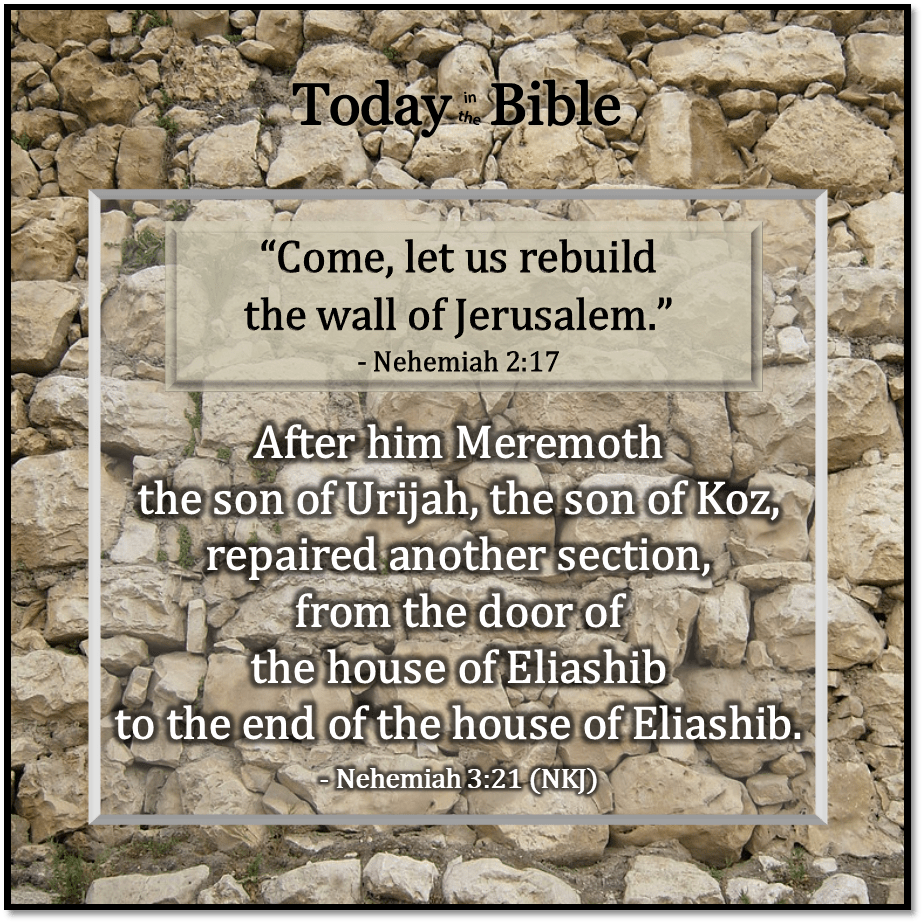
Today in the Bible, we’re continuing our study of the men and women who lent the work of their hands to the restoration of the walls and gates of the Holy City, Jerusalem. We’re back in the days of Ezra and Nehemiah, two of the leaders of the people who returned from the Babylonian exile to the Land of Israel. It’s been three weeks since we started which means we aren’t even half-way through the 52 days that the Bible says it took for them to complete the job on Elul 25.
After him Meremoth the son of Urijah, the son of Koz, repaired another section, from the door of the house of Eliashib to the end of the house of Eliashib. – Nehemiah 3:21 (NKJ)
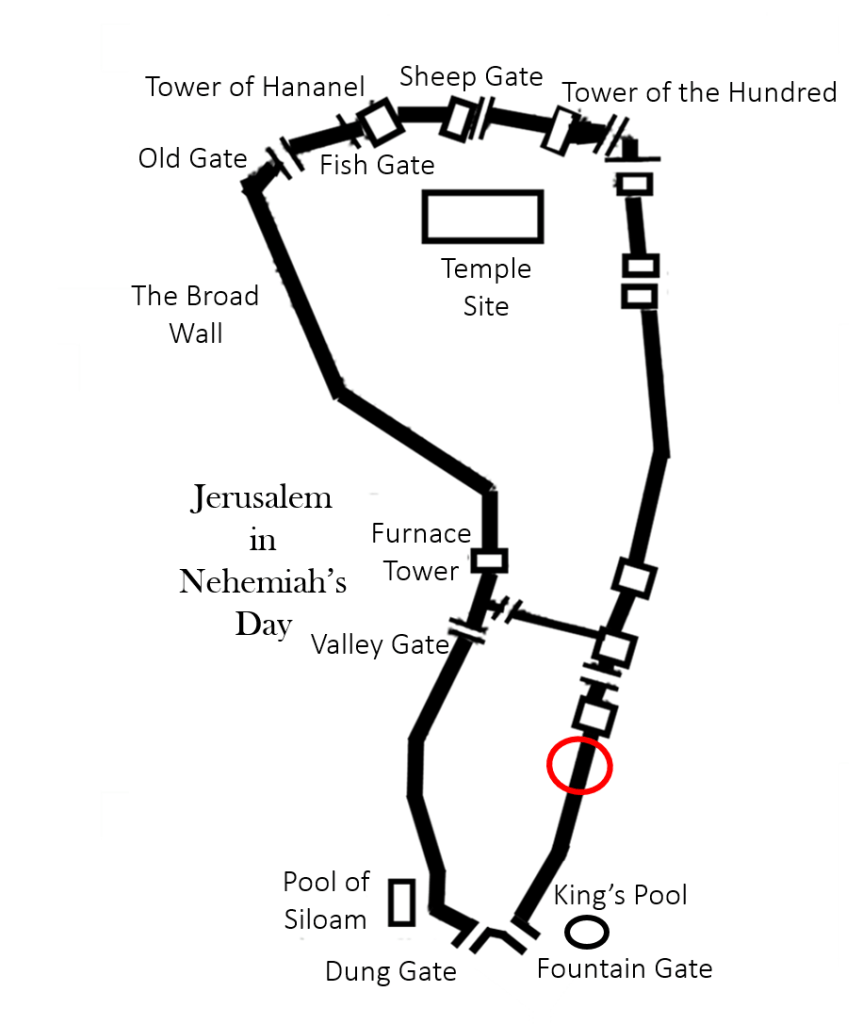
Do these names sound familiar? If you’ve been following our series, exactly three weeks ago (Av 7) we met Meremoth repairing another section of the wall…
And next to them Meremoth the son of Urijah, the son of Koz, made repairs. – Nehemiah 3:4a (NKJ)
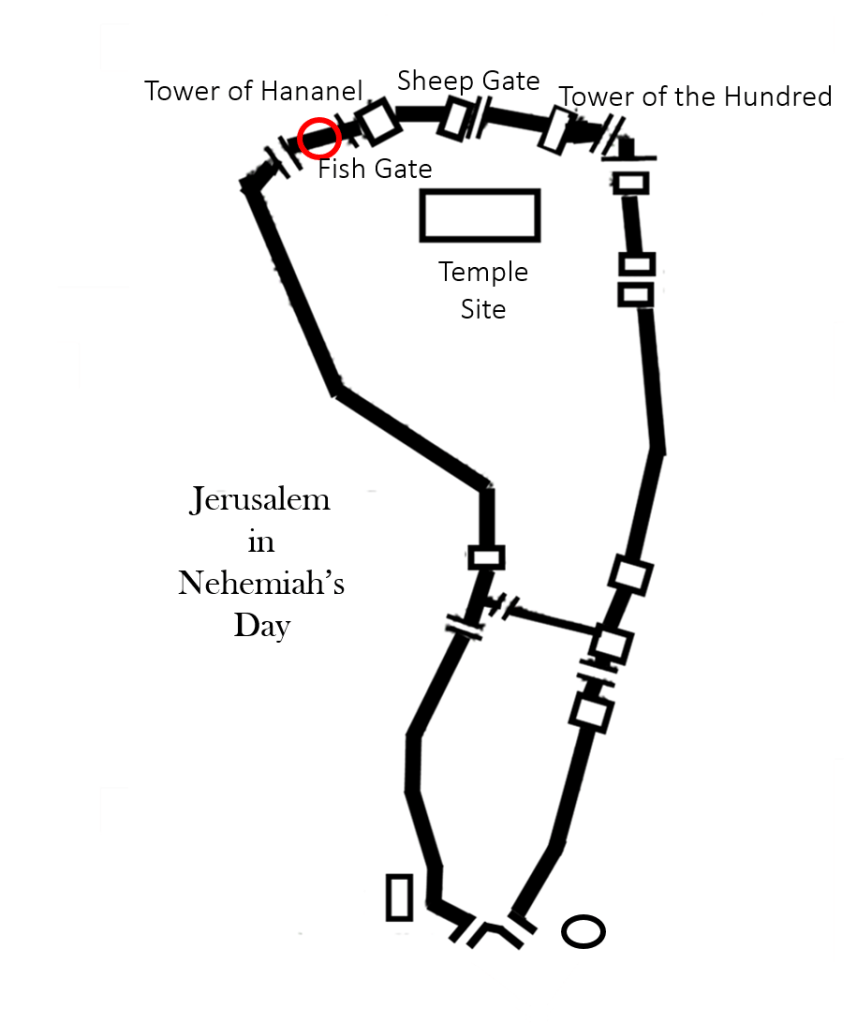
Even before that, we had met Meremoth when we were following Ezra’s journey from Babylon to Jerusalem. He was mentioned in the book of Ezra as the one to whom the silver and gold vessels were delivered. Let’s review what we learned about Meremoth a few weeks ago.
There are some who have the opinion that this is a different Meremoth, son of Urijah. Their reasoning? In Ezra 8:33, when Ezra handed the gold and silver vessels to Meremoth, son of Urijah, the text adds “the priest” to his name. The “son of Koz” is not mentioned in that verse. In today’s verse, the words “the priest” are not present but “the son of Koz” is. We tend to believe that these texts are referring to the same person. Our reasoning? Both Ezra 2:61 and Nehemiah 7:63 refer to “the sons of Koz” who are listed among the priestly families.
Whether the Meremoth who received the gold and silver vessels and the Meremoth who worked to restore the wall are one and the same man or the texts are referring to two different men, the meaning of the name Meremoth remains the same. Let’s take a look it.
מְרֵמוֹת
Meremot = Meremoth
Depending on how you learned to transliterate Hebrew, the ת (“tav”), which ends Meremoth’s name, can be transliterated with a “t” or a “th” – either way is acceptable. Most Bible dictionaries define the name Meremoth as “Heights.” They see it as stemming from the verb-root “rum” (רוּם – “room”) meaning “to be high, lofty, or rise up.” The word “ramah” (רָמָה) comes from this root, it means “height” or “a high place.” Ramah is a feminine noun which is found in its singular form. As in French, Spanish, and other languages, Hebrew also has masculine and feminine words. To change this word to plural, we remove the “ah” ending and replace it with “ot” (or “oth”). This would leave us with “ramot” / “ramoth” meaning “heights” or “high places.” This does not mean that Meremoth was a woman, it only means that the word “ramah” is a feminine noun.
But Meremoth begins with the letter “m.” The letter which creates the same sound in Hebrew is called “mem.” Adding מ (“mem”) to the beginning of a word can mean a few things. It can indicate an inseparable preposition, meaning “from.” An inseparable preposition means that the letter is actually attached to the word – it’s “inseparable” – it becomes a part of it. In this case, the name Meremoth would have a definition of “From the Heights.” This prefix may also denote an agent or instrument of a verb, or for a noun, it may indicate a special place. The charts below pull apart the name and show how each letter contributes to the meaning.
| Prefix | Transliteration | Function |
| מ | m | inseparable preposition meaning “from” – or – |
| מ | m | denotes an agent or instrument of the action of a verb – or – |
| מ | m | denotes a special place |
| Word | Transliteration | Meaning |
| רָמָה | ramah | height, a high place – feminine singular in form |
| Singular – “ramah” | Plural – “ramot” / “ramoth” | Explanation |
| רמה | רמות | to make a feminine singular word plural, remove the “ah” (ה) from the end of the word and add “ot” (or “oth” – וֹת). |
| “ramot” / “ramoth” | Add the prefix “mem” | Gives us “Meremoth” |
| רמות | מרמות | מְרֵמוֹת |
מְרֵמוֹת
From this point of view, “Meremoth” could mean something like: “From High Places, Heights or Special High Places.”
Another school of thought sees Meremoth as coming from a totally different origin. In this scenario, the first two letters (מר – mr) derive from the verb-root “maror” (מרר) which means “to be bitter or strong.” The last three letters (מות) are understood to originate in the verb-root “mut” / “mot” (מות) which means “to die, be killed, or have someone executed.” The letter ו (vav), found in the center of this root, is very unique. In ancient times, scholars believe that ו made a “w” sound, making the letter name “waw.” Similar to the ת (“tav”) – that we learned could be transliterated as either “t” or “th” – transliterators today use either a “w” or a “v” for this letter. But we said that ו is a “very” unique letter. That means there are even more ways of pronouncing it.
There are times when ו can be used as a vowel. The Hebrew alphabet does not contain vowel letters; therefore, the original Hebrew text was unable to convey which vowel sounds to use with the consonants. The correct pronunciation was passed on by oral tradition. As in English, changing a vowel sound can impact the meaning of the word (i.e. “sit” vs. “sat”). It wasn’t until around one thousand years ago that a system of dots and dashes were devised to indicate vowel sounds. These are called the “nikkudim.” When a dot is placed over וֹ it makes a long “o” sound. When a dot is placed under וּ, it makes a long “u” (“oo”) sound. That makes it easy to remember: over = “o” and under = “u.”
| Verb Root | Transliteration | Meaning |
| מרר | maror | to be bitter or strong |
| מות | mut / mot | to die, be killed, or have someone executed |
מְרֵמוֹת
From this point of view, “Meremoth” could mean something like: “Bitter Death“.
The text tells us that Meremoth was the son of Urijah. Let’s explore the meaning of the name Urijah.
אוּרִיָּה
Uriyah = Urijah
Urijah is pronounced like “Oo-ree-yah.” The Hebrew alphabet does not contain a letter which makes a “j” sound. So, all of those words which get transliterated with “j” should actually be “y.” Jerusalem = Yerushalayim. Jesus = Yeshua. Judah = Yehudah. The list goes on and on. Our name Urijah is a combination of two words. The first word, אור (“or”), means “to be or become light.” As we learned above, the ו (“vav”) in Urijah’s name can make more than one sound. In the verb-root, ו makes an “o” sound; in Urijah, ו makes a “u” (“oo”) sound. The second portion of his name, יה (“yah”), is a truncated form of God’s Holy Name. See our article on The Name of the LORD for more information.
| Verb Root | Transliteration | Meaning |
| אור | or | to be or become light |
| Prefix/Suffix | Transliteration | Comments |
| י | y, i | sometimes, just a “yod” (י), the first letter of God’s Holy Name, may serve as an indicator of its presence |
| ה | h | “yah” (יה) this combination of the 1st and 2nd letters of “The Name” is often translated as “iah” & is a very common name ending |
| ו | v, w, u, o | “yahu” (יהו) – the first three letters – is not quite as common but still found – as in “Elijah” – “Eliyahu” |
| ה | h | adding all four letters of “The Name” is not done |
These four letters represent God’s Holy Name. Many proper nouns use a combination of two or three of these letters as a prefix or a suffix to indicate an attachment to the Name of the LORD.
“Urijah” means “Light” (ur) of the LORD (yah).”
Urijah was the son of Koz. Let’s get out the trowel and dig into the name Koz. (Isn’t learning Hebrew something akin to archaeology? You dig and dig and sometimes find amazing discoveries!)
הַקּוֹץ
Hakkotz = Koz
It depends on which English translation of the Bible you’re reading whether this verse reads, “the son of Koz” or “the son of Hakkoz.” In Hebrew, it’s Hakkotz. The letter ץ makes more of a “tz” or “ts” sound but it often transliterated as simply “z.” Also, the letter ק may be transliterated as “q” by some translators. We tend to steer away from this thought because, in English, the letter “q” is often paired with “u” – making us want to say a “kwa” sound. This is not the case in Hebrew, therefore most translators simply use the letter “k.”
The letter ה (pronounced “hey”) when prefixed to a word means “the” or “of.”
The root word kutz (קוץ) means “to be grieved or loathed.” One of the nouns that comes from this root is a word for thorn, “kotz” (קוֹץ). Kotz is the word used for the punishment that Adam received for obeying his wife rather than obeying God.
Then to Adam He said, “Because you have heeded the voice of your wife, and have eaten from the tree of which I commanded you, saying, `You shall not eat of it’: “Cursed is the ground for your sake; in toil you shall eat of it all the days of your life. Both thorns (kotz) and thistles it shall bring forth for you, and you shall eat the herb of the field. In the sweat of your face you shall eat bread till you return to the ground, for out of it you were taken; for dust you are, and to dust you shall return.” – Genesis 3:17-19 (NKJ – emphasis mine)
There are some scholars who believe Hakkoz refers to a person from the generation that was sent into exile – the ones who were loathed – the ones who were grieved. As we stated above, Ezra 2:61 and Nehemiah 7:63 refer to “the sons of Koz” who are listed among the priestly families. To us, this indicates that Koz was the name of an individual. Perhaps he was among the first generation of children born into exile. Oftentimes children were given names that reflected the feelings that their parents were experiencing at the time of their birth. Think of Leah and Rachel and how the children of Israel were named. It really seemed to be more about their feelings than how they envisioned their child’s character.
Once again, we’ll employ the charts below to pull apart the pieces of Hakkotz.
| Prefix | Transliteration | Function |
| ה | h | indicates the “definite article” (“the”); an example of the definite article would be if I asked you to bring me a spoon, you may assume that any old spoon would do; but if I asked you to bring me “the” spoon, you would assume that I wanted a specific spoon |
| if used in combination with another prefix it is found in second place; it may even be omitted and assumed to be present; in which case the vowel associated with the other prefix is changed to indicate the presence of the ה | ||
| ה | h | may also mean “of” |
| הֲ | ha | when associated with the “chataf patach” vowel point, this combination indicates an interrogative form, in other words, a question |
| Verb Root | Transliteration | Meaning |
| קוץ | kutz / qutz | to be grieved or loathed |
| Associated Word | Transliteration | Meaning |
| קוֹץ | kotz / qotz | thorn, thornbush |
Hakkoz means something like, “The Grieved One,” “The Loathed One,” or “The Thorn.” Whether it is the name of a person named Hakkoz or, perhaps, a description of a person from the generation that was sent into exile – we may never know for sure. The exile lasted for 70 years; this person could certainly have been one of those who were forced into exile all those years ago by Nebuchadnezzar.
אֶלְיָשִׁיב
Elyashiv = Eliashib
We’ve already studied out the name of Eliashib, the high priest. His was the very first name that we dug into when we studied verse one of this chapter – and – we just ran into him again yesterday. Eliashib means “God Returns” or “God Restores.” Please refer to our article on Eliashib for the full story.
To read all of our posts on Nehemiah, click on the image above.

© 2026 Today in the Bible

 Today in the Bible
You must be logged in to post a comment.