Elul 1, 5784; from sunset September 3, 2024, to sunset September 4, 2024
(The first day of the sixth month)

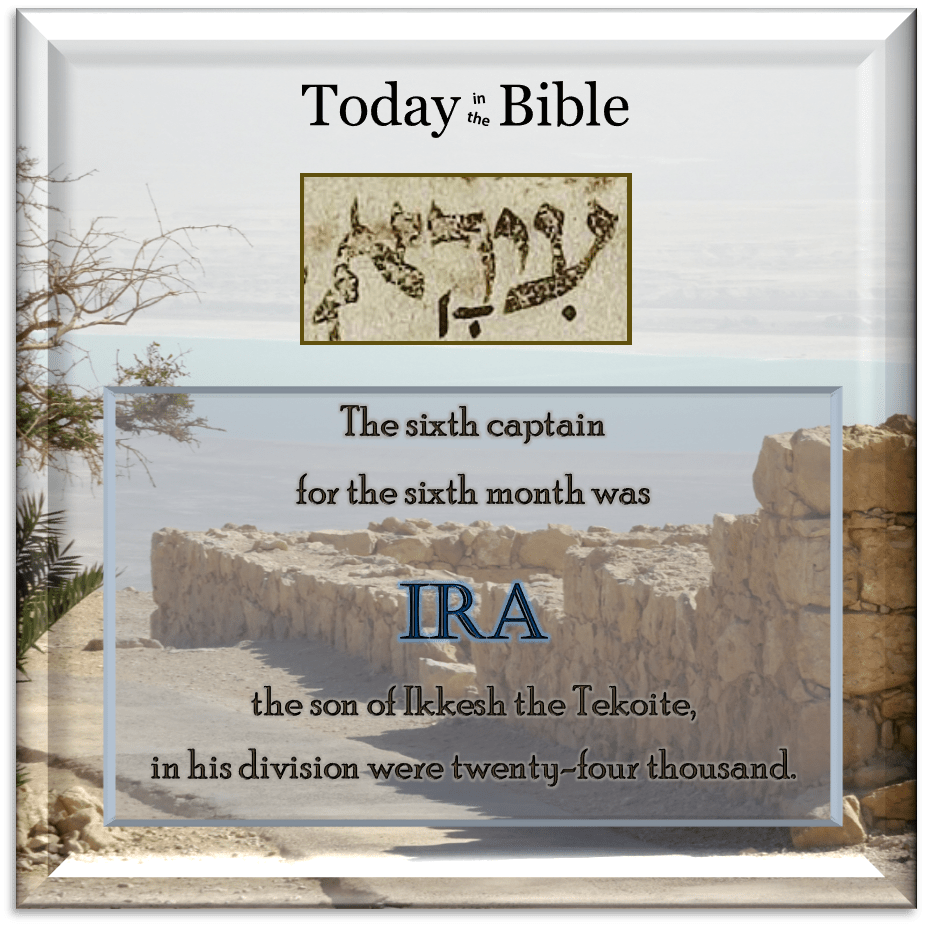
Our featured image for today is from the top of the fortress Masada. We’ve chosen to use this location when remembering the men whom King David selected to protect the kingdom. As the last hold-out after Rome destroyed Jerusalem, Masada has become a symbol of Jewish resistance. In modern times, IDF recruits would complete a pre-dawn climb to its summit and, there, took an oath of allegiance to the nation of Israel. Though this practice has largely ended, Masada’s symbolism lives on.
This is the name Ira as it appears in 1 Chronicles 27:9 in the Aleppo Codex.
It’s a new month and that means a new military commander; King David set up a military guard that rotated every month. Each month had a leader and 24,000 men. Today in the Bible, Shamhuth passes leadership to Ira.
And the children of Israel, according to their number, the heads of fathers’ houses, the captains of thousands and hundreds and their officers, served the king in every matter of the military divisions. These divisions came in and went out month by month throughout all the months of the year, each division having twenty-four thousand. – 1 Chronicles 27:1
The sixth captain for the sixth month was Ira the son of Ikkesh the Tekoite; in his division were twenty-four thousand. – 1 Chronicles 27:9 (NKJ)
Ira is listed among David’s thirty mighty men in 2 Samuel 23 and 1 Chronicles 11.
עִירָא
Ira
The name Ira (pronounced like “ee-RAH) likely comes from the verb root ‘ur (עור) which means “to rouse oneself, to awake, to incite.” The NOBSE Study Bible and Jones’ Dictionary say that Ira means “Watchful.”
עִקֵּשׁ
Ikkesh
Ira’s father’s name, Ikkesh, comes from the root-word “akash” (עקש) which means “to be crooked, twisted or perverse.” (How would you like to have that name?)
תְקוֹעַ
Tekoa
Ira was from the city of Tekoa – a Tekoite – which comes from the verb “taka” (תקע) meaning “to blow, clap or strike; to produce a sudden and brief burst of force.” The noun “teka” means a “blast or sudden sound (of a horn);” the noun “tekoa” means “trumpet.” We’ve run into others from Tekoa in our study of the restoration of the walls and gates of Jerusalem during the days of Nehemiah.
It’s kind of neat that Ira the Tekoite is captain for the sixth month (Elul). During the month of Elul, the shofar is blown daily. The “blast of the trumpet” (Tekoite) is meant to “rouse or awaken” (Ira) ourselves so that we repent. This is done to prepare us for the fall festivals of:
- Feast of Trumpets (Rosh Hashanah)
- Day of Atonement (Yom Kippur)
According to Jewish tradition, God keeps our names written in a book – the Book of the Righteous, the Book of the Wicked, or the Book of the In-between. In the Bible, it’s simply called the Book of Life (or the Lamb’s Book of Life in Revelation). Tradition says that every year on Rosh Hashanah the books are open and we are able to do good deeds in hopes of improving our standing before the books are closed ten days later on Yom Kippur. This may sound a little weird to many Christians, but there are several references or allusions to the Book of Life throughout the Bible.
As Christians we know that, yes, our deeds do matter (read the book of James for that) and Revelation confirms that what we do is important.
And I saw the dead, small and great, standing before God, and books were opened. And another book was opened, which is the Book of Life. And the dead were judged according to their works, by the things which were written in the books.
The sea gave up the dead who were in it, and Death and Hades delivered up the dead who were in them. And they were judged, each one according to his works.
Then Death and Hades were cast into the lake of fire. This is the second death.
And anyone not found written in the Book of Life was cast into the lake of fire. – Revelation 20:12-15 (NKJ)
…our works are important but we know it’s our faith in Jesus that seals our fate.
It is also said that the Adversary (Satan) makes his case against us before our Creator during these ten days. The trumpet is blown during Elul to remind us to repent of our sins, to repair our relationships, and to repay our debts before Tishrei 1. By blowing the shofar for an entire month before Rosh Hashanah, inevitably we will feel remorse over our past misdeeds and want to begin anew. If so, Satan’s case against us falls apart. Rabbi Jonathan Sacks’ teaching, Confusing Satan (which can be found on Youtube), explains that the book of Job takes place during the days of awe…the ten days between Rosh Hashanah and Yom Kippur. It’s a time of testing. For Job, even though all of his blessings were taken away – he would still not curse God.
From another stance, Ira the Tekoite could also be representative of the trumpet blast that will accompany the return of Jesus which will arouse, awaken those who have died in Christ. Many believe this will occur on the Feast of Trumpets which is on the first day of the seventh month.
For the Lord Himself will descend from heaven with a shout, with the voice of the archangel and with the trumpet of God, and the dead in Christ will rise first. – 1 Thessalonians 4:16
Let’s pray that we all hear the trumpet leading up to the return of our Messiah, Jesus.
To read all of our posts on King David’s military leaders, please click on the image above.

© 2026 Today in the Bible

 Today in the Bible
You must be logged in to post a comment.