
Elul 6, 5784; from sunset September 8, 2024, to sunset September 9, 2024
(The sixth day of the sixth month)
This is an image of a portion of the wall rebuilt by Nehemiah and company.
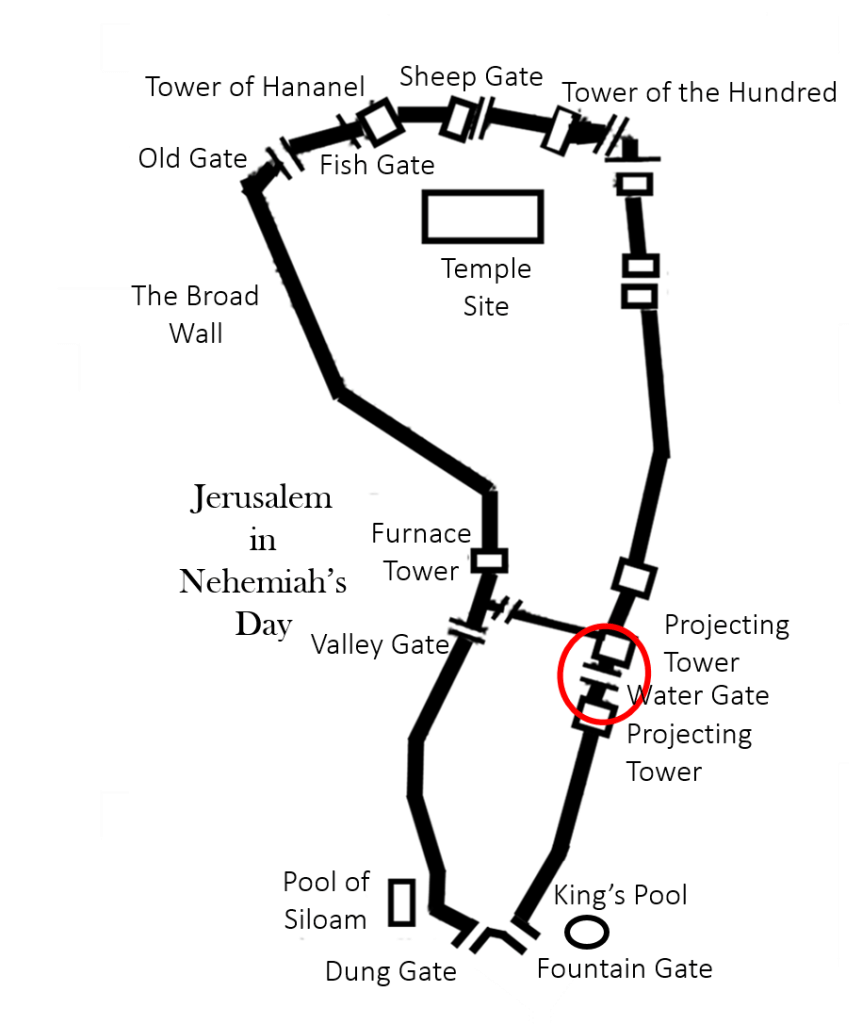
Today in the Bible, we meet the Nethinim who worked on the restoration of the Water Gate. Let’s explore the connection between the Nethinim and the work that they performed.
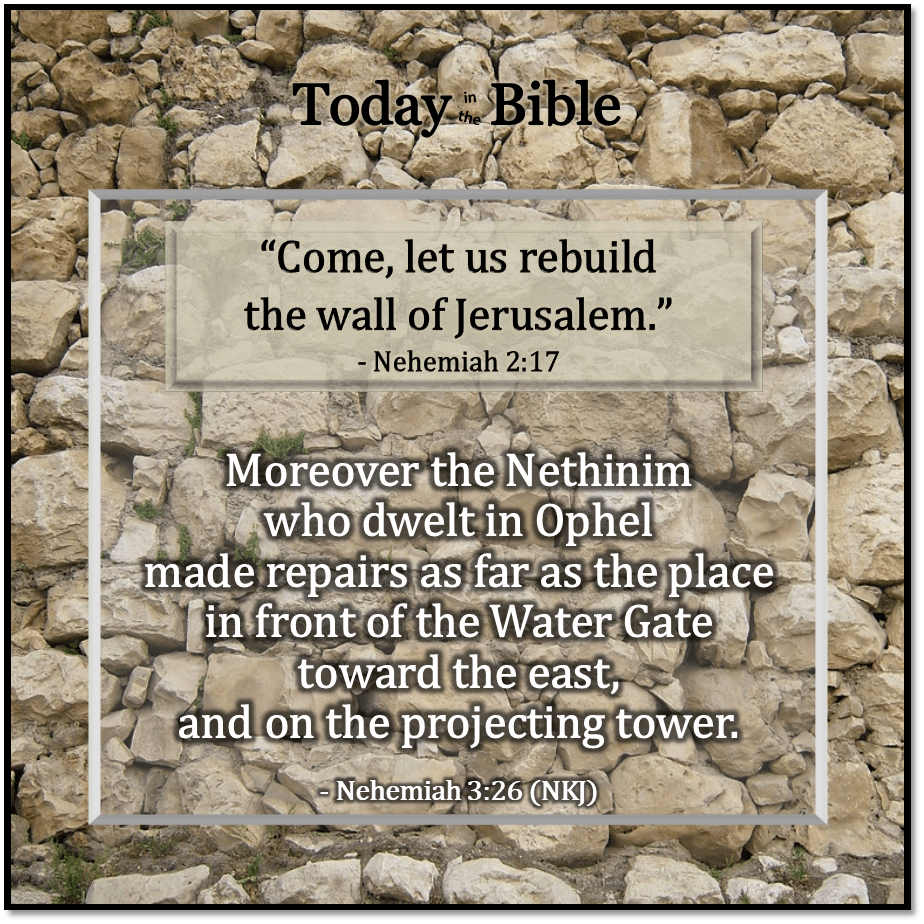
Moreover the Nethinim who dwelt in Ophel made repairs as far as the place in front of the Water Gate toward the east, and on the projecting tower. – Nehemiah 3:26 (NKJ)
וְהַנְּתִינִים
Vehanetinim = And the Nethinim
From the verb “natan” (נתן) meaning “to give.” Nethinim is plural and means Given Ones.
The Nethinim are believed to have originated in the inhabitants of Gibeon. Those with whom Israel made a covenant, way back in the days of Joshua. These are the people who tricked the Israelites into believing they were wanderers and not residents of the Land – for God had warned Israel not to make a covenant with any peoples of the Land. When Israel found out they had been tricked, they spared the lives of the Gibeonites since they had sworn before God to let them live. They were put to work as woodcutters and water carriers for the House of the LORD. (Joshua 9)
The Nethinim show back up again with a single mention in 1 Chronicles 9:2, but the remainder of their appearances in the Bible are in the books of Ezra and Nehemiah where they are mentioned no less than 17 times – often in tandem with the priests, Levites, gatekeepers, singers, or the sons of Solomon’s servants.
Another train of thought regarding the Nethinim is that they became synonymous with men who wanted to serve in the Temple but were unable to provide a lineage proving they were descendants of Aaron or Levi.
All the Nethinim and the children of Solomon’s servants were three hundred and ninety-two. And these were the ones who came up from Tel Melah, Tel Harsha, Cherub, Addan, and Immer; but they could not identify their father’s house or their genealogy, whether they were of Israel:
the sons of Delaiah, the sons of Tobiah, and the sons of Nekoda, six hundred and fifty-two; and of the sons of the priests: the sons of Habaiah, the sons of Koz, and the sons of Barzillai, who took a wife of the daughters of Barzillai the Gileadite, and was called by their name.
These sought their listing among those who were registered by genealogy, but they were not found; therefore they were excluded from the priesthood as defiled. And the governor said to them that they should not eat of the most holy things till a priest could consult with the Urim and Thummim. – Ezra 2:58-63 (NKJ)
The Nethinim (Given Ones) were willing to give themselves over to the service of the LORD – even if they couldn’t serve in a more prestigious position of a priest or Levite– they expressed humility by assisting them, even in the most menial of tasks. However, their efforts did not go unnoticed and their standing among the servants of the LORD was established.
The Nethinim were banished into exile along with the rest of Judah and they are listed among those who returned with Ezra. They met up with him in Ahava and fasted and prayed for a safe journey back to Jerusalem (Ezra 8). Here they are described as the ones “whom David and the leaders had appointed for the service of the Levites.” Just as the priests and Levites were exempt from paying taxes, so too were the Nethinim (Ezra 7:24).
The Nethinim of Nehemiah’s day seem to still be fulfilling the duties assigned to them back in the days of Joshua…that being, “woodcutters and water carriers.” The focus of their restoration work revolved around the Water Gate.
עֹפֶל
Ophel
This name comes from the verb “aphal” (עפל) meaning “to swell, to be lifted up.” Other words that stem from this root include the “tumors” inflicted upon the Philistines while they were in possession of the Ark of the Covenant – parts of the flesh that were “swollen” or “lifted up.”
The Ophel in this verse references a certain part of Jerusalem that is elevated from its surroundings, a spur on the eastern hill, running due south, just to the west of the Temple area, joining the Kidron Valley on the east. The Ophel was the Jebusite stronghold taken by David. King Jotham fortified the Ophel and Manassah built an outer wall surrounding it. Our verse tells us that this was the area where the Nethinim lived.
שַׁעַר הַמַּיִם
Sha’ar Hamayim = The Water Gate
When we hear Water Gate we may think of President Nixon, but it was a deal long before him. The Water Gate is only mentioned in the book of Nehemiah. It is the place where everyone gathered together on the first day of the seventh month, aka the Feast of Trumpets (Nehemiah 8), and Ezra read to them from the words of the Law on a platform built for that purpose. Ezra had a heart to teach the people the Word of God and in chapter 8, we read the touching story of how he did so on the appointed time and how emotional the people became, grieving over their sins of neglect.
Now all the people gathered together as one man in the open square that was in front of the Water Gate; and they told Ezra the scribe to bring the Book of the Law of Moses, which the LORD had commanded Israel. – Nehemiah 8:1 (NKJ)
That same year, during the feast of Sukkot (Feast of Tabernacles), the people built their sukkot in the square by the Water Gate and dwelt there, according to the Torah. Over the centuries, during the festival of Sukkot, the priests drew water from the brook and brought it through this gate for the water libation ceremony. It was during this celebration when our Master cried out, “All who are thirsty come to Me and drink” (John 7:37).
Large boulders revealed by Kathleen Kenyon in the 1960s were associated with the Jebusite Water Gate (left) and are partially covered by Hezekiah’s mid-slope wall (right). The Gihon Spring, with its channel, pool, passageway, and tower, lies at the bottom of the stairway (upper left).
וְהַמִּגְדָּל הַיּוֹצֵא
Vehamigdal Hayotze = And the Tower of Projecting
The tower (migdal) of projecting (yatza). The verb “yatza” (יצא) means “to go out, come out, or go forth.” A fun way of remembering what this verb means is to think of the game Yahtzee — and how the dice “go out” from the cup. (We checked; this is not how Yahtzee got its name.)
Just a reminder that it’s tradition to read Psalm 27 daily through the Feast of Tabernacles. You can find it by clicking on the link.
To read all of our posts on Nehemiah, click on the image above.

© 2026 Today in the Bible

 Today in the Bible
You must be logged in to post a comment.