Elul 17, 5784; from sunset September 19, 2024, to sunset September 20, 2024
(The seventeenth day of the sixth month)
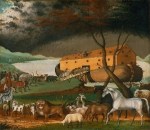
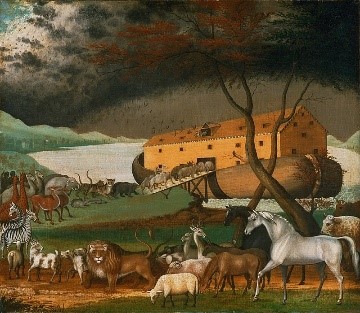
Noah’s Ark (1846), by the American folk painter Edward Hicks.
Today in the Bible, we’re continuing to follow Rashi’s timeline for Noah’s year in the ark. One week ago, Rashi placed the date that Noah dispatched the raven. Today he marks as the day that Noah sent a dove from the window of the ark to see if the flood waters have subsided.
He also sent out from himself a dove, to see if the waters had receded from the face of the ground. But the dove found no resting place for the sole of her foot, and she returned into the ark to him, for the waters were on the face of the whole earth. So he put out his hand and took her, and drew her into the ark to himself. – Genesis 8:8-9 (NKJ)
Some have pondered the reason for sending out the raven and the dove. There are lots of opinions as to the meaning behind each bird. Others question why did Noah even bother to send them out? He went into the ark at the command of God – wouldn’t he also just wait for God’s command to go out? Since God closed the door and sealed him in, would he even be able to go out? Indeed, Noah does later remove the covering on the first day of the first month and the earth was dry; but he doesn’t leave the ark until the 27th day of the second month – when God tells him to.
Yanki Tauber published an article on chabad.org with his opinion. He sees a parallel between the chaotic world before the flood and our present circumstances. His article reminds us of our opportunity during these chaotic times…
Rabbi Israel Baal Shem Tov explains the relevance of the divine instruction to Noah, “Come into the ark,” to our daily lives. The Hebrew word for “ark,” is “teivah.” Teivah also means “word.”
“Come into the word…”
“Come into the word,” says the Almighty to each and every one of us; enter within the words of prayer and Torah study. Here you will find a haven of wisdom, meaning and sanctity amidst the raging floodwaters of life.
The word that the Torah uses for the flood is “mabul,” which means “disorder and confusion.” Our world is a “mabul” of moral disarray and distorted priorities. But even as the chaos of a still unperfected world churns about us, we have the ability to create, as did Noah, an island of tranquility and perfection, sheltered by the protective “words” (“teivot”) of Torah and prayer.”
Tauber goes on to say that our Bible studies and prayers are really meaningless unless they can serve as seeds from which a new creation can grow. Just as Noah had everything he needed in the ark, it really meant nothing until it could be released to grow a new world. Our mission in life is to work towards a world free of greed, jealousy and hate; a world that is permeated with the wisdom and goodness of its Creator.
The directive, “Come into the ark,” which characterizes our task during the “mabul-years” of history, is but a prelude to the “go out from the ark” Messianic era, when the holiness and perfection of a Torah-defined existence will extend to all of creation.
The dove has become a symbol of peace. If we think about how we live our lives, do we see ourselves sending out peace? Or are we contributing to the chaos? Like Noah, we can “test the waters” for signs that our Messiah is coming. We can do everything within our power to be ready for that day…and “prepare ye the way of the LORD.” And like Noah, it’s not up to us to decide when that day will come. We must wait for the Word.
Just a reminder that it’s tradition to read Psalm 27 daily through the Feast of Tabernacles. You can find it by clicking on the link.
If you’d like to read all of our posts on Noah, please click on the image above.

© 2026 Today in the Bible

 Today in the Bible
You must be logged in to post a comment.