
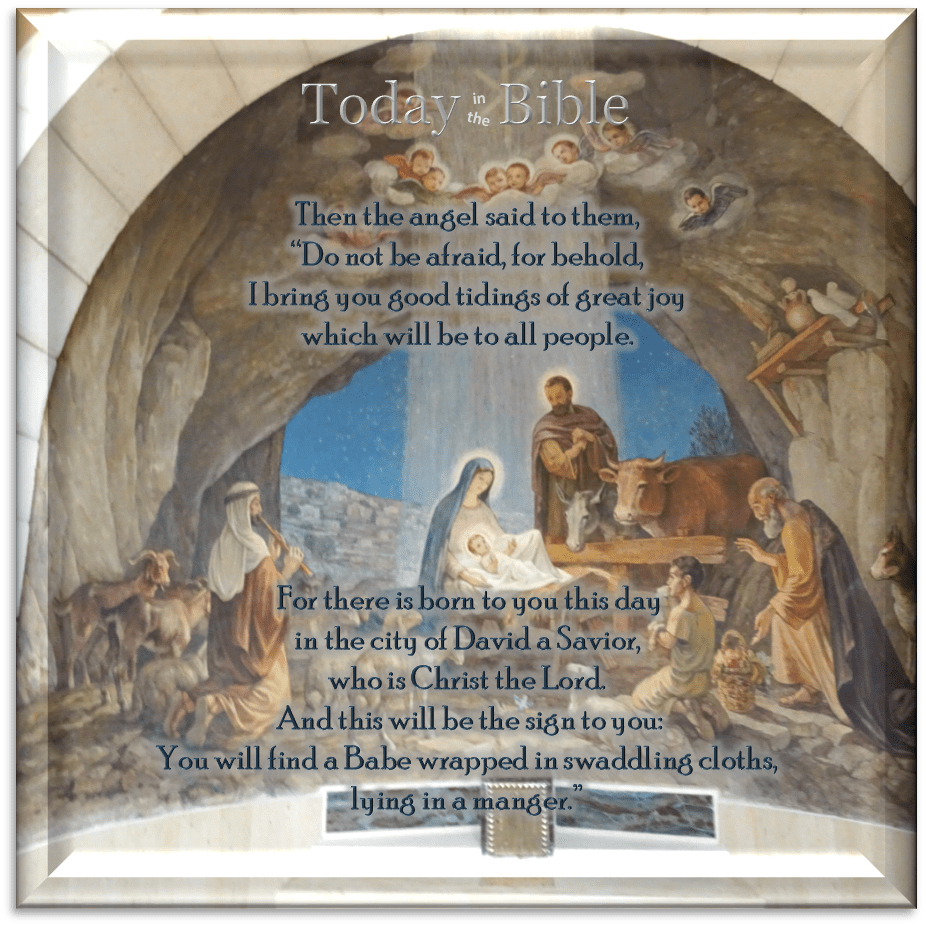
Tishrei 1, 5785; from sunset October 2, 2024, to sunset October 3, 2024
(The first day of the seventh month)
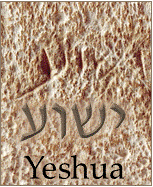
This is the name “Yeshua” (יֵשׁוּעַ – Jesus) as seen on the James Ossuary. Yeshua comes from the verb “yasha” meaning “to save or deliver.” Yeshua means “Salvation.”
Today in the Bible, we would like to propose one more event that may have occurred on this day. In our earlier posts we learned that today is the traditional date for when God created Adam…“in the beginning…” There is also a long-standing tradition which dates Noah’s birth to Tishrei 1. Noah was a type of a “Second Adam.” A “re-creation,” if you will. He was a part of a new beginning. The name of the month “Tishrei,” itself, means “beginning.”
When God created Adam, he was made out of the “adamah” – the earth, the ground. When Noah left the ark, the text tells us a similar tale. First, let’s look at how a few translations render this verse.
And Noah the husbandman began, and planted a vineyard. – Genesis 9:20 (JPS)
And Noah began to be a farmer, and he planted a vineyard. – Genesis 9:20 (NKJ)
Noah, a man of the soil, began to plant a vineyard. – Genesis 9:20 (NET)
Now, let’s read it in Hebrew:
וַיָּחֶל נֹחַ אִישׁ הָאֲדָמָה וַיִּטַּע כָּרֶם
Vayachel, No’ach, ish ha’adamah, vayitta karem.
And he began, Noah, to be a man of the “adamah” (the earth, ground), and he planted a vineyard.
Just as the original Adam was formed out of the “adamah.” Noah, too, began to be a man of the “adamah” after he left the ark.
We, at Today in the Bible, see another who fits the pattern of Adam and Noah. We’d like to suggest one more very significant birth which may be dated to today — that of our Savior, Jesus of Nazareth. The Apostle Paul called Jesus the “Last Adam” (1 Corinthians 15:45) and he taught that anyone who is in Christ Jesus is a “new creation” (2 Corinthians 5:17). Jesus left His heavenly abode and became “a man of the earth, a man of the ‘adamah.’” He became a part of mankind.
But we shouldn’t make our assumption based on these similarities alone. With these parallels in hand, it’s time to put on your thinking cap, open your mind, and strap yourself in as we relate the rest of the journey of how we arrived at our belief that Jesus may have been born today, Tishrei 1.
A Time Appointed by the LORD
Our first big assumption is that, as the Son of God, we believe that Jesus would have been born at a time appointed by the LORD. To back this up, we look to the Bible for other births fitting the same criteria. Our Father has filled the Bible with patterns; they are a way for us to look for similar circumstances which can help us expand our understanding of biblical stories. In this case, it doesn’t take long to find one. Genesis chapter 21 tells us the story of a famous birth which shadows that of our Savior.
- A miraculous conception
- Born at an appointed time set by God
- A long-awaited, much beloved son
This is the story of Isaac.
וַה׳ פָּקַד אֶת-שָׂרָה כַּאֲשֶׁר אָמָר וַיַּעַשׂ ה׳ לְשָׂרָה כַּאֲשֶׁר דִּבֵּר
Va’ADONAI pakad et-Sarah ka’asher amar. Vaya’as ADONAI leSarah ka’asher diber.
And the LORD, He visited Sarah as He said. And He did, the LORD, as He had spoken.
וַתַּהַר וַתֵּלֶד שָׂרָה לְאַבְרָהָם בֵּן לִזְקֻנָיו לַמּוֹעֵד אֲשֶׁר-דִּבֶּר אֹתוֹ אֱלֹהִים
Vatahar vateled Sarah le’Avraham ben lizkunav lamo’ed asher-diber oto Elohim.
And she conceived and she bore, Sarah, to Abraham a son for his old age according to the appointed time (“mo’ed”) which was spoken of to him by God.
וַיִּקְרָא אַבְרָהָם אֶת-שֶׁם-בְּנוֹ הַנּוֹלַד-לוֹ אֲשֶׁר-יָלְדָה-לּוֹ שָׂרָה יִצְחָק
Vayikra Avraham et-shem-beno hanolach-lo asher yaldah-lo Sarah Yitzchak.
And he called, Abraham, the name of his son begotten to him, which was born to him by Sarah, Isaac.
From these verses, we learn that Isaac was born at a time that was appointed by God. We’ve called out the words “appointed time” in the text above and have made the effort to transliterate and translate these verses from their original language in order to highlight the word “mo’ed” (מוֹעֵד). In Hebrew “appointed time” is one word, “mo’ed” (מוֹעֵד). It comes from the verb-root “ya’ad” (יָעַד). It’s typical for Hebrew nouns to stem from a verb-root and that those nouns are related to the action of the verb. Let’s take a look at our verb “ya’ad” and the nouns which stem from it.
- “ya’ad” (יָעַד) – to appoint, betrothe, assemble, meet, or set
- “edah” (עֵדָה) – a congregation
- “mo’ed” (מוֹעֵד) – an appointed place
- “mo’ad” (מוֹעָד) – a place of assembly
- “mu’adah” (מוּעָדָה) – an appointed city
The circumstances surrounding Isaac’s birth are not the only connection between himself and Jesus. Before God changed his name to Abraham (“Father of Many”), Isaac’s father’s name was Abram (meaning “Exalted Father”). We could say that Jesus, as the Son of God, also has an “Exalted Father.” And, as we continue with Isaac’s story, we find that when he grew to be a man, Abraham was commanded by God to offer him as a sacrifice. This is known as the “binding of Isaac.” (Genesis 22) Jesus also, was bound and offered as a sacrifice by His Father.
There are some traditions which place the age of Isaac in his mid-thirties (perhaps 36) at the time of his “binding.” This is based upon the comparison of the age of his mother, Sarah (90 years – Genesis 17:17), at the time God told Abraham he would have a son by her and her age at the time of her death (127 years – Genesis 23:1). Sarah’s death is related just a few short verses after Isaac was bound, leading scholars to believe that she died shortly after the incident. Of course, this is the same age range as Jesus when He was offered as a sacrifice by His Father. Perhaps even the exact age, if we assume 3 BC for His birth and 33 AD for His death. We know that there are many who would dispute these dates, but we see signs in the heavens that back up these assumptions. We’ll talk more about them later in this article. [1]
Jesus’ birth follows after the pattern of Isaac. He was the long-awaited Son. He was born at a time appointed by God. And, He was miraculously conceived. No, He wasn’t conceived by two old people past their childbearing years, but by an even bigger miracle. He was conceived by the Holy Spirit. He was born to a mother who was a virgin, the Virgin Mary, and His Father is the LORD God, the King of the Universe Himself.
Appointed Times of the LORD
“…these are My feasts.”
And the LORD spoke to Moses, saying, “Speak to the children of Israel, and say to them: `The feasts of the LORD, which you shall proclaim to be holy convocations, these are My feasts.” – Leviticus 23:1-2 (NKJ)
The word “mo’ed” (מוֹעֵד) is also used in another significant part of the Bible, the 23rd chapter of Leviticus. This chapter is commonly called “The Feasts of the LORD.” In it, God provides us with a list of His self-proclaimed Holy Days. These are times which are important to Him. They belong to Him. They are holy to Him. They are times when He wants His people to gather together. And He included specific dates for them. Since the “feasts” are given specific dates, many people translate them as “Appointed Times” instead of “feasts.” With our expanded understanding of the word “mo’ed” (מוֹעֵד), it’s easier to see why and it’s probably a better translation of the word. We, too, are going to use “Appointed Times” to refer to God’s Holy Days.
Let’s bring in a high-level listing of the LORD’s Appointed Times as listed in Leviticus 23.
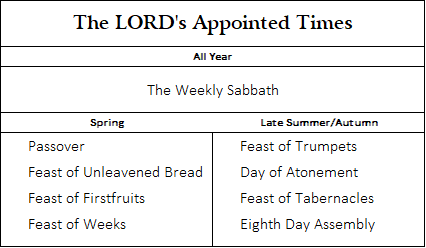
We promised to share our journey for how we got to today, so here goes! We looked at several possibilities for the date of Jesus’ birth from our list of Appointed Times before landing where we are today.
Feast of Weeks
There was a time when we believed that Jesus may have been born on the Feast of Weeks, which is also known by its Greek name, Pentecost. Why did we think that? Well, according to Jewish tradition, that is the anniversary of the day that God made a covenant with Israel at Mount Sinai. The Ten Commandments. “The Word Made Stone.”
The text tells us that the people were in unison (“yachad”) at that time (Exodus 19:8). The New King James versions translates the word “yachad” as “together.” The verb-root itself means “to be united, to be joined.”
Then all the people answered together and said, “All that the LORD has spoken we will do.” So Moses brought back the words of the people to the LORD. – Exodus 19:8 (NKJ)
The Bible goes on to tell us that, on that morning, there was thunder and lightning on the mountain and smoke like that of a furnace. Exodus 20:18 states…
Now all the people witnessed the thunderings, the lightning flashes, the sound of the trumpet, and the mountain smoking; and when the people saw it, they trembled and stood afar off. – Exodus 20:18 (NKJ)
The original Hebrews says that the people “saw the voices and the torches (flames).” The Young’s Literal Translation does a better job of capturing the original language.
And all the people are seeing the voices, and the flames, and the sound of the trumpet, and the mount smoking; and the people see, and move, and stand afar off, – Exodus 20:18 (YLT)
What does that mean? What did they see? Jewish tradition says that when God spoke, His voice thundered out in all of the languages of the world at once. His words took on the form of sparks which landed as flames on the tops of the heads of the people gathered around the mountain. The people saw the voices and the torches! Are there any other stories recorded in the Bible that would fit this pattern?
When the Day of Pentecost had fully come, they were all with one accord in one place. (Acts 2:1 NKJ)
When conducting our search, we couldn’t help but think of that first Pentecost after Jesus’ death and resurrection. Most Christians are familiar with it. It’s the day that the Holy Spirit was poured out on the believers who were present. The text tells us that the apostles were all gathered together “with one accord.” Just like the people at Mount Sinai, there was unity. Just like Sinai, flames landed on the heads of those gathered around. Just like Sinai, many languages were spoken. This time, it was the “Word was made Spirit” instead of the “Word Made Stone.”
When considering the birth of Jesus, how could this fit into the “pattern?” We couldn’t find a connection to flames. But Jesus is called “The Word Made Flesh” (John 1:14). He was God and Man joined. He was for all mankind. Perhaps He was born on the Feast of Weeks? It seems fitting that His birth would align with the other significant events occurring on that day.
One more important tradition revolving around the Feast of Weeks is that, King David was born and died on that Appointed Time. Even Simon Peter mentioned King David’s death and burial in his famous speech on that spring day when the Holy Spirit was poured out on the believers gathered in Jerusalem (Acts 2:29). David, the king of a united Israel. David, born in Bethlehem. Jesus, King of Israel. Jesus, born in Bethlehem. There is a lot that fits the pattern. Surely Jesus was born on the Feast of Weeks! But, wait.
Feast of Tabernacles
But then someone brought up their belief that Jesus was born on the Feast of Tabernacles. They believed He came to “tabernacle” with us on the first day of the seven-day long feast. The eighth day was a time for a special assembly. It is also one of the Appointed Times listed in Leviticus 23. As the eighth day, it would have been the day that Jesus would have been brought into the covenant of circumcision; bookending both His birth and His circumcision with Appointed Times. The number eight is representative of eternity. Also, the roof of the temporary shelters that the native-born Israelites are commanded to dwell in, is typically sparsely populated…leaving it open to the sky…open to see the stars. With the Star of Bethlehem playing such a significant part of Jesus’ nativity story, this makes another nice tie-in. Surely, He must have been born at the Feast of Tabernacles! But, wait.
The Pilgrimage Festivals
If we return to the meaning of our verb-root “ya’ad” and its related nouns, we see that its very essence indicates not only specific times, but specific places. Now that we’ve got our list of Appointed Times, let’s look into the “specific places” tied to them.
In Deuteronomy 16:16, God designated three of His Appointed Times as pilgrimage festivals. A time to appear before the LORD.
“Three times a year all your males shall appear before the LORD your God in the place which He chooses: at the Feast of Unleavened Bread, at the Feast of Weeks, and at the Feast of Tabernacles; and they shall not appear before the LORD empty-handed. – Deuteronomy 16:16 (NKJ)
That makes three of the Appointed Times on our list pilgrimage festivals. Times when all men of Israel were to appear before the LORD. Let’s mark them with an “x.”
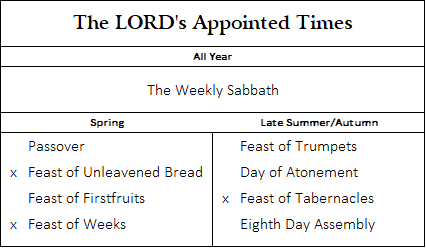
The text says that they were to meet at the place that the LORD chooses. At the time of Moses, this was “TBD.” God finally revealed the location of His choice to King David. It was the threshing floor of Araunah (aka Ornan), the Jebusite.
2 Samuel 24 relates the story of the plague that was unleashed upon Israel because David took a census of the people. Many in Israel died from north to south but when the angel of the LORD came to Jerusalem, the LORD relented and restrained the hand of the angel from causing its destruction. It happened over the threshing floor of Araunah. David received a command from the LORD to go and purchase the threshing floor, build an altar, and make a sacrifice to Him there. It became the place where his son, Solomon, built the Temple (2 Chronicles 3:1).
After learning how we know that Jerusalem was the place the LORD our God chose, let’s bring our discussion back to the pilgrimage festivals; it was on these three Appointed Times that God desired His people to be in Jerusalem. Now let’s learn about the place where Jesus was born.
Bethlehem
Most of us already know that Jesus was born in Bethlehem, but let’s read the text anyway.
And it came to pass in those days that a decree went out from Caesar Augustus that all the world should be registered. This census first took place while Quirinius was governing Syria. So all went to be registered, everyone to his own city.
“So all went to be registered, everyone to his own city.”
Joseph also went up from Galilee, out of the city of Nazareth, into Judea, to the city of David, which is called Bethlehem, because he was of the house and lineage of David, to be registered with Mary, his betrothed wife, who was with child. So it was, that while they were there, the days were completed for her to be delivered. And she brought forth her firstborn Son, and wrapped Him in swaddling cloths, and laid Him in a manger, because there was no room for them in the inn. – Luke 2:1-7 (NKJ)
The text reads, “So all went to be registered, everyone to his own city.” Why is this important? We can discern from this statement that, because of Augustus’ order, the people of Israel were “not” all gathered together in Jerusalem when Jesus was born. If Rome would have directed the citizens of Israel to register in their ancestral town at the time they were to have made a pilgrimage to Jerusalem, there would have been quite an uproar. We would expect that it would have been recorded somewhere. If it was, we aren’t aware of it today. At the time of Jesus’ birth, Rome allowed Judea to freely observe their religious practices. Luke 2:41 implies that Jesus’ family was accustomed to making the journey to Jerusalem for the pilgrimage festivals.
So, it’s not only the fact that Jesus was born in Bethlehem, it’s that everyone else was commanded to return to the city of their ancestors as well. With the assumptions we’ve made, we can eliminate those three Appointed Times from our list. Subsequently, we can remove Passover and the Feast of Firstfruits from the list since they are connected to the Feast of Unleavened Bread. The Eighth Day Assembly falls on the day immediately following the seven-day-long Feast of Tabernacles; it seems we can mark it off too. That leaves us with the Feast of Trumpets and the Day of Atonement.
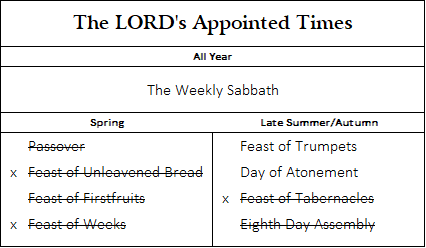
So, do we prefer one of these over the other? Of course, or we wouldn’t be talking about it today, on the Feast of Trumpets! The Day of Atonement just doesn’t seem to fit into the pattern of a birth or a new beginning – but we’ve got some other ideas for ancient events which do line up with the pattern of Yom Kippur. Join us throughout the next ten days as we explore the significance of that Appointed Time.
Today, we are starting a new year. And, even though the creation of Adam and Noah’s birthday don’t find an actual date in the Bible (they are placed here by tradition only); we do, however, find something related to the birth of a king that is connected to this date.
Birth of a King
The prophet Micah foretold the place where the Messiah would be born.
“But you, Bethlehem Ephrathah, though you are little among the thousands of Judah, yet out of you shall come forth to Me the One to be Ruler in Israel, Whose goings forth are from of old, from everlasting.
“Therefore He shall give them up, until the time that she who is in labor has given birth; then the remnant of His brethren shall return to the children of Israel. And He shall stand and feed His flock In the strength of the LORD, in the majesty of the name of the LORD His God; and they shall abide, for now He shall be great to the ends of the earth;” – Micah 5:2-4 (NKJ)
We’ve already established Bethlehem as the place of Jesus’ birth. Let’s refresh our memory of what happened after it, when the wise men from the East arrived in Jerusalem.
Now after Jesus was born in Bethlehem of Judea in the days of Herod the king, behold, wise men from the East came to Jerusalem, saying, “Where is He who has been born King of the Jews? For we have seen His star in the East and have come to worship Him.”
When Herod the king heard this, he was troubled, and all Jerusalem with him. And when he had gathered all the chief priests and scribes of the people together, he inquired of them where the Christ was to be born.
So they said to him, “In Bethlehem of Judea, for thus it is written by the prophet: `But you, Bethlehem, in the land of Judah, are not the least among the rulers of Judah; for out of you shall come a Ruler Who will shepherd My people Israel.’”
Then Herod, when he had secretly called the wise men, determined from them what time the star appeared. And he sent them to Bethlehem and said, “Go and search carefully for the young Child, and when you have found Him, bring back word to me, that I may come and worship Him also.”
When they heard the king, they departed; and behold, the star which they had seen in the East went before them, till it came and stood over where the young Child was. When they saw the star, they rejoiced with exceedingly great joy.
And when they had come into the house, they saw the young Child with Mary His mother, and fell down and worshiped Him. And when they had opened their treasures, they presented gifts to Him: gold, frankincense, and myrrh. – Matthew 2:1-11 (NKJ)
So, the wise men were able to determine from the heavens that a king was born in Israel. They were confident enough in their assumptions that they obtained costly gifts, made the long journey, and presented themselves before King Herod, asking him where the Child was. What did the wise men see that would spur such actions?
Let’s move ahead to the book of the Revelation of Jesus Christ, where John recorded this vision…
Now a great sign appeared in heaven: a woman clothed with the sun, with the moon under her feet, and on her head a garland of twelve stars. Then being with child, she cried out in labor and in pain to give birth. And another sign appeared in heaven: behold, a great, fiery red dragon having seven heads and ten horns, and seven diadems on his heads. His tail drew a third of the stars of heaven and threw them to the earth. And the dragon stood before the woman who was ready to give birth, to devour her Child as soon as it was born. She bore a male Child who was to rule all nations with a rod of iron. And her Child was caught up to God and His throne. – Revelation 12:1-5 (NKJ)
If you think these verses refer to the birth of Jesus, then there may be a significant clue to the date of His birth hidden in the text. On his website https://bethlehemstar.com/, Rick Larson shares how, in his search for the Star of Bethlehem, he accidently stumbled onto what he believes to be the “woman clothed with the sun, with the moon under her feet” described by John.[1] What he saw was the Sun on its path through the constellation of Virgo and the Moon was at her feet. It was the first tiny crescent of the Moon, meaning that it was the first day of the biblical month. A “Baby Moon,” if you will. The name of the constellation Virgo comes from the Latin word for virgin.
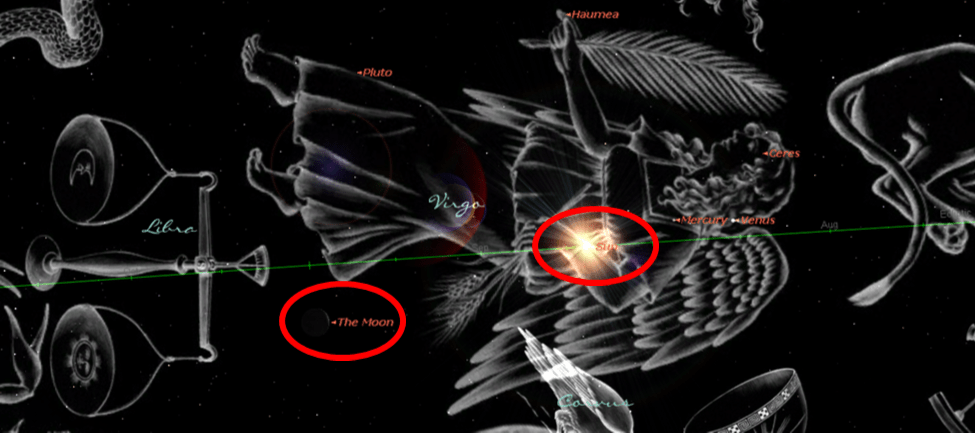
The image above was taken from the Starry Night Enthusiast 6 application. It shows the constellation of Virgo with the illustrations drawn in. The daylight has been removed in order for the Sun and Moon to be viewed easier. The software dates this image to September of 3 BC. The location of the Sun and Moon have been circled. Notice how the Sun is near the “Virgin’s” mid-section; the area where a woman would carry a child. Could this be what the magi saw? A virgin with child?
About seven hundred years before Jesus’ birth, the prophet Isaiah received a word from the LORD for King Ahaz.
“Therefore the Lord Himself will give you a sign: Behold, the virgin shall conceive and bear a Son, and shall call His name Immanuel.” – Isaiah 7:14 (NKJ)
The Apostle Matthew recorded a dream that Joseph had after he had decided to quietly end his engagement to Mary due to her unexpected pregnancy. In this dream, Joseph was visited by an angel of the LORD.
Then Joseph her husband, being a just man, and not wanting to make her a public example, was minded to put her away secretly. But while he thought about these things, behold, an angel of the Lord appeared to him in a dream, saying, “Joseph, son of David, do not be afraid to take to you Mary your wife, for that which is conceived in her is of the Holy Spirit. And she will bring forth a Son, and you shall call His name JESUS, for He will save His people from their sins.”
So all this was done that it might be fulfilled which was spoken by the Lord through the prophet, saying: “Behold, the virgin shall be with child, and bear a Son, and they shall call His name Immanuel,” which is translated, “God with us.”
Then Joseph, being aroused from sleep, did as the angel of the Lord commanded him and took to him his wife, and did not know her till she had brought forth her firstborn Son. And he called His name JESUS. – Matthew 1:19-25 (NKJ)
Matthew saw a fulfillment of Isaiah’s prophecy in Jesus’ birth. He also made for us a translation of the name “Immanuel.” — “God with Us.”
עִמָּנוּ אֵל
Immanu-El. The word “im” means “with.” “Immanu” means “with us.” “El” means “God.” Did the wise men have a copy of the Isaiah text? Did they make the connection between the “virgin” seen in the stars and the birth of “God with Us?”
Incidentally, the name Jesus came to us after being translated from language to language. In Hebrew, the angel said that Joseph should call His name “Yeshua” (יֵשׁוּעַ). Yeshua comes from the verb-root “yasha” (ישע) which means “to save or deliver.” Yeshua means “Salvation.” To Joseph’s ears, the angel would have said…
“And she will bring forth a Son, and you shall call His name SALVATION, for He will save His people from their sins.”
On the biblical calendar, a month is aligned with the lunar cycle. The first visible sliver of the Moon is the first day of the month. In our image above, the Moon is in that phase. Because of this, we know that this image can be dated to the first day of the biblical month. The Sun moves through the constellation of Virgo every year in the September/October timeframe. This coincides with the months of Tishrei (the 7th month) or Cheshvan (the 8th month).
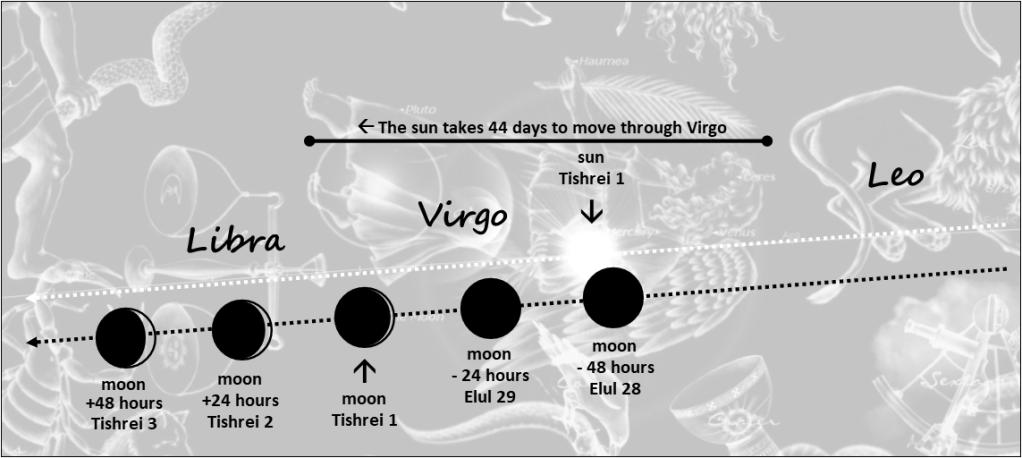
It takes the Sun 44 days to completely move through Virgo. With the Sun in this position, it normally means the first day of the month of Tishrei. The first day of Tishrei is the date for the Appointed Time of the “Feast of Trumpets.” In this day and age, the “Feast of Trumpets” is commonly referred to as “Rosh Hashanah.” Rosh = “head, beginning.” Hashanah = “of the year” as it is considered to be the first day of the new biblical year.
The image above shows how the Moon (which has been enlarged) moves in relationship to the Sun. While the Sun appears to creep through the constellation day by day for 44 days, the Moon moves much more quickly, and its crescent enlarges each day. Notice how far it moved in the five days shown above.
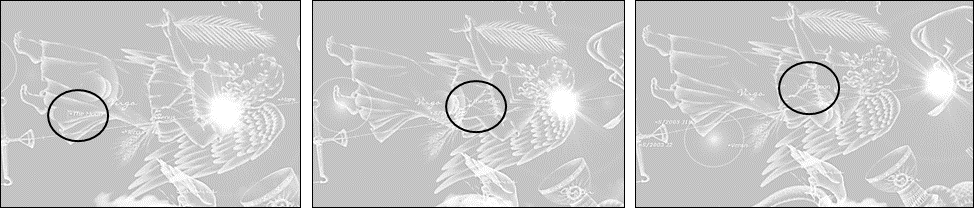
This exact alignment does not occur every year. Sometimes the Sun is near the virgin’s shoulder on Rosh Hashanah and sometimes near the top of her head. The images above show the position of the Sun on Rosh Hashanah of 2019, 2020, and 2021. The Moon has been circled. So, to have the Sun in her mid-section and the Moon at her feet is not an every year occurrence…but it does continue to happen.
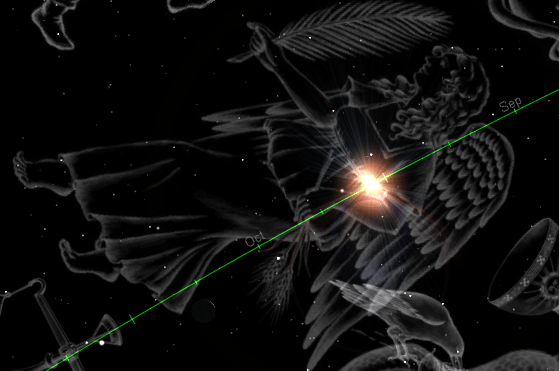
2024 (as seen above) is one of those years with the Sun in her mid-section and the Moon at her feet. The next time we’ll see this is 2035.
If Jesus was, indeed, born on the first day of the seventh month, that would mean He was born at a time appointed by God. At the beginning of the year…a new beginning. And on the anniversary of the day that Adam was created. Noah’s birth (a type of a “second Adam”) and the story of a “new creation” after the flood, also adds to this imagery. It seems fitting that the King of the Universe would have taken such great care in planning the day that His Son, the “Last Adam” would be born.
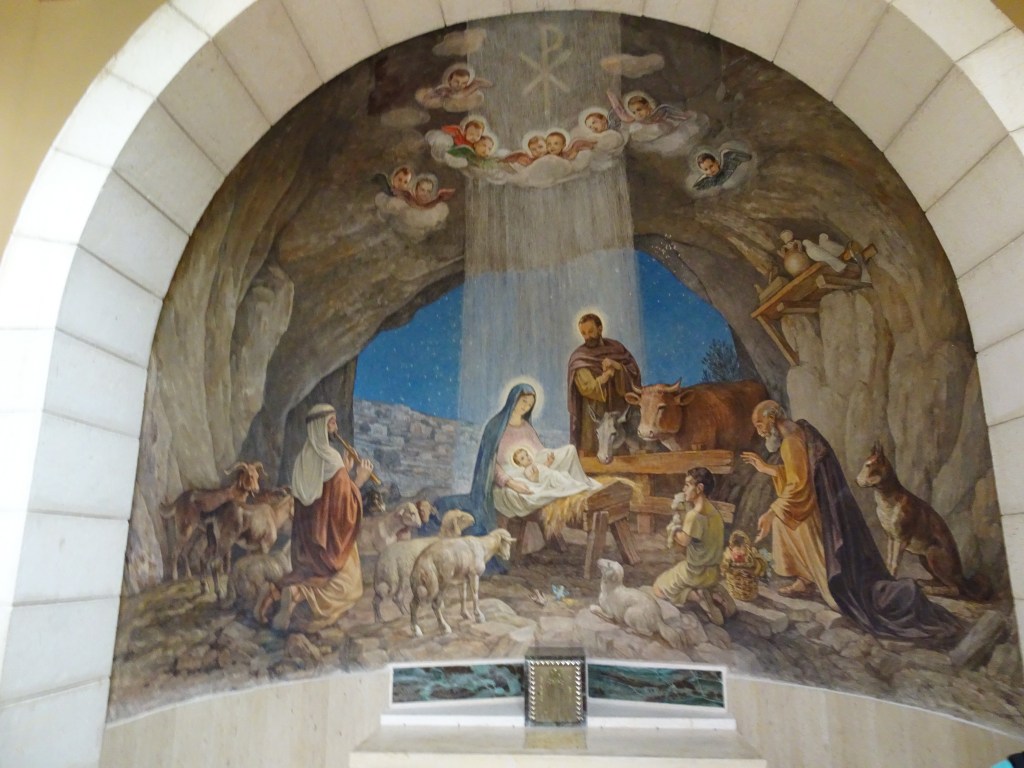
Photo Credit: Today in the Bible.
Just a reminder that it’s tradition to read Psalm 27 daily through the Feast of Tabernacles. You can find it by clicking on the link.
[1] Our assumption that Jesus may have been 36 years old at the time of His crucifixion is based upon the special alignment of the Sun, Moon, and stars brought to our attention by Rick Larson on his website: https://bethlehemstar.com/. In this article, we’ve already explained how he saw the “woman clothed with the sun and the moon at her feet,” as described in Revelation 12. This was in September of 3 BC.
Mr. Larson also searched for the date of Jesus’ crucifixion. He arrived at April 3, 33 AD, which was Passover and a Full Moon. On that date, when the Moon rose over Jerusalem, it was already in a full eclipse. This is often called a “Blood Moon” because of the reddish tint taken on by the shadow of the Earth. The Full Blood Moon was found once again at the foot of the constellation Virgo. The “foot of the virgin.” If the first sliver of the Moon in September represented a new life, a “baby” Moon, then the Full Moon in April indicated life at its fullness. Jesus, struck down in the prime of His life. The Bible specifies that His mother, Mary, was present at the cross at the time of His death.

© 2026 Today in the Bible

 Today in the Bible
You must be logged in to post a comment.