
Tishrei 10, 5785; from sunset October 11, 2024, to sunset October 12, 2024
(The tenth day of the seventh month)
The Day of Atonement (Yom Kippur) falls upon the 10th day of the seventh month; but this post is being published a few days before, on the 5th day. We’re taking an early look at the some of the events in the Bible that may be related to Yom Kippur.
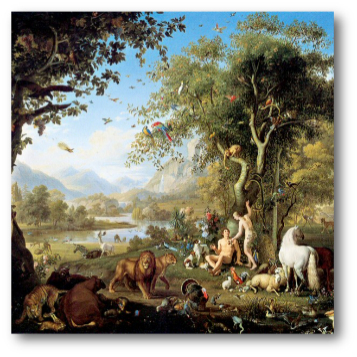
Paradiso terrestre, Wenzel Peter 1745-1829
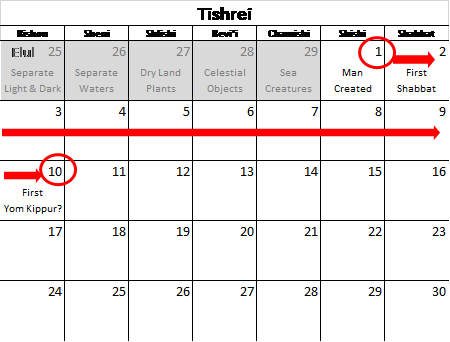
On Tishrei 1, we observed the anniversary of the day that Jewish tradition recognizes as the sixth day of creation. The day that God created Adam and Eve. There are some who teach that they disobeyed God on their very first day; but we like to think they made it to day ten…
Let’s take a look at their story.
Now the serpent was more crafty than any of the wild animals the LORD God had made. He said to the woman, “Did God really say, ‘You must not eat from any tree in the garden’?”
The woman said to the serpent, “We may eat fruit from the trees in the garden, but God did say, ‘You must not eat fruit from the tree that is in the middle of the garden, and you must not touch it, or you will die.’”
“You will not certainly die,” the serpent said to the woman. “For God knows that when you eat from it your eyes will be opened, and you will be like God, knowing good and evil.”`
When the woman saw that the fruit of the tree was good for food and pleasing to the eye, and also desirable for gaining wisdom, she took some and ate it. She also gave some to her husband, who was with her, and he ate it. Then the eyes of both of them were opened, and they realized they were naked; so they sewed fig leaves together and made coverings for themselves.
Then the man and his wife heard the sound of the LORD God as he was walking in the garden in the cool of the day, and they hid from the LORD God among the trees of the garden. But the LORD God called to the man, “Where are you?”
He answered, “I heard you in the garden, and I was afraid because I was naked; so I hid.”
And he said, “Who told you that you were naked? Have you eaten from the tree that I commanded you not to eat from?”
The man said, “The woman you put here with me– she gave me some fruit from the tree, and I ate it.”
Then the LORD God said to the woman, “What is this you have done?” The woman said, “The serpent deceived me, and I ate.”
So the LORD God said to the serpent, “Because you have done this, “Cursed are you above all livestock and all wild animals! You will crawl on your belly and you will eat dust all the days of your life. And I will put enmity between you and the woman, and between your offspring and hers; he will crush your head, and you will strike his heel.”
To the woman he said, “I will make your pains in childbearing very severe; with painful labor you will give birth to children. Your desire will be for your husband, and he will rule over you.”
To Adam he said, “Because you listened to your wife and ate fruit from the tree about which I commanded you, ‘You must not eat from it, ‘”Cursed is the ground because of you; through painful toil you will eat food from it all the days of your life. It will produce thorns and thistles for you, and you will eat the plants of the field. By the sweat of your brow you will eat your food until you return to the ground, since from it you were taken; for dust you are and to dust you will return.”
Adam named his wife Eve, because she would become the mother of all the living.
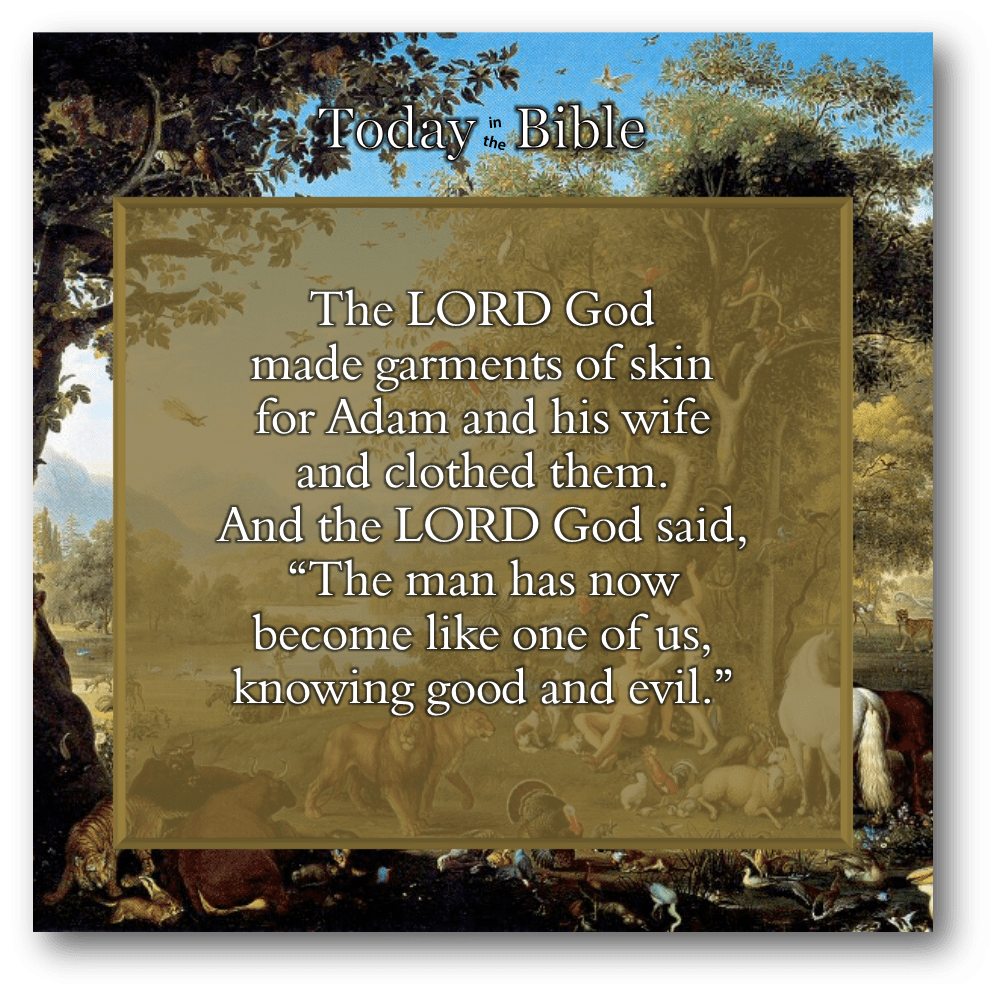
The LORD God made garments of skin for Adam and his wife and clothed them
The LORD God made garments of skin for Adam and his wife and clothed them. And the LORD God said, “The man has now become like one of us, knowing good and evil. He must not be allowed to reach out his hand and take also from the tree of life and eat, and live forever.” So the LORD God banished him from the Garden of Eden to work the ground from which he had been taken.
After he drove the man out, he placed on the east side of the Garden of Eden cherubim and a flaming sword flashing back and forth to guard the way to the tree of life. – Genesis 3 (NIV)
Here we learn the meaning of Adam’s and Eve’s names:
The name Adam means “mankind” and is related to the word “adamah” meaning “ground.”
In the sweat of your face you shall eat bread till you return to the ground (adamah), for out of it you were taken; for dust you are, and to dust you shall return. – Genesis 3:19
The name Eve is “Chavah” and comes from the verb “chayah” which means “to be alive.”
And Adam called his wife’s name Eve (Chavah), because she was the mother of all living (chai) things. – Genesis 3:20
On Tishrei 1, we pondered what it meant that God made mankind in His image and likeness. Did God create Adam and Eve as beings of light? We started a little “midrash” and discovered that the Bible says “God is Light.” That Moses’ face shone after being the presence of God and we remembered Jesus’ transfiguration and John’s description of Him in Revelation, where His face was shining like the sun. We tied letting our “light shine” to obedience to the commandments of God. Jesus, being sinless, shone like the sun. Perhaps Adam and Eve, before the fall, were beings of light as well.
The word for “light” in Hebrew, is “or” (אוֹר – “oar”). After committing their first sin, the Bible tells us that God clothed Adam and Eve with garments of “skin.” The word for “skin” in Hebrew is “or” (עוֹר – “oar”). No, this is not a typo. If you notice the Hebrew, there is just one letter difference between these two words – א and ע.
אוֹר עוֹר
Hebrew is an interesting language. There are some letters that can make more than one sound – as we learned just a few days ago when we studied the root word for “kippur.” And there are two letters which make no sound what-so-ever – א and ע. Though aleph (א) and ayin (ע) do not make a sound on their own, they are able to carry the sound of any vowel.
The word for light and the word for skin are pronounced in the exact same way, lending credence to the story from the Zohar that Adam and Eve were created in God’s image, as beings of “light” (“אוֹר”). After their sin, God clothed them with “skin” (“עוֹר”).
Leviticus 16 tells us that the Day of Atonement (Yom Kippur) is all about dealing with sin. In fact, “Yom Kippur” in the Hebrew text is actually “Yom Kippurim.” Kippurim is the plural form of Kippur. Perhaps we can look at the story of Adam and Eve as the first time that God made atonement for the sin of mankind?
A few days ago we studied the root-word of “kippur” – “kafar.” We learned that it not only carries with it the meaning of atonement, but is also connected to the idea of a covering. It would be great if we were able to linguistically connect the root word “kafar” used in Yom Kippur with the “covering” that takes place in Genesis 3, but we can’t. We CAN, however, make several other connections between this story and the Day of Atonement. It seems that our Heavenly Father wanted to invoke the imagery of Adam in the Garden – each year – during the Yom Kippur ceremony.
First, both of these events are God’s way of dealing with the sin…in Eden, it was Adam and Eve, in the Yom Kippur ceremony, it was mankind (“adam”).
Second, in the Yom Kippur ceremony, the High Priest is the “only man” allowed in the Tabernacle. Adam, was the “only man” in the garden. The Tabernacle was decorated with images of plants, flowers, trees, and even the cherubim which guarded its way…evoking descriptions of the Garden of Eden.
Third, the word translated as “clothed,” in both places, is the verb “lavash” – which we studied in our last post.
And, fourth, the garments that the LORD made for Adam and Eve compare to the garment that the High Priest wore on the Day of Atonement. In the case of Adam and Eve, it’s called “kotnot” (כׇּתְנוֹת – “coat note”); a word that, though spelled slightly differently, comes from the same root as the priestly garment we learned in our last post – “ketonet”- כְּתֺנֶת). It is defined as a tunic or a long, shirt-like garment usually made of linen – with long sleeves, to the palm of the hands; and long in length, to the “palm” of the foot. The garments God made for Adam and Eve were made of skin (עוֹר – “or”). The word used for skin can mean either human or animal skin.
Most people understand that the LORD clothed them with animal skins and call this the introduction to animal sacrifices and the idea of a substitute death. However, there is a conversation recorded in the Epic of Gilgamesh between the Mesopotamian hero, Gilgamesh, and Utnapishtim that suggests that the wearing of animal skin clothing might also symbolize all the frailties of fallen human life. Through their sin, Adam and Eve fell from their divine immortal status to something resembling that of a mere mortal animal.
The word translated as “clothed” in the text is “lavash” (pronounced like “lah-vahsh”). This word is used three different ways in scripture:
- The simple act of being clothed
- Being clothed – as a sign of rank, status, or character (a king, priest, soldier, widow, virgin, etc. – each can be identified by their clothing)
- Poetically (being clothed in righteousness, salvation, etc.)
When God clothed Adam and Eve in skin, it may have been an indication of their change in status – from immortal to mortal. He covered them with skin – and that is what we are still wearing today; but, in a twinkling of an eye we will all be changed…to…? There has to be a connection to 1 Corinthians 15:52 – an undoing of what was done in Eden. A status change from mortal to immortal. During the Yom Kippur service, we learned that the High Priest had to leave his holy garments in the Holy Place. Perhaps Adam and Eve had to leave their immortal garments of light in the “holy place” – the Garden – and, perhaps, those who have been atoned for will get to wear them again in Paradise.
And so it is written, “The first man Adam became a living being.” The last Adam became a life-giving spirit. However, the spiritual is not first, but the natural, and afterward the spiritual. The first man was of the earth, made of dust; the second Man is the Lord from heaven. As was the man of dust, so also are those who are made of dust; and as is the heavenly Man, so also are those who are heavenly. And as we have borne the image of the man of dust, we shall also bear the image of the heavenly Man.
Now this I say, brethren, that flesh and blood cannot inherit the kingdom of God; nor does corruption inherit incorruption. Behold, I tell you a mystery: We shall not all sleep, but we shall all be changed–in a moment, in the twinkling of an eye, at the last trumpet. For the trumpet will sound, and the dead will be raised incorruptible, and we shall be changed.
For this corruptible must put on incorruption, and this mortal must put on immortality.
So when this corruptible has put on incorruption, and this mortal has put on immortality, then shall be brought to pass the saying that is written: “Death is swallowed up in victory. O Death, where is your sting? O Hades, where is your victory?”
The sting of death is sin, and the strength of sin is the law. But thanks be to God, who gives us the victory through our Lord Jesus Christ. Therefore, my beloved brethren, be steadfast, immovable, always abounding in the work of the Lord, knowing that your labor is not in vain in the Lord. – 1 Corinthians 15:45-58 (NKJ)
Just a reminder that it’s tradition to read Psalm 27 daily through the Feast of Tabernacles. You can find it by clicking on the link.
Did you know that our posts are categorized and tagged by content?
When you visit our home page at https://todayinthebible.com and select any post,
you can find the associated categories and tags just to the right of the title.
Simply click on any tag and you will be taken to all related posts.

© 2026 Today in the Bible

 Today in the Bible
You must be logged in to post a comment.