
Tishrei 27, 5785; from sunset October 28, 2024, to sunset October 29, 2024
(The twenty-seventh day of the seventh month)
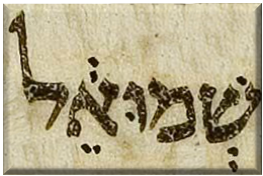
This is the name “Shemu’el” (שְׁמוּאֵל – Samuel) as seen in the Aleppo Codex, written over one thousand years ago.
Well, we’ve made it through the very busy holy days during the month of Tishrei. The Bible contains a plethora of stories surrounding them. Now, the people have been sent home and it’s time for us to move on as well. Today in the Bible, we’ll start setting up a story that likely occurred sometime during the autumn months in Israel. The events we’ll study today are not necessarily connected to this specific time of year, rather they are inserted here as an introduction to the main story that we’ll begin studying in a couple of days. Let’s turn to 1 Samuel chapters 1-3 for a summary of the prelude to our story. We’ll touch upon a few key verses here, but you are encouraged to read all three chapters in their entirety.
Our story begins with a man named Elkanah and his wife Hannah. They were very much in love, but Hannah was childless. She would pray to the LORD for a son every time they went up to Shiloh to make a sacrifice at the Tabernacle. On this particular trip, when they arrived at the Tabernacle…
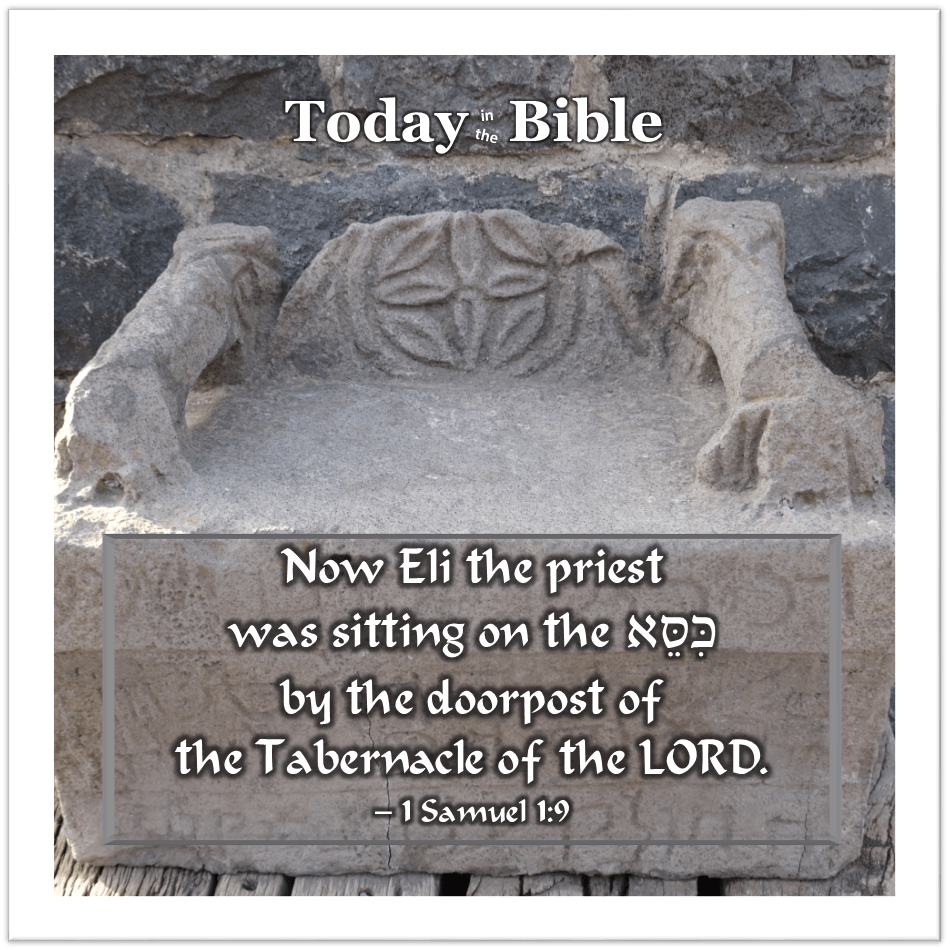
…Eli the priest was sitting on the seat by the doorpost of the Tabernacle of the LORD. – 1 Samuel 1:9[1]
The word translated as “seat” is the Hebrew word כִּסֵּא (“kisse” – pronounced like “kee-say”). A “kisse” is defined as a seat, a stool, or a throne. The TWOT Lexicon states that “kisse” occurs 136 times in the Hebrew Scriptures and all but seven of those refer to either a royal throne or a divine throne – but in all cases it refers to a seat of honor. As the main priest serving in the Tabernacle of God, Eli occupied a “kisse” – a seat of honor. In the book of Matthew, Jesus makes reference to the “seat of Moses” – and seems to be using the term in a similar way.
Then Jesus spoke to the multitudes and to His disciples, saying: “The scribes and the Pharisees sit in Moses’ seat. Therefore whatever they tell you to observe, that observe and do, but do not do according to their works; for they say, and do not do. For they bind heavy burdens, hard to bear, and lay them on men’s shoulders; but they themselves will not move them with one of their fingers. But all their works they do to be seen by men. They make their phylacteries broad and enlarge the borders of their garments. They love the best places at feasts, the best seats in the synagogues…” – Matthew 23:1-6
But let’s get back to our story. As she did every time they were at the Tabernacle, Hannah prayed for a child. The text says she cried out to the LORD from a bitterness in her soul, in anguish, desperate for a son. She made a vow that if the LORD would give her a son, she would give the boy over to the service of the LORD for all the days of his life. Elkanah and Hannah returned home where she conceived and bore a son. She called him Samuel and raised him until he was weaned. Then, as promised, she brought him to Eli to serve before the LORD for the rest of his days. After fulfilling her vow, she spoke forth a beautiful poem that’s become known as “Hannah’s Song.”
And Hannah prayed and said:
“My heart rejoices in the LORD; my horn is exalted in the LORD. I smile at my enemies, because I rejoice in Your salvation. No one is holy like the LORD, for there is none besides You, nor is there any rock like our God. Talk no more so very proudly; let no arrogance come from your mouth, for the LORD is the God of knowledge; and by Him actions are weighed.
“The bows of the mighty men are broken, and those who stumbled are girded with strength. Those who were full have hired themselves out for bread, and the hungry have ceased to hunger. Even the barren has borne seven, and she who has many children has become feeble.
“The LORD kills and makes alive; He brings down to the grave and brings up. The LORD makes poor and makes rich; He brings low and lifts up. He raises the poor from the dust and lifts the beggar from the ash heap, to set them among princes and make them inherit the throne of glory. For the pillars of the earth are the LORD’s, and He has set the world upon them.
“He will guard the feet of His saints, but the wicked shall be silent in darkness. For by strength no man shall prevail. The adversaries of the LORD shall be broken in pieces; from heaven He will thunder against them. The LORD will judge the ends of the earth. He will give strength to His king, and exalt the horn of His anointed.” – 1 Samuel 2:1-10
The underlined words “throne of glory” in Hebrew are כִּסֵּא כָבוֹד (“kisse chavod”). We’re already familiar with the word “kisse” and, through Hannah’s song we are introduced to כָבוֹד (pronounced like “khavode”). “Chavod” comes from a root word which means “to be heavy, grievous, hard, rich, honorable, or glorious.” When we studied the “Glory of the LORD” a couple of weeks ago, we were studying the “chavod” of the LORD.
In Hannah’s song she states that God, “raises the poor from the dust and lifts the beggar from the ash heap, to set them among princes and make them inherit the throne of glory.” Let’s keep in mind the words “kisse” and “chavod” and the theme of humbling the proud as we study out the accounts of Eli and his sons. So, let’s get to know the sons of Eli — Hophni and Phinehas.
Now the sons of Eli were corrupt; they did not know the LORD. And the priests’ custom with the people was that when any man offered a sacrifice, the priest’s servant would come with a three-pronged fleshhook in his hand while the meat was boiling. Then he would thrust it into the pan, or kettle, or caldron, or pot; and the priest would take for himself all that the fleshhook brought up. So they did in Shiloh to all the Israelites who came there.
Also, before they burned the fat, the priest’s servant would come and say to the man who sacrificed, “Give meat for roasting to the priest, for he will not take boiled meat from you, but raw.” And if the man said to him, “They should really burn the fat first; then you may take as much as your heart desires,” he would then answer him, “No, but you must give it now; and if not, I will take it by force.” Therefore the sin of the young men was very great before the LORD, for the men abhorred the offering of the LORD. – 1 Samuel 2:12-17
Hophni and Phinehas were cheating both the LORD and those bringing their sacrifices. The book of Leviticus devotes large sections of text concerning the instructions for offerings; among them are the laws regarding the fat of the sacrifices…
“…all the fat is the LORD’s. This shall be a perpetual statute throughout your generations in all your dwellings: you shall eat neither fat nor blood.” – Leviticus 3:16-17
Eli knew very well everything that his sons were doing; but he failed to reign them in. So, God sent someone to Eli with a warning.
Now Eli was very old; and he heard everything his sons did to all Israel, and how they lay with the women who assembled at the door of the tabernacle of meeting. So he said to them, “Why do you do such things? For I hear of your evil dealings from all the people. No, my sons! For it is not a good report that I hear. You make the LORD’s people transgress. If one man sins against another, God will judge him. But if a man sins against the LORD, who will intercede for him?” Nevertheless they did not heed the voice of their father, because the LORD desired to kill them.
And the child Samuel grew in stature, and in favor both with the LORD and men.
Then a man of God came to Eli and said to him, “Thus says the LORD: `Did I not clearly reveal Myself to the house of your father when they were in Egypt in Pharaoh’s house? Did I not choose him out of all the tribes of Israel to be My priest, to offer upon My altar, to burn incense, and to wear an ephod before Me? And did I not give to the house of your father all the offerings of the children of Israel made by fire? Why do you kick at My sacrifice and My offering which I have commanded in My dwelling place, and honor (“chavod”) your sons more than Me, to make yourselves fat with the best of all the offerings of Israel My people?’
“Therefore the LORD God of Israel says: `I said indeed that your house and the house of your father would walk before Me forever.’ But now the LORD says: `Far be it from Me; for those who honor (“chavod”) Me I will honor (“chavod”), and those who despise Me shall be lightly esteemed. Behold, the days are coming that I will cut off your arm and the arm of your father’s house, so that there will not be an old man in your house. And you will see an enemy in My dwelling place, despite all the good which God does for Israel. And there shall not be an old man in your house forever. But any of your men whom I do not cut off from My altar shall consume your eyes and grieve your heart. And all the descendants of your house shall die in the flower of their age.
`Now this shall be a sign to you that will come upon your two sons, on Hophni and Phinehas: in one day they shall die, both of them. Then I will raise up for Myself a faithful priest who shall do according to what is in My heart and in My mind. I will build him a sure house, and he shall walk before My anointed forever. And it shall come to pass that everyone who is left in your house will come and bow down to him for a piece of silver and a morsel of bread, and say, “Please, put me in one of the priestly positions, that I may eat a piece of bread.”’” – 1 Samuel 2:22-36
Oh, boy. Eli’s in big trouble. It seems the LORD has called him out. “You, Eli, are sitting in a ‘kisse chavod’ and yet, you are showing more ‘chavod’ to your sons than you are to Me. Instead of placing the fat on My altar, you are making yourselves fat.”
And while Samuel was gaining stature with the LORD, Eli and his sons were losing theirs.
In God’s warning to Eli, He mentioned that Eli’s “eyes” shall be “consumed.” The Hebrew root word for “consumed” means “to be finished, spent, consumed, cease or fail.” Let’s jump ahead and take a quick look into chapter three…
Then the boy Samuel ministered to the LORD before Eli. And the word of the LORD was rare in those days; there was no widespread revelation. And it came to pass at that time, while Eli was lying down in his place, and when his eyes had begun to grow so dim that he could not see, and before the lamp of God went out in the Tabernacle of the LORD where the Ark of God was, and while Samuel was lying down, that the LORD called Samuel. And he answered, “Here I am!” So he ran to Eli and said, “Here I am, for you called me.” And he said, “I did not call; lie down again.” And he went and lay down. – 1 Samuel 3:1-5
Here we are told that Eli’s eyes were literally failing him. In upcoming verses, we find that Eli was a heavy man. Given his diet and the fact that his eyes were going bad; perhaps we can infer that Eli had diabetes? But I think we can take this metaphorically as well. The text says that a word from the LORD was rare in those days. Many times the Bible describes one as “seeing the word of the LORD,” as if in a vision. In fact, the word translated as “revelation,” in the verses above, is the Hebrew word “chazon” meaning “vision.” If we read between the lines, maybe we can conclude that Eli’s careless handling of the Tabernacle and his “kisse chavod” was likely the root cause of his failing vision and the rarity of the LORD’s word? Compare the description of Moses in his old age versus that of Eli:
Moses was one hundred and twenty years old when he died. His eyes were not dim nor his natural vigor diminished. – Deuteronomy 34:7
But since then there has not arisen in Israel a prophet like Moses, whom the LORD knew face to face… – Deuteronomy 34:10
Moses’ eyes were not dim and he knew the LORD intimately.
The text reads that Eli’s “eyes had begun to grow so dim that he could not see” and then goes on to say, “before the lamp of God went out” — the LORD called out to Samuel. Perhaps we can make an analogy between the eyes of Eli and the lamp of God — both of them were going dim. Eli just couldn’t “see” the word of God anymore; but before the “lamp of God” totally went out — the LORD begins to call upon Samuel — instead of Eli. And just as the name Samuel means “God Has Heard” [2] — we learn that Samuel has heard God. We are seeing the beginning of the transfer of the “kisse chavod” from Eli to Samuel.
Now Samuel had never heard the LORD call out to him before and he thought it was Eli calling him. This happened a few more times before Eli figured out what was happening (his eyes were dim after all; it took a while for him to “see” what was happening). Eli then guided Samuel to his first conversation with the LORD.
We’ve covered a lot today and kind of bounced around a bit, too. Hopefully we didn’t distract you from the key concepts of the story. Throughout the accounts of Eli, our main focus will be upon the word “chavod.” We’ll give you tomorrow to thoroughly read through 1 Samuel chapters 1-3 and sort through the details for yourself. Then we’ll pick up again where we left off.
[1] All Scripture references in this lesson are from the New King James version.
[2] Jones Dictionary of Old Testament Proper Names
To read all of our posts on Samuel, the Philistines, and the Ark of the Covenant, click on the name Shemu’el above.

© 2026 Today in the Bible

 Today in the Bible
You must be logged in to post a comment.