
Cheshvan 4, 5785; from sunset November 4, 2024, to sunset November 5, 2024
(The fourth day of the eighth month)
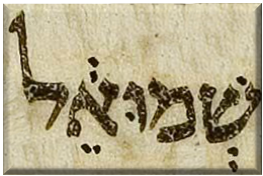
This is the name “Shemu’el” (שְׁמוּאֵל – Samuel) as seen in the Aleppo Codex, written over one thousand years ago.
We’re picking up where we left off yesterday in 1 Samuel, chapter 4, and the story of Israel and the Philistines at Ebenezer. Even though there is no specific date listed in the Bible, we’re placing these events as occurring in the autumn months in Israel.
The Israelites had just experienced a sound whipping by the Philistines and returned to camp, licking their wounds. They decided to send to Shiloh and bring the Ark of the Covenant back to camp with them. Yesterday we read how all of Israel gave a great shout, a “teruah gedolah,” when the Ark arrived. It was so loud the Philistines heard it from their camp and were afraid! Even so, the Philistines encouraged one another saying, “Conduct yourselves like men, and fight!”
So the Philistines fought, and Israel was defeated, and every man fled to his tent. There was a very great slaughter, and there fell of Israel thirty thousand foot soldiers. Also the Ark of God was captured; and the two sons of Eli, Hophni and Phinehas, died.
Then a man of Benjamin ran from the battle line the same day, and came to Shiloh with his clothes torn and dirt on his head. Now when he came, there was Eli, sitting on a seat by the wayside watching, for his heart trembled for the Ark of God. And when the man came into the city and told it, all the city cried out.
When Eli heard the noise of the outcry, he said, “What does the sound of this tumult mean?” And the man came quickly and told Eli. Eli was ninety-eight years old, and his eyes were so dim that he could not see. Then the man said to Eli, “I am he who came from the battle. And I fled today from the battle line.” And he said, “What happened, my son?”
So the messenger answered and said, “Israel has fled before the Philistines, and there has been a great slaughter among the people. Also your two sons, Hophni and Phinehas, are dead; and the Ark of God has been captured.”
Then it happened, when he made mention of the Ark of God, that Eli fell off the seat backward by the side of the gate; and his neck was broken and he died, for the man was old and heavy. And he had judged Israel forty years.
Now his daughter-in-law, Phinehas’ wife, was with child, due to be delivered; and when she heard the news that the Ark of God was captured, and that her father-in-law and her husband were dead, she bowed herself and gave birth, for her labor pains came upon her. And about the time of her death the women who stood by her said to her, “Do not fear, for you have borne a son.” But she did not answer, nor did she regard it.
“The glory has departed from Israel!”
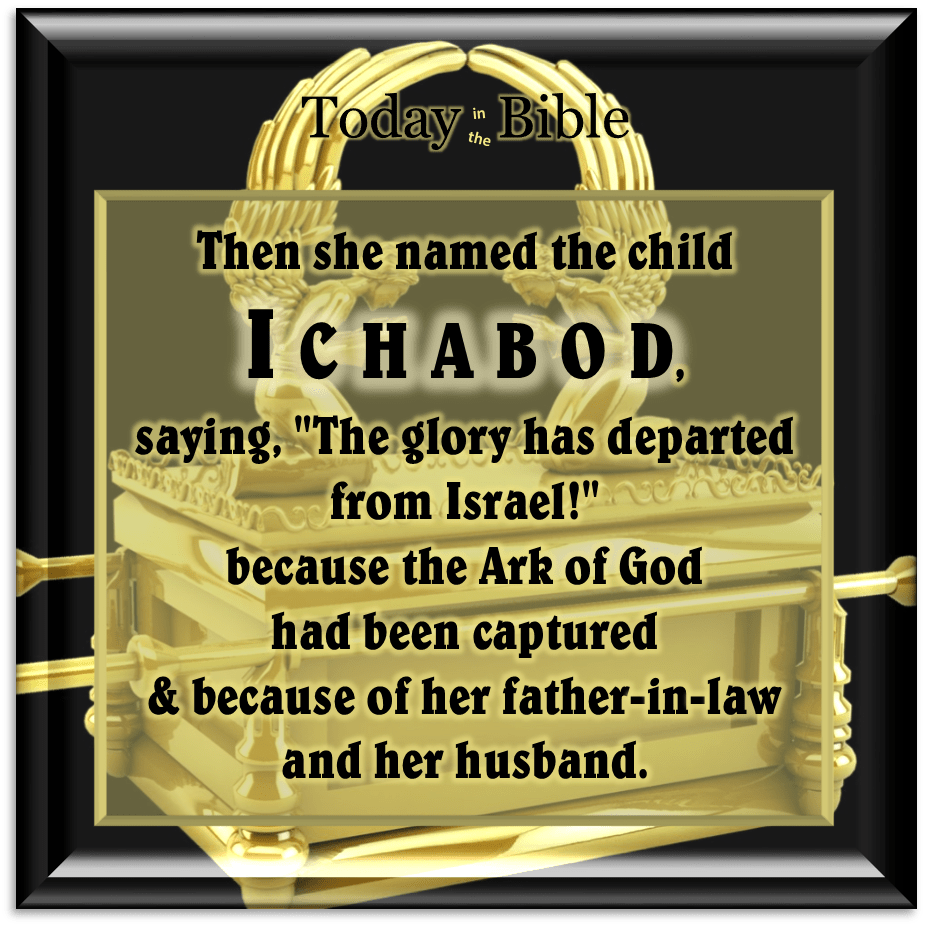
Then she named the child Ichabod, saying, “The glory has departed from Israel!” because the Ark of God had been captured and because of her father-in-law and her husband. And she said, “The glory has departed from Israel, for the Ark of God has been captured.”
Then the Philistines took the Ark of God and brought it from Ebenezer to Ashdod. – 1 Samuel 4:10-5:1 (NKJ)
Yesterday we looked at the words “teruah gedolah” – today we’ll study another word or two of interest.
But first, let’s recollect our study from a few days ago. We considered different possibilities for the cause of Eli’s poor eyesight. Today, we meet up with Eli again, he is sitting on his “kisse” – “watching.” Let’s call out two things here. First, are we sure we want Eli to be the one who’s watching? A guy who’s nearly blind? And, second, NOW he decides to watch out for the Ark of the Covenant??? He did not care enough about the Word of God in the past – at least not enough to reign in his sons’ lawlessness!
Moving on, there is a lot of word-play in the text revolving around the naming of the child, Ichabod. Ichabod is a combination of two Hebrew words: “i” and “chavod.”
אִ-כָבוֹד
The first part, אִ, indicates a movement away from something…i.e. a departure. It is transliterated into English as the letter “i” – but this letter/vowel point combination is pronounced like “ee.”
The second part, כָבוֹד, comes from a root word which means “to be heavy, grievous, hard, rich, honorable, or glorious.” It is transliterated as “chavod” and pronounced like “kha-vode.” In Hebrew there are a few letters which can represent more than one sound, depending upon the structure of the word. Chavod contains two of these letters. The first is “כ” – when there is a dot located within this letter (כּ) it makes a harder “k” sound; if there is no dot in the letter (כ), it makes a softer “ch” sound, similar to the “ch” sound in the name Bach. The second letter pulling double-duty is “ב” which can make either a “b” (בּ) or a “v” (ב) sound. Again, the letter with the dot makes a harder sound. This is why we often see I-chavod’s name transliterated as “Ichabod.”
I-chavod’s mother explains the meaning of her son’s name: “Departing Glory.” The word “chavod” is often used to describe the “Glory of the LORD;” hence Phinehas’ wife’s declaration, “‘the glory has departed from Israel!’ – because the Ark of God had been captured.” But if you keep reading, verse 21 continues, “because the Ark of God had been captured and because of her father-in-law and her husband.” What do Eli and Phinehas have to do with departing glory?
Let’s back up a minute. In verse 18, the text tells us that, “Eli fell off the seat backward…for the man was old and heavy.” First, let’s take a look at the word translated here as “seat.” In Hebrew, this word is כִּסֵּא (“kisse” – pronounced like “kee-say”). We studied this word a few days ago. When we first met Eli, he was sitting on the “kisse” by the door of the Tabernacle. We learned that a “kisse” is a seat of honor (“chavod”) and that Eli and his sons were not conducting the service of the LORD in an honorable manner. Now, we see that Eli has “fallen off his ‘kisse’” – he has literally departed (“i”) from his seat of honor (“chavod”). Both Eli and Phinehas have departed from their positions of “honor/glory” (“Ichabod”) – just as Phinehas’ wife declared.
If we think back to when we studied Hannah’s Song, she spoke of God raising the poor and making them inherit the throne of glory. Mary, the mother of Jesus, also had a song which mirrors that of Hannah’s in many ways. She spoke of putting down the mighty from their thrones and exalting the lowly.
He raises the poor from the dust and lifts the beggar from the ash heap, to set them among princes and make them inherit the throne of glory. – Hannah’s Song – 1 Samuel 2:8
He has put down the mighty from their thrones, and exalted the lowly. – Mary’s Song – Luke 1:52
But we’re not done with the wordplay yet! The text tells us that Eli was old and “heavy.” The word translated as “heavy” is כָכֵד (“chaved” – pronounced like “kha-vaid”). Chaved is a word that comes from the same root as כָבוֹד (“chavod”). If you remember, we stated that “chavod” comes from a root which means “to be heavy, grievous, hard, rich, honorable, or glorious.” A few days ago, we “supposed” that Eli may have been heavy because he and his sons were eating the fat from the sacrifices brought before the LORD; something that was prohibited by God’s Law. Phinehas may have also been a “heavy” man. It appears Eli and his sons traded the “chavod” of the LORD for the “chaved” of their bodies.
I don’t know about you, but in the past when I heard the name Ichabod, all I could think about was the Legend of Sleepy Hollow and Ichabod Crane and the headless horseman. But now, after unlocking the Hebrew behind the story, all of that has changed. Studying the Hebrew Scriptures in their original language often brings forth amazing finds!
We’re not done with the story of the Philistines and the Ark of the Covenant – or with studying the “Chavod of the LORD.” The Bible tells us that the Philistines had possession of the Ark for seven months. So, over the next few months, we’ll check in from time to time to see what the “Chavod of the LORD” means to the Philistines.
To read all of our posts on Samuel, the Philistines, and the Ark of the Covenant, click on the name Shemu’el above.

© 2026 Today in the Bible

 Today in the Bible
You must be logged in to post a comment.