

Cheshvan 7, 5785; from sunset November 7, 2024, to sunset November 8, 2024
(The seventh day of the eighth month)
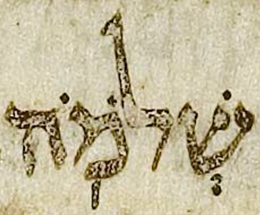
This is the name “Shelomoh” (שְׁלׄמׄה – Solomon) as seen in the Aleppo Codex, written over one thousand years ago. The name Solomon stems from the verb-root “shalam” meaning “to be complete, sound, or peaceful.” It’s the same root that the familiar word “shalom” comes from.
Last Pilgrims Return Home
On the twenty-third day of the seventh month he sent the people away to their tents, joyful and glad of heart for the good that the LORD had done for David, for Solomon, and for His people Israel. – 2 Chronicles 7:10 (NKJ)
After the festival of Sukkot, Solomon sent the people home. All of those who made the pilgrimage to Jerusalem began to caravan back to their dwelling places – thousands streamed out from the Holy City, taking all that holiness with them back to their regular lives. During the Second Temple era, Cheshvan 7 was the date on which the most distant Jew, who resided on the banks of the Euphrates River, arrived at his homestead. All Jews would wait for this day before beginning to pray for rain.
In the fifth and sixth months (Av and Elul), we focus our attention upon repentance – getting ready for the High Holy Days to come. In the seventh month (Tishrei) we observe the sacred Appointed Times – where our focus is upon God and His great mercy, loving-kindness, and desire to dwell with us. Once we’re all home again, in the eighth month (Cheshvan), we return to our ordinary, every-day lives. We’re back to pruning and planting and working in our vineyards and orchards. The sages saw this day as a time when the people of Israel were once more back home, each under his own vine and fig tree – a symbol of the Messianic Era – an extension of the Feast of Tabernacles. If all of the repentance and spirituality of the past few months stick with us, we should have learned all that we need to know to live our life now as a reflection of the day when Yeshua (Jesus), our Messiah, ushers in that era. The Torah of God can be compared to the rains from heaven…necessary for growth and refreshment.
Below is the Ashkenazi version of the prayer for rain…the tefillat geshem. It is added to the daily prayers beginning today and continuing until Passover, at which time it is exchanged with the prayer for dew.
Our God and God of our ancestors:
Remember Abraham who flowed to You like water. You blessed him like a tree planted by streams of water. You rescued him from fire and water. He passed Your test by planting good deeds by every source of water. For Abraham’s sake, do not keep back water.
Remember Isaac, whose birth was foretold when Abraham offered the angels a little water. You asked his father to spill his blood like water. In the desert Isaac dug and found wells of water. For Isaac’s sake, do not keep back water.
Remember Jacob, who crossed the Jordan’s water. He bravely rolled the stone off the mouth of the well of water. He wrestled with an angel made of fire and water, and therefore You promised to be with him through fire and water. For Jacob’s sake do not keep back water.
Remember Moses, who was drawn in a reed basket out of the Nile’s water. Who helped Jethro’s daughters: He drew water and gave the sheep water. He struck the rock and out came water. For Moses’ sake do not hold back water!
Remember Aaron, the High Priest, who, on Yom Kippur, washed himself five times with water, he prayed and was sprinkled with purifying water, he kept apart from a people who were as unstable as water. For Aaron’s sake do not hold back water.
Remember the Twelve Tribes whom You brought through the divided waters; for whom You sweetened bitter water; their descendants’ blood was spilled like water. Turn to us, God, who are surrounded by troubles like water. For the Jewish people’s sake, do not hold back water.
You are Adonai, our God Who causes the wind to blow and the rain to fall. For blessing and not for curse. Amen. For life and not for death. Amen. For plenty and not for lack. Amen.
Did you know that you can view any of our posts whenever you’d like?
Visit our home page at https://todayinthebible.com
where you can find them organized by month
in the “Archives” section on the right side of the page.

© 2026 Today in the Bible

 Today in the Bible
You must be logged in to post a comment.