
Cheshvan 11, 5785; from sunset November 11, 2024, to sunset November 12, 2024
(The eleventh day of the eighth month)
Today’s post is traditionally dated to Cheshvan 11; however, we’re taking an early look at it, on Cheshvan 8, in order to make room for another post which is dated to the 11th of Cheshvan.
In a few days, the Bible will tell us that Noah, his family, and the animals enter the ark…just a week before the rains begin. But before they go in, the book of Jasher [1] says that Noah’s grandfather, Methuselah, died.
Methuselah
Genesis chapter five provides us with the “toldot” of Adam. We’ve studied the word “toldot” before. It was a part of our article for the first day of creation. If you remember, we looked at Genesis 2:4 where it says, “This is the ‘history‘ of the heavens and the earth…” We learned that, in Hebrew, the word translated as “history” is “toldot” – which comes from the verb “yalad” meaning” to give birth.” The creation narrative provided us with images that could be compared to the birthing of a child.
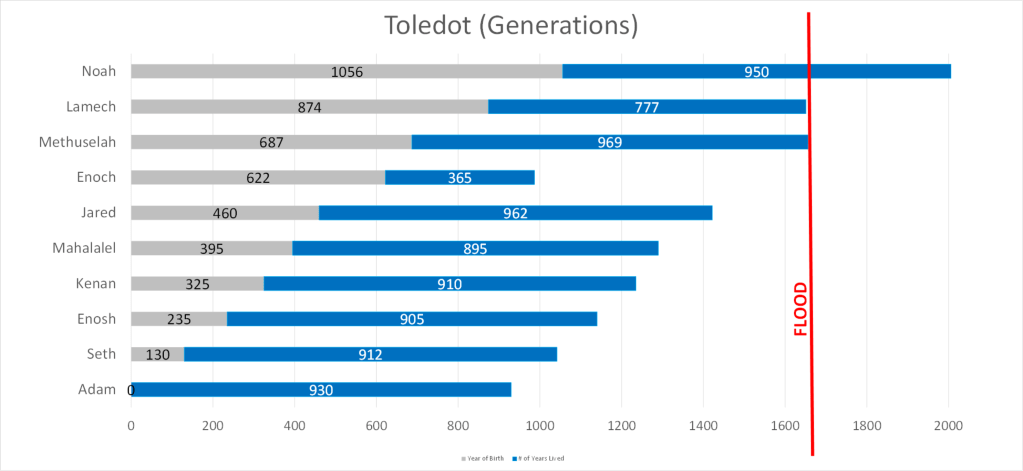
Adam’s toldot is a listing of the birthings, the generations, of Adam and his descendants. It contains their age at the time their son was born and their age at their death. If you are a complete Bible nerd (like me), you can graph it out. Working off of the data provided in Genesis 5, the graph below shows the generations from Adam to Noah. The numbers in the gray bar represent the year that each person was born (from creation). The numbers in the blue portion of the bar represent length of their lives. The red line represents the year of the flood.
Now that we’ve got an idea of where Methuselah falls in Adam’s toldot; let’s read about his birth:
Enoch lived sixty-five years, and begot Methuselah. After he begot Methuselah, Enoch walked with God three hundred years, and had sons and daughters. So all the days of Enoch were three hundred and sixty-five years. And Enoch walked with God; and he was not, for God took him.
Methuselah lived one hundred and eighty-seven years, and begot Lamech. After he begot Lamech, Methuselah lived seven hundred and eighty-two years, and had sons and daughters. So all the days of Methuselah were nine hundred and sixty-nine years; and he died.
Lamech lived one hundred and eighty-two years, and had a son. And he called his name Noah, saying, “This one will comfort us concerning our work and the toil of our hands, because of the ground which the LORD has cursed.” After he begot Noah, Lamech lived five hundred and ninety-five years, and had sons and daughters. So all the days of Lamech were seven hundred and seventy-seven years; and he died.
And Noah was five hundred years old, and Noah begot Shem, Ham, and Japheth. –Genesis 5:21-32 (NKJ)
As you can see, all of Noah’s ancestors either died or were taken by God before the flood occurred. The extra-biblical book of Jasher provides additional insight.
And all the sons of men who knew the Lord, died in that year before the Lord brought evil upon them; for the Lord willed them to die, so as not to behold the evil that God would bring upon their brothers and relatives, as he had so declared to do. – Jasher 5:21
At that time, after the death of Methuselah, the Lord said to Noah, Go thou with thy household into the ark; behold I will gather to thee all the animals of the earth, the beasts of the field and the fowls of the air, and they shall all come and surround the ark. – Jasher 6:1
It’s kind of hard to tell on the graph, but according to our reckoning, Lamech died about five years before his father Methuselah. It’s obvious that Enoch was taken before Lamech died. That leaves Methuselah and Noah; everyone else on the list of Adam’s descendants died long before the flood.
According to Jasher, Methuselah died just one week prior to the flood. The traditional date for his death is Cheshvan 11 – in three days’ time from the date of this post – but we’ll be studying the death of another biblical character on that day. Hopefully Methuselah won’t mind if we remember him today instead.
Methuselah lived the longest of anyone recorded in the Bible. He saw a lot in his days – even the death of the first man, Adam. The book of Jasher says that two of Adam’s sons, along with Methuselah and Lamech, buried Adam “with great pomp, as at the burial of kings, in the cave which God had told him. And in that place all the sons of men made a great mourning and weeping on account of Adam…” (Jasher 3:14-15). The wording in this text brings to mind a prophecy from Zechariah 12:10:
…they will look on me, the one they have pierced, and they will mourn for him as one mourns for an only child, and grieve bitterly for him as one grieves for a firstborn son. – Zechariah 12:10 (NIV)
John 19:37 connects this prophecy to Jesus, the “last Adam” (1 Corinthians 15:45), who will be mourned in the same way as the first Adam was. One big difference, Jesus is alive and well.
During his days, Methuselah saw the deaths of his…
- Grandfather, Jared
- Great grandfather, Mehalalel
- Great, great grandfather, Kenan
- Great, great, great grandfather, Enosh
- Great, great, great, great grandfather, Seth
- Great, great, great, great, great grandfather, Adam
His father, Enoch, also was “no more” during Methuselah’s days, for God took him. Finally, Methuselah saw the death of his own son, Lamech. On the flip side, Methuselah saw the births of his…
- Son, Lamech
- Grandson, Noah
- Great, grandsons, Shem, Ham, and Japheth
According to Jasher, Methuselah learned the ways of his father Enoch who walked with God. In Hebrew, verbs take on different forms than they do in English. It’s not just past, present, and future. The structure of a word can also indicate the causation and intensity of the action. In Enoch’s case, he “walked” with God. The verb form indicates this was something that he caused himself to do with an increased intensity, also in a reciprocating manner. Let’s take a look at several translations of the verse. The New King James version is typical of most translations. The others do a better job of picking up on the extended meaning of the verb stem.
After he begot Methuselah, Enoch walked with God three hundred years, and had sons and daughters. – Genesis 5:22 (NKJ)
After the birth of Methuselah, Enoch lived in close fellowship with God for another 300 years, and he had other sons and daughters. – Genesis 5:22 (NLT)
After he became the father of Methuselah, Enoch walked faithfully with God 300 years and had other sons and daughters. – Genesis 5:22 (NIV)
And Enoch walketh habitually with God after his begetting Methuselah three hundred years, and begetteth sons and daughters. – Genesis 5:22 (YLT)
We’ll want to keep this verb form in mind when we move on to the toldot of Noah tomorrow. Noah also walked with God in the same way as his great, grandfather Enoch – and one could assume that Methuselah did as well. Jasher goes on to say that Methuselah spent his years teaching the way of righteousness and passed down the knowledge of the LORD to his grandson, Noah.
As we’ve become accustomed to doing, let’s learn the meaning of the name Methuselah.
מְתוּשָׁלַח
As with many biblical names, there is more than one possibility for the meaning of Methuselah. In Hebrew, his name is pronounced like Meh-too-shah-lahkh.
Methuselah consists of two elements. The first part is מת (mt). This letter combination has a couple of possibilities.
- מת = “mat” meaning “man.” It is used most often to indicate a male capable of combat.
- מות = “mut” meaning “to die.”
I think it’s possible that these two root-words are related. Man, after all, is mortal.
The second part comes from the verb שלח (shalach).
- שלח = “shalach” meaning #1 “to send,” “to send away,” or “to let go.” Related nouns include “shaliach,” which is an apostle, a “sent one;” and “shelach” which is a type of a weapon – a spear, javelin, or some sort of missile that is thrown and “let go.”
- שלח = “shalach” meaning #2 “to strip off a hide.” This particular verb is not used in the Hebrew Scriptures. (It has cognates in the Arabic and Syriac languages.) Yet, there is a Hebrew noun stemming from this root which is present in the Bible. It is “shulchan” which means “table.” Shulchan is most famously used in Psalm 23, “You prepare a table (shulchan) before me in the presence of my enemies.” It is thought that the connection between an animal hide and a table comes from the act of spreading an animal hide over the ground in preparation for eating a meal.
So, how do scholars define the name Methuselah? Here are three meanings from three different dictionaries.
- Fausset Dictionary: “he dies (met) and (u) it (the flood?) is sent (shalach).”
- ISBE Encyclopedia: “man (met) of (u) the javelin (shelach).”
- Easton Dictionary: “man (metu) of (u) the dart (shelach).”
Which one do you think is correct? It’s tempting to accept Fausset’s definition in light of the tradition of the date of Methuselah’s death, but we just don’t know for sure.
1 The book of Jasher is mentioned in Joshua 10:13 and 2 Samuel 1:18; however, the book itself has long been lost. The version floating around out there today is questionable and most scholars dismiss it; though it can add color to some biblical stories – it should not be considered authentic.
If you’d like to read all of our posts on Noah, please click on the image above.

© 2026 Today in the Bible

 Today in the Bible
You must be logged in to post a comment.