
Cheshvan 9, 5785; from sunset November 9, 2024, to sunset November 10, 2024
(The ninth day of the eighth month)
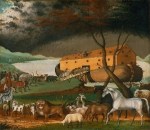
Noah’s Ark (1846), by the American folk painter Edward Hicks.
In a couple of days, the Bible will tell us that Noah, his family, and the animals enter the ark…just a week before the rains begin. But before they do, let’s look at Noah’s toldot. Yesterday, we remembered the toldot of the heavens and the earth in the creation narrative; as well as the toldot of Adam. If we move on to Genesis chapter six, we see that Noah’s story also begins with his toldot.
This is the “toldot” of Noah. Noah was a just man, perfect in his generations. Noah walked with God. – Genesis 6:9
Just as the story of creation began with the toldot of the heavens and the earth; the story of Noah also begins with a toldot. In a sense, God was going to “uncreate” and “recreate” the world. Noah was like a second Adam, but that’s something we’ll take a look at more closely as we study further about Noah’s toldot. Over the next year, we’ll follow Rashi’s1 timeline for the flood and check in with Noah at key points in his journey.
In the text above, we see that Noah “walked” with God. We studied this word yesterday, Noah’s great grandfather, Enoch, also “walked” with God. We learned that the form of this verb indicated that Enoch and, now, Noah caused themselves to intensively, reflexively walk with God. Since we’re making comparisons to the creation narrative, here is one more similarity. In the verses below, the word “walking” (called out below) is found in the same intensive, reflexive verb form as it is with Enoch and Noah.
Now the serpent was more cunning than any beast of the field which the LORD God had made. And he said to the woman, “Has God indeed said, `You shall not eat of every tree of the garden’?”
And the woman said to the serpent, “We may eat the fruit of the trees of the garden; but of the fruit of the tree which is in the midst of the garden, God has said, `You shall not eat it, nor shall you touch it, lest you die.’”
Then the serpent said to the woman, “You will not surely die. For God knows that in the day you eat of it your eyes will be opened, and you will be like God, knowing good and evil.”
So when the woman saw that the tree was good for food, that it was pleasant to the eyes, and a tree desirable to make one wise, she took of its fruit and ate. She also gave to her husband with her, and he ate. Then the eyes of both of them were opened, and they knew that they were naked; and they sewed fig leaves together and made themselves coverings.
And they heard the sound of the LORD God walking in the garden in the cool of the day, and Adam and his wife hid themselves from the presence of the LORD God among the trees of the garden.
Then the LORD God called to Adam and said to him, “Where are you?” – Genesis 3:1-9 (NKJ)
I don’t know about you, but in the past when I’ve read this verse, I had in my mind a picture of God casually strolling through the garden. But now, after understanding what the form of the verb indicates, I have a much different view.
I compare this to something that may have happened in my childhood. Picture my brothers, sister, and I in the living room playing while Mom is in the kitchen preparing dinner. All of the sudden, she hears a big crash coming from the direction of the living room. Now, do you think she’s going to casually stroll into the room, or do you think she’s going to intensively, reflexively move into the room? Of course, she’s on a mission, she’s causing herself to move with intensity. “What happened?! What was the cause of the crash? Was anyone hurt?!”
This is the intensity of action I now envision God had when “walking” through the garden to get to Adam and Eve. The crash = the disobedience of His children. He caused Himself to move with intensity; most likely in order to prevent the next planned act of the serpent – to get Adam and Eve to eat from the Tree of Life and live forever in their sinful state. Our Father was not about to let that happen!
With this picture in mind, let’s return to Noah. He intentionally caused himself to walk intensively with God. The verse says that he was “perfect in his generation.” When we compare Noah’s actions to those of the others in his generation, we see a stark difference. Let’s take a peek at what the Bible has to say about the days of Noah.
Then the LORD saw that the wickedness of man (adam) was great in the earth, and that every intent of the thoughts of his heart was only evil continually.
And the LORD was sorry that He had made man on the earth, and He was grieved in His heart. So the LORD said, “I will destroy man whom I have created from the face of the earth, both man and beast, creeping thing and birds of the air, for I am sorry that I have made them.”
But Noah found grace in the eyes of the LORD.
This is the genealogy of Noah. Noah was a just man, perfect in his generations. Noah walked with God. – Genesis 6:5-9 (NKJ)
When reading the underlined words in their full Hebrew meanings, this verse conveys that, “every form, framing, and intent of the thoughts of their “heart” – their mind, will, and inner-most being – was always, only, continually — evil.” This is the equivalent to “intensively, reflexively walking with evil.” The Bible wants us to see the juxtaposition between the righteousness of Noah’s “walk” with God and the exact opposite “walk” of the rest of his generation.
To further our comparison to the creation narrative, the text above translated as “man” is actually “adam” in Hebrew. It goes on to give us God’s reaction to “adam’s” sin this time. When “Adam” sinned, God covered him with a tunic of skin. In the story of Noah, when “adam” sinned, God was sorry He made man. He regretted it. The lexicon states that the origin of the word translated as “sorry” seems to reflect the idea of “breathing deeply” – a big sigh – hence the physical display of one’s feelings, usually sorrow, compassion, or comfort. It goes on to say that He was “grieved.” This word also indicates a physical reaction — this time it was pain. God was grieved, pained in His “heart” – His mind, will, inner-most being. He was hurt like only someone who loves deeply can be hurt.
When Jesus was asked about the end days, He compared them to the days of Noah.
“But as the days of Noah were, so also will the coming of the Son of Man be. For as in the days before the flood, they were eating and drinking, marrying and giving in marriage, until the day that Noah entered the ark, and did not know until the flood came and took them all away, so also will the coming of the Son of Man be.” – Matthew 24:37-39 (NKJ)
Now we have a better idea of what it was like in the days of Noah.
- Rashi is an acronym for “Rabbi Shlomo Yitzchaki,” a medieval French rabbi who authored comprehensive commentaries on the Talmud and Hebrew Bible. ↩︎
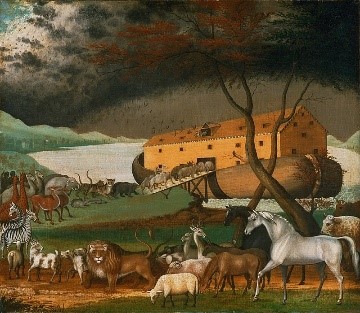
If you’d like to read all of our posts on Noah, please click on the image above.

© 2026 Today in the Bible

 Today in the Bible
You must be logged in to post a comment.