
Cheshvan 10, 5785; from sunset November 10, 2024, to sunset November 11, 2024
(The tenth day of the eighth month)
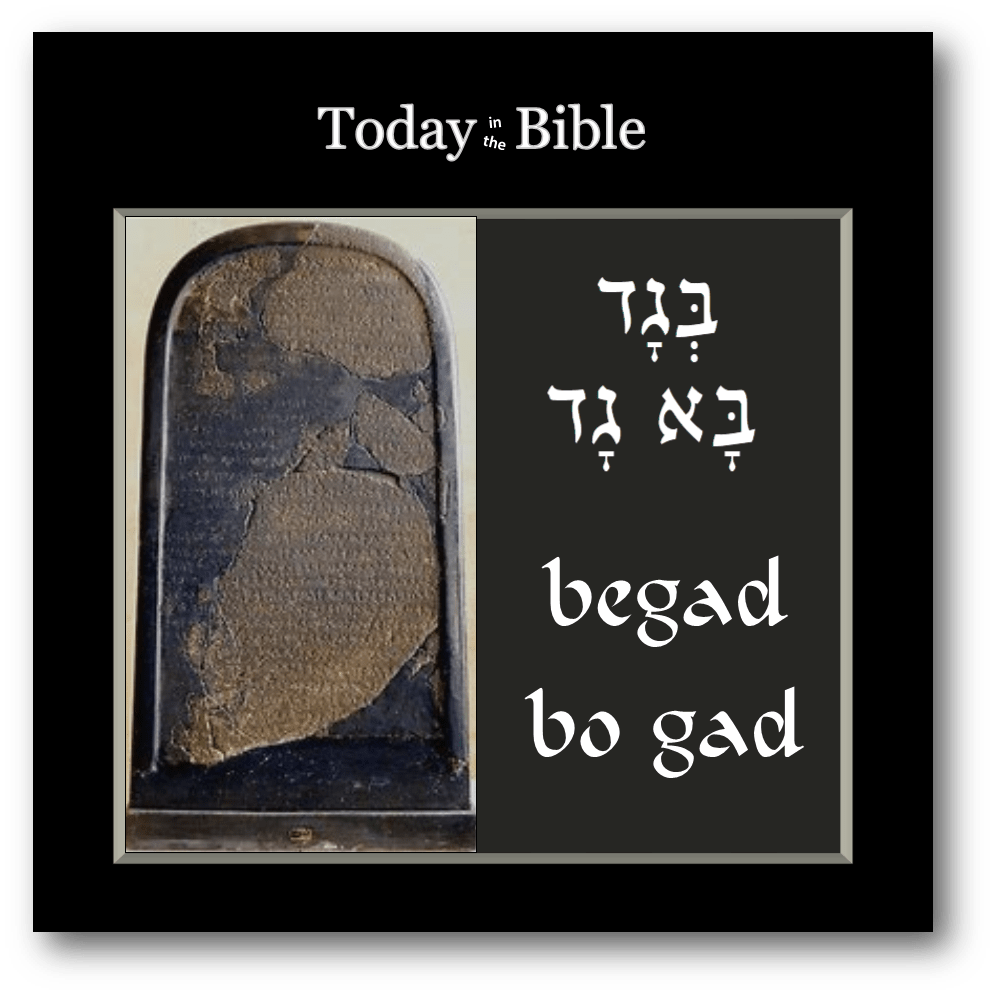
This is an image of the Mesha Stele, also known as the Moabite Stone. It was discovered in 1868 in Dhiban, Jordan, and dated to 840 BC. It is a Canaanite inscription in the name of King Mesha of Moab in which the tribe of Gad is mentioned, “And the men of Gad dwelled in the country of Ataroth from ancient times.” The stele goes on to boast of a Moabite conquest resulting in the removal of Israelite oppression. There seems to be a parallel of these events described in 2 Kings chapter 3 which you are hereby encouraged to read. (cf Wikipedia, Mesha Stele).
Birth of Gad
According to tradition, Gad was born on the 10th of Marcheshvan. He lived to be 125 years old. (Yalkut Shimoni, Shemot, remez 162). Gad was the first son of Jacob by Leah’s maid Zilpah, the seventh son of Jacob overall.
When Leah saw that she had stopped bearing, she took Zilpah her maid and gave her to Jacob as wife. And Leah’s maid Zilpah bore Jacob a son. – Genesis 30:9-10 (NKJ)
There are a couple of ideas as to the meaning of the name Gad. Below are representatives of the two types of translations for his name.
Then Leah said, “What good fortune!” So she named him Gad. – Genesis 30:11 (NIV)
Then Leah said, “A troop comes!” So she called his name Gad. – Genesis 30:11 (NKJ)
Gad comes from the verb-root “gadad” which means “to cut or invade.” Some of the nouns stemming from this root are:
- gedud (I): a marauding band
- gedud (II): a furrow, a cutting
- gad (I): coriander
- gad (II): fortune
- Gad: Gad, 7th son of Jacob
As a verb, this root is used eleven times, nine of which are used to refer to the self-laceration used in mourning customs or as an act of worship, the type described in the story of Elijah and the ba’als on Mount Carmel (1 Kings 18).
When reading about his birth in the original Hebrew, we see the following word-play.
וַתֹּאמֶר לֵאָה (בְּגָד) [בָּא גָד] וַתִּקְרָא אֶת-שְׁמוֹ גָּד
Vatomer Le’ah, “Begad bo gad,” vatikra et-shemo Gad.
And she said, Leah, “Begad bo gad” (in gad comes gad), and she called his name Gad.
In English, we capitalize proper nouns; that’s not the case in Hebrew, there are no capital letters in their alphabet. So how, where, do we capitalize the Gs in “begad bo gad” — if at all?
According to the sage, Rashi, Gad means “mazal tav” or “good luck.” He would translate “begad bo Gad,” something like, “In luck has come Gad.” The Isaac Leeser version (a Jewish translation from the 1800s) reads, “And Leah said, ‘Good luck hath come: and she called his name Gad.’”
Another sage from around the same era as Rashi, Ibn Ezra, said that Gad means a troop (as gedud), and this is what Leah meant when she said “beGad bo gad” – “in Gad comes a troop” for her sons now made up a whole “troop.”
Most versions follow along with the “good fortune” translation; the King James, New King James, and Young’s Literal Translations all render “troop.”
When Jacob was dying, he called his sons together.
And Jacob called his sons and said, “Gather together, that I may tell you what shall befall you in the last days: gather together and hear, you sons of Jacob, and listen to Israel your father. – Genesis 49:1-2 (NKJ)
These are the words he spoke over Gad; let’s use the same two translations as above.
Gad will be attacked by a band of raiders, but he will attack them at their heels. – Genesis 49:19 (NIV)
Gad, a troop shall tramp upon him, but he shall triumph at last. – Genesis 49:19 (NKJ)
Let’s look at his words in the original Hebrew:
גָּד גְּדוּד יְגוּדֶנּוּ וְהוּא יָגֻד עָקֵב:
“Gad gedud yegudenu vehu yagud akev.”
Did you catch the wordplay employed by Jacob? Gad, gedud, yegudenu, and yagud are all words that comes from our verb-root “gadad.” Another possible play on words here is the word “akev” – “heel” – the name Jacob (Ya’akov) comes from the same root. Perhaps in the story recounted in 2 Kings chapter 3, Mo’ab is the band of raiders who trampled over Gad from Jacob’s prophecy; but in the last days, they will triumph. The territory of the tribe of Gad was on the east side of the Jordan River, in what is now the country of Jordan. In the last days, we expect that the full borders of Isra’el will be returned to them by the hand of the God of Ya’akov.
As for Moses, his blessing over Gad is as follows:
And of Gad he said: “Blessed is he who enlarges Gad; he dwells as a lion and tears the arm and the crown of his head. He provided the first part for himself, because a lawgiver’s portion was reserved there. He came with the heads of the people; he administered the justice of the LORD, and His judgments with Israel.” – Deuteronomy 33:20-21 (NKJ)
The city of Ataroth mentioned in the Mesha Stele (and assumed to refer to the city by that name located within the borders of Gad) is located on a summit (or crown?) of a plateau. The name Ataroth comes from the verb-root “atar” which means “to surround.” The word “ataroth” means “a crown or a wreath.” The word translated as “crown” in Moses’ prophecy does not come from the same root but does refer to “the crown of the head.” Since the city of Ataroth was requested as their inheritance by the tribe of Gad, perhaps Moses is making a veiled reference to it here? Others see the name Ataroth as referring to a cattle enclosure – the tribe of Gad was wealthy in herds and chose this land because it was good for grazing. As mentioned above, the verb atar means to surround.
The book of Jasher mentions that Gad took a wife from among the daughters of Amuram, the grandson of Abraham’s brother Nahor.
And Gad and Naphtali went to Haran and took from thence the daughters of Amuram the son of Uz, the son of Nahor, for wives. And these are the names of the daughters of Amuram; the name of the elder was Merimah, and the name of the younger Uzith; and Naphtali took Merimah, and Gad took Uzith; and brought them to the land of Canaan, to their father’s house. – Jasher 45:9-10
Unto Gad and Uzith were born seven sons.
And the sons of Gad were Ziphion, Chaggi, Shuni, Ezbon, Eri, Arodi and Areli. – Jasher 59:15
Which corresponds to Gad’s children as listed in Genesis 46:16.
The sons of Gad: Zephon, Haggi, Shuni, Ezbon, Eri, Arodi and Areli. – Genesis 46:16 (NIV)
Jasher also recounts the circumstances around the death of Gad, which is traditionally attributed to have occurred on the same calendar day as his birth.
And in the eighty-third year died Gad, he was a hundred and twenty-five years old at his death, and he was put into a coffin in Egypt, and given into the hands of his children. – Jasher 62:5
Did you know that you can view any of our posts whenever you’d like?
Visit our home page at https://todayinthebible.com
where you can find them organized by month
in the “Archives” section on the right side of the page.

© 2026 Today in the Bible

 Today in the Bible
You must be logged in to post a comment.