Kislev 18, 5785; from sunset December 18, 2024, to sunset December 19, 2024
(The eighteenth day of the ninth month)
Noah’s Ark (1846), by the American folk painter Edward Hicks.
Last time we checked in with Noah, we learned how the ark “walked” upon the surface of the water and compared that to Jesus’ walking on the water. Today we’ll dig into the word a little deeper and see what else we can scratch out of it.
Then the flood came upon the earth for forty days; and the water increased and lifted up the ark, so that it rose above the earth. And the water prevailed and increased greatly upon the earth; and the ark floated on the surface of the water.
And the water prevailed more and more upon the earth, so that all the high mountains everywhere under the heavens were covered. The water prevailed fifteen cubits higher, and the mountains were covered.
And all flesh that moved on the earth perished, birds and cattle and beasts and every swarming thing that swarms upon the earth, and all mankind; of all that was on the dry land, all in whose nostrils was the breath of the spirit of life, died.
Thus He blotted out every living thing that was upon the face of the land, from man to animals to creeping things and to birds of the sky, and they were blotted out from the earth; and only Noah was left, together with those that were with him in the ark. – Genesis 7:17-23 (NAS)
If we read between the lines, perhaps we could say that God was “undoing” creation. In many ways we’re back to the way it was “in the beginning.” The waters and the dry ground were no longer separated. The waters above and the waters below were reunited. The earth was once again entirely surrounded by water. In the Creation narrative, God gave every living creature the breath of life. Here, all creatures with the breath of life have now had it taken away.
We started this blog on the traditional first day of creation and noticed similarities between the opening lines of the Bible and the birth of a child. Perhaps we can understand the story of Noah as a rebirth? Being born again, if you will.
Rabbi Shneur Zalmen of Liadi, described the flood as a cleansing process. The waters of the flood are like the waters of a “mikveh,” a ritual immersion, where the waters spiritually cleanse the dross that had accumulated. The world received a spiritual cleansing and was made like unto a new creation. Its sinfulness was washed away. When we become believers, we – like the world in the story of Noah – are baptized into the work of Jesus; a spiritual cleansing that becomes ours. We die to our old sinful way of life, are reborn, and become a new creation.
Therefore, if anyone is in Christ, he is a new creation; old things have passed away; behold, all things have become new. – 2 Corinthians 5:17 (NKJ)
And this picture continues…the Bible says that every living thing died…all, except those who were with Noah in the ark. If we use Noah as a depiction of Jesus, our text would read…
Thus God blotted out every living thing that was upon the face of the earth, from man to animals to creeping things and to birds of the sky, and they were blotted out from the earth; and only Jesus was left, together with those that were with Him.
The story of Noah can be seen as an analogy of what it means to choose Jesus as our Messiah. He is the Way to eternal life in the new heavens and the new earth that John saw in the book of Revelation. A place that has been cleansed of the great sinfulness of mankind.
Thank you for studying with us today. We hope you’ll consider joining us again.
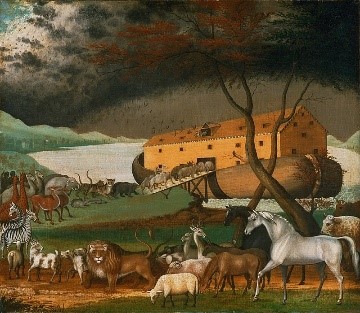
If you’d like to read all of our posts on Noah, please click on the image above.

© 2026 Today in the Bible

 Today in the Bible
You must be logged in to post a comment.