
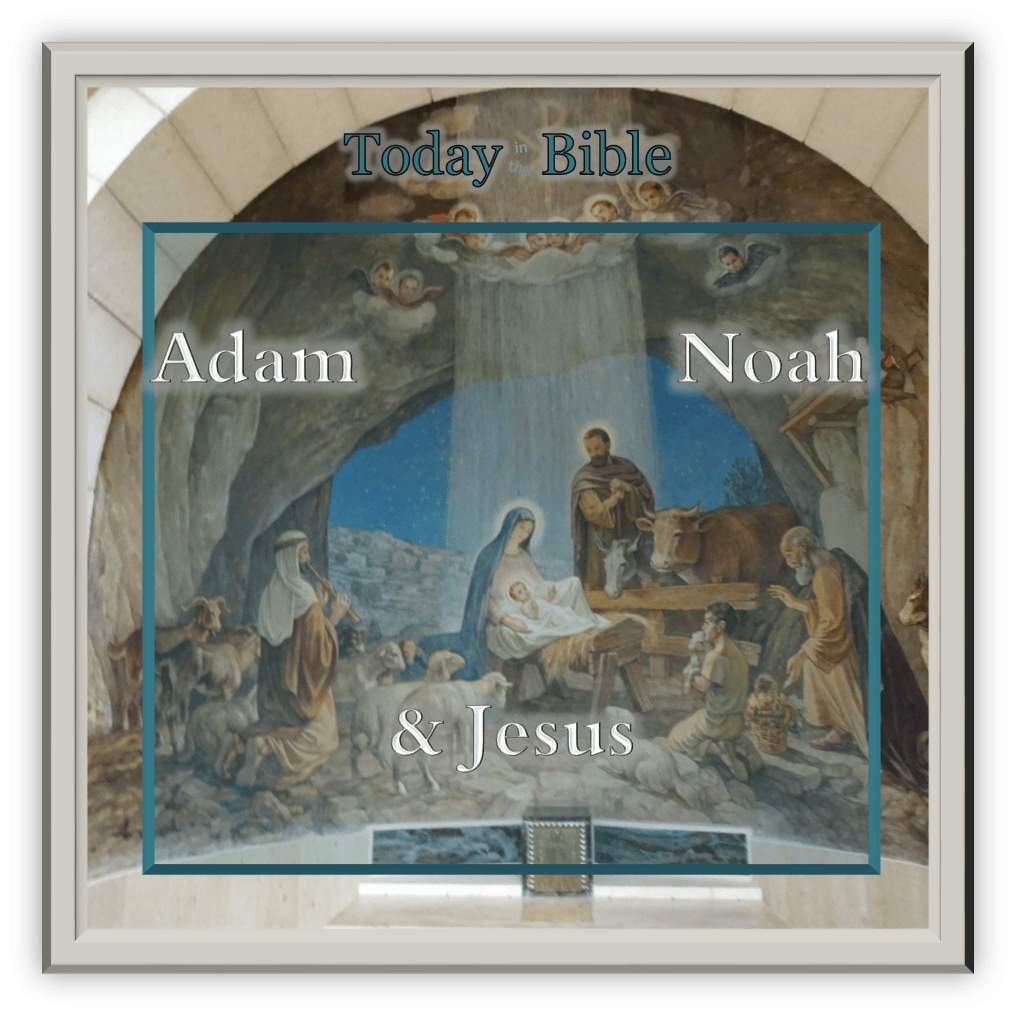
The last time we checked in with Noah, the windows of the heavens were closed and the rains had stopped falling. Since the time Noah entered the ark, about two months ago, we’ve made several comparisons between him and Jesus. We’ve also compared the flood to the creation narrative – a “re-creation” if you will. A fresh start after the world had been cleansed from its great sinfulness. You could say that Noah was like a “Second Adam.” Jesus is called the “Last Adam” (1 Corinthians 15:45). He also dealt with the great sinfulness of the world, and those that are in Him are a new creation (2 Corinthians 5:17).
With today recognized as the traditional day of Jesus’ birth, I’d like to propose an alternative date and bring Adam and Noah into the mix. Let’s take a deeper look into the comparison between these three men.
We started the Today in the Bible blog on the traditional first day of creation. We compared the description of the earth to that of a baby in a womb. Unformed. Surrounded by water. Existing in darkness. Then God said, “Let there be light.” And, like a baby emerging from the birth canal, light was seen for the very first time. In the story of Noah, we find ourselves in a similar situation. The earth was once again completely surrounded by water.
And the waters prevailed exceedingly on the earth, and all the high hills under the whole heaven were covered. The waters prevailed fifteen cubits upward, and the mountains were covered. – Genesis 7:19-20 (NKJ)
Nine months later, the mountain tops began to appear and the rebirth of the world began.
When we choose to become a follower of Jesus, we are baptized. A traditional baptism involves a complete submersion into water and a re-emergence. This follows the pattern of the world at its birth and in the story of its rebirth through the flood. We, too, are born anew (John 3:3).
God “formed man out of the dust of the ground” (Genesis 2:7) and called him, Adam. In Hebrew, the word “ground” is “adamah.” After Noah left the ark, most translators say that Noah became a farmer. The Hebrew says he became a man of the “adamah” (Genesis 9:20). Jesus, also, came down from heaven and became a man of the “adamah.”
The Bible tells us that Adam was created on the sixth day (Genesis 1:26-31). According to Jewish tradition, the creation of Adam occurred on the first day of the year. The first day of the year is called “Rosh Hashanah.” “Rosh” means “head” and “hashanah” means “of the year.” This occurs in late summer or early autumn of the northern hemisphere. When Israel returned from the Babylonian exile, they brought the Babylonian name of this month with them. It is now referred to as “Tishrei” which means “Beginning.”
There is a tradition, recorded in Seder Olam Radak, that Noah’s birthday was on the first day of the first month of the year. The apocryphal book of Jasher corroborates this date.
And the wife of Lamech conceived and bare him a son at that time, at the revolution of the year. And Methuselah called his name Noah, saying, “The earth was in his days at rest and free from corruption,” and Lamech his father called his name Menachem, saying, “This one shall comfort us in our works and miserable toil in the earth, which God had cursed.” – Jasher 4:13-14.
So here we see that Jewish tradition places the creation of Adam and the birth of Noah as occurring on the first day of the year.
At the time of the exodus from Egypt, God told Moses to make that month the first month of the year.
Now the LORD spoke to Moses and Aaron in the land of Egypt, saying, “This month shall be your beginning of months; it shall be the first month of the year to you.” – Exodus 12:1-2 (NKJ)
With this declaration, God turned what was the first month into the seventh month. It’s still the beginning of the year, but it’s no longer the first month. That title now belongs to the month when the Passover occurred, in the springtime, when the barley is ripe. The Babylonian calendar’s name for that month is Nisan.
In the book of Leviticus, God gave Moses a listing of Appointed Times. These are God’s self-proclaimed holy days. Let’s read Leviticus 23:23-25.
Then the LORD spoke to Moses, saying, “Speak to the children of Israel, saying: `In the seventh month, on the first day of the month, you shall have a sabbath-rest, a memorial of blowing of trumpets, a holy convocation. You shall do no customary work on it; and you shall offer an offering made by fire to the LORD.’” (NKJ)
Since God gave these instructions to Moses after the exodus from Egypt. That means that the seventh month listed here, is the seventh month according to God’s new reckoning. Therefore, the appointed time of the Feast of Trumpets and Rosh Hashanah occur on the same day of the calendar. The same day that tradition places the creation of Adam and the birth of Noah. There’s a lot of imagery associated with this day! I’d like to suggest that we could date one more event to this day. The birth of Jesus.
In the book of the Revelation of Jesus Christ, John recorded this vision…
Now a great sign appeared in heaven: a woman clothed with the sun, with the moon under her feet, and on her head a garland of twelve stars. Then being with child, she cried out in labor and in pain to give birth. And another sign appeared in heaven: behold, a great, fiery red dragon having seven heads and ten horns, and seven diadems on his heads. His tail drew a third of the stars of heaven and threw them to the earth. And the dragon stood before the woman who was ready to give birth, to devour her Child as soon as it was born. She bore a male Child who was to rule all nations with a rod of iron. And her Child was caught up to God and His throne. – Revelation 12:1-5 (NKJ)
If you think these verses are referring to the birth of Jesus, then there may be a significant clue to the date of His birth hidden in the text. In his website https://bethlehemstar.com/, Rick Larson shares how, in his search for the Star of Bethlehem, he accidently stumbled onto the “woman clothed with the sun, with the moon under her feet.” What he saw was the Sun on its path through the constellation of Virgo and the first tiny crescent of the Moon was at her feet. A “Baby Moon,” if you will. The word “Virgo” comes from the Latin word for “virgin.”
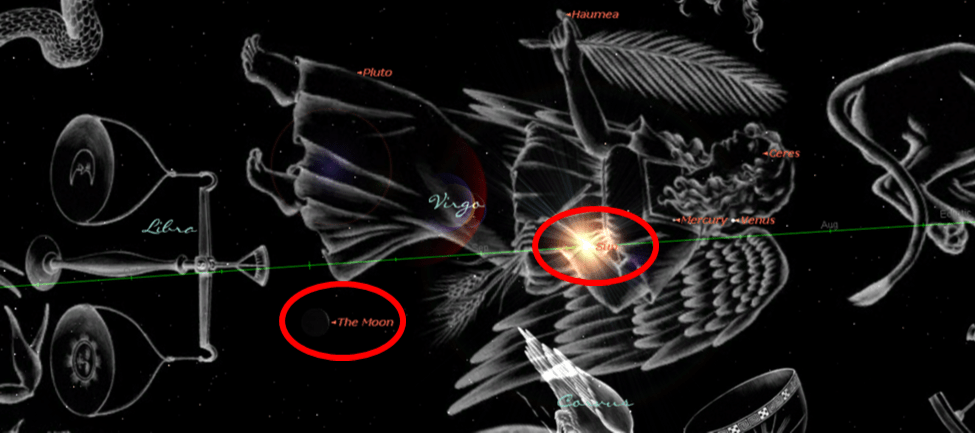
The image above was taken from the Starry Night Enthusiast 6 application, the daylight has been removed in order for the Sun, Moon, and stars to be seen easier. The software dates this image to September of 3 BC. The Sun and Moon have been circled. Notice how the Sun is near Virgo’s mid-section, the area where a woman would carry a child. Could this be what the magi saw? A virgin with chid?
On the biblical calendar, a month is aligned with the lunar cycle. The very first visible sliver of the crescent Moon is the first day of the month. In our image above, the Moon is in this phase. What day was this? Rosh Hashanah, the first day of the seventh month. This exact alignment does not occur every year. Sometimes the Sun is near her shoulder on Rosh Hashanah, and sometimes near the top of her head. So, to have the Sun in her mid-section and the Moon at her feet is not an every year occurrence…but it does continue to happen…in fact, it happened on Rosh Hashanah of 2024.
If Jesus was, indeed, born on the first day of the seventh month, that would mean He was born at a time appointed by God. It seems fitting that the King of the Universe would have planned the day that His Son would be born.
Happy Birthday Jesus!
(which ever day it is!)
Did you know that you can view any of our posts whenever you’d like?
Visit our home page at https://todayinthebible.com
where you can find them organized by month
in the “Archives” section on the right side of the page.

© 2026 Today in the Bible

 Today in the Bible
You must be logged in to post a comment.