Tevet 7, 5785; from sunset January 6, 2025, to sunset January 7, 2025
(The seventh day of the tenth month)
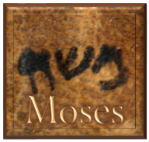
This is the name “Mosheh” (מֺשֶׁה – Moses) as seen in the Dead Sea Scrolls, written over two thousand years ago.
Today in the Bible we’re catching up with Betzalel and Oholiav and all of those whom God gifted artistic talent to fashion the furnishings for His new home, the Tabernacle. In Hebrew, the word for the Tabernacle is “Mishkan.” Mishkan comes from the verb root “shachan” which means “to dwell or tabernacle.” Mishkan means “a special dwelling place.” They started gathering items last fall during the Feast of Tabernacles. Today we’ll read about the mizbach haketoret, the altar of incense.
When Moses went up to Sinai for forty days after the LORD gave them the Ten Commandments, God gave him detailed instructions for how to build the furnishings for the Tabernacle. These are the instructions for how to make the incense altar.
“You shall make an altar to burn incense on; you shall make it of acacia wood. A cubit shall be its length and a cubit its width– it shall be square– and two cubits shall be its height. Its horns shall be of one piece with it. And you shall overlay its top, its sides all around, and its horns with pure gold; and you shall make for it a molding of gold all around. Two gold rings you shall make for it, under the molding on both its sides. You shall place them on its two sides, and they will be holders for the poles with which to bear it. You shall make the poles of acacia wood, and overlay them with gold.
“And you shall put it before the veil that is before the ark of the Testimony, before the mercy seat that is over the Testimony, where I will meet with you. Aaron shall burn on it sweet incense every morning; when he tends the lamps, he shall burn incense on it. And when Aaron lights the lamps at twilight, he shall burn incense on it, a perpetual incense before the LORD throughout your generations. You shall not offer strange incense on it, or a burnt offering, or a grain offering; nor shall you pour a drink offering on it.” – Exodus 30:1-9 (NKJ)
He was also given instructions for how to make the incense. This incense was to be holy to the LORD. No one else was to make it for their personal use.
And the LORD said to Moses: “Take sweet spices, stacte and onycha and galbanum, and pure frankincense with these sweet spices; there shall be equal amounts of each. You shall make of these an incense, a compound according to the art of the perfumer, salted, pure, and holy. And you shall beat some of it very fine, and put some of it before the Testimony in the tabernacle of meeting where I will meet with you. It shall be most holy to you. But as for the incense which you shall make, you shall not make any for yourselves, according to its composition. It shall be to you holy for the LORD. Whoever makes any like it, to smell it, he shall be cut off from his people.” – Exodus 30:34-38 (NKJ)
So Betzalel made the incense altar and the incense according to the LORD’s instructions.
He made the incense altar of acacia wood. Its length was a cubit and its width a cubit– it was square– and two cubits was its height. Its horns were of one piece with it. And he overlaid it with pure gold: its top, its sides all around, and its horns. He also made for it a molding of gold all around it. He made two rings of gold for it under its molding, by its two corners on both sides, as holders for the poles with which to bear it. And he made the poles of acacia wood, and overlaid them with gold. He also made the holy anointing oil and the pure incense of sweet spices, according to the work of the perfumer. – Exodus 37:25-29 (NKJ)
In Scripture, incense is often associated with prayer. David prayed, “May my prayer be set before you like incense” (Psalm 141:2). In his vision of heaven, John saw that the elders around the throne “were holding golden bowls full of incense, which are the prayers of God’s people” (Revelation 5:8; cf. 8:3). As Zechariah the priest was offering incense in the temple in Luke 1:10, “all the assembled worshipers were praying outside.”
It seems as if each of the furnishings of the Tabernacle/Temple may be connected to one of the Feasts…the Mo’adim…the Appointed Times (Leviticus 23). Both the Temple and the Feasts are a picture of God’s plan for salvation and a return of His dwelling presence.
The incense altar may be related to the Feast of Trumpets. The Feast of Trumpets is actually called “Zikron Teruah” in Leviticus 23:24; or a “Remembering Blast.” A teruah is a loud blast from a trumpet or shofar – it can even be a loud shout – a raising of the alarm or shouts of joy. Since the Feast of Trumpets is often associated with the return of the Messiah – Jesus – I see His return as a response to our urgent shout, cry, or prayer for help…just as David cried out in Psalm 141 (…while I escape safely.)
A Psalm of David. LORD, I cry out to You; make haste to me! Give ear to my voice when I cry out to You. Let my prayer be set before You as incense, the lifting up of my hands as the evening sacrifice.
Set a guard, O LORD, over my mouth; keep watch over the door of my lips. Do not incline my heart to any evil thing, to practice wicked works with men who work iniquity; and do not let me eat of their delicacies.
Let the righteous strike me; it shall be a kindness. And let him rebuke me; it shall be as excellent oil; let my head not refuse it. For still my prayer is against the deeds of the wicked. Their judges are overthrown by the sides of the cliff, and they hear my words, for they are sweet.
Our bones are scattered at the mouth of the grave, as when one plows and breaks up the earth. But my eyes are upon You, O GOD the Lord; in You I take refuge; do not leave my soul destitute. Keep me from the snares they have laid for me, and from the traps of the workers of iniquity. Let the wicked fall into their own nets, while I escape safely. – Psalm 141 (NKJ)
Many Hebrew words have a cognate, a “sister,” in other Semitic languages; however, teruah is unique to Hebrew. Perhaps this is a nod to our Messiah, who is also unique to the Hebrew people. He is the One who will hear our cry – our teruah – and act on our behalf.
The altar of incense can also be seen as a picture of the intercession of Jesus. Just as the altar of sacrifice in the courtyard was a type of His death on our behalf, the altar of incense in the Holy Place was a type of His mediation on our behalf. The altar of incense was situated before the mercy-seat of the Ark—a picture of Jesus standing in the presence of the Father (Hebrews 7:25; 9:24). The incense was to be burning continually on the altar of incense, which shows the perpetual nature of His mediation. Our Messiah’s intercession on our behalf is a sweet-smelling savor to the Father.1
Therefore be imitators of God as dear children. And walk in love, as Christ also has loved us and given Himself for us, an offering and a sacrifice to God for a sweet-smelling aroma. – Ephesians 5:1-2 (NKJ)
1 https://www.gotquestions.org/altar-of-incense.html
To read all of our posts on the building of the Tabernacle, click on the image above.
© 2026 Today in the Bible
 Today in the Bible
You must be logged in to post a comment.