
Tevet 21, 5785; from sunset January 20, 2025, to sunset January 21, 2025
(The twenty-first day of the tenth month)
שִׁמעוֹן – “Shim’on” – “Simeon”
According to tradition, today marks both the birth and the death of Simeon. (Some sources list the 28th of Tevet.) Simeon was the second son of Jacob and Leah.
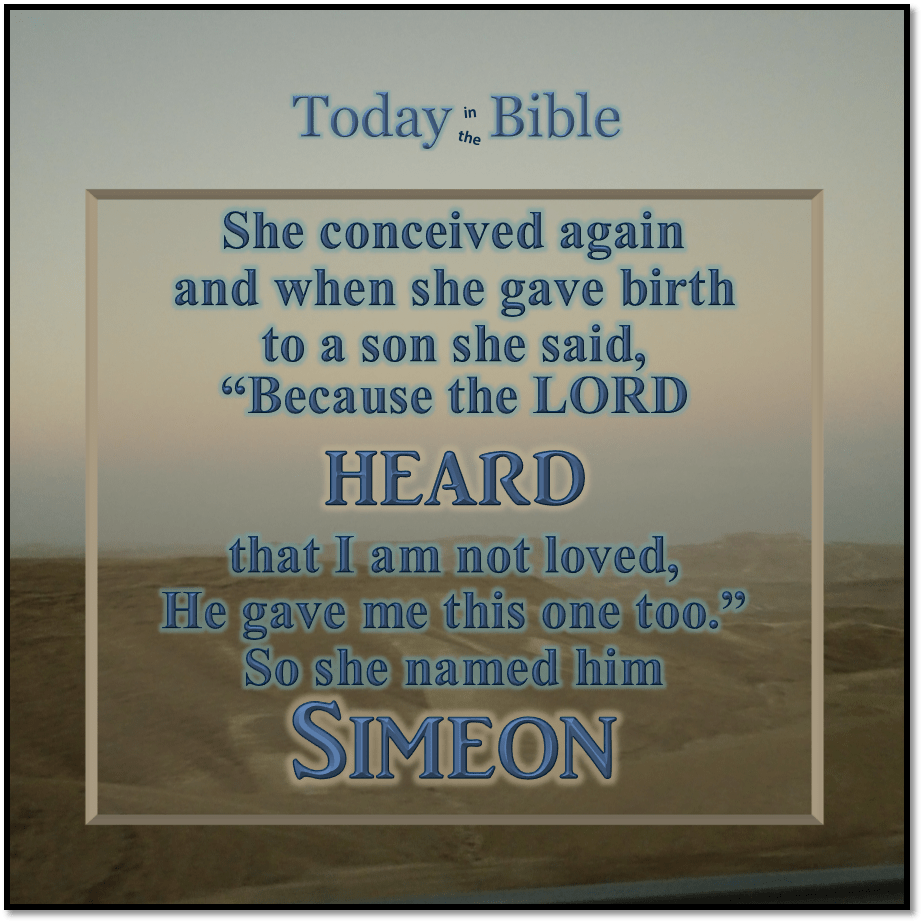
She conceived again, and when she gave birth to a son she said, “Because the LORD heard that I am not loved, he gave me this one too.” So she named him Simeon. – Genesis 29:33 (NIV).
As Leah indicated above, Simeon’s name has something to do with hearing. “Because the LORD heard that I am not loved…” His name comes from the same verb-root as “shema” (שמע) which means “to hear or obey.” Simeon means something like “the one who hears.” In Hebrew his name is “Shim’on” (שִׁמעוֹן) and pronounced like “sheem-oan.”
Simeon, along with his brother Levi, got themselves into trouble while defending their sister’s honor. After a Hivite man named Shechem had sexually violated Dinah, he wanted to make things right and marry her. Simeon and Levi convinced the Hivites that they had to become circumcised in order to intermarry with them. Genesis chapter 34 tells what happened next, as Simeon and Levi tricked the Hivites and slayed them, carrying off their flocks, herds, and donkeys along with all of their wealth and women and children. Their father was furious with them but they defended their actions saying, “Should our sister be treated like a prostitute?”
Simeon went on to become the father of six sons.
The sons of Simeon were Jemuel, Jamin, Ohad, Jachin, Zohar, and Shaul, the son of a Canaanite woman. – Genesis 46:10 (NKJ)
One day, Simeon’s father, Jacob, sent Joseph to check on his older brothers who were tending the flock. Joseph was the long-awaited son from Jacob’s beloved wife, Rachel. The Bible tells us that Jacob loved Joseph more than his older sons. Because of their jealousy, Simeon and his brothers sold Joseph to traders who took him to Egypt. While in Egypt, Joseph went through trials and testing but remained faithful to God, who moved him into a position of authority. When a famine came upon the land, Jacob sent his sons to Egypt to buy grain. Joseph suddenly found his brothers standing before him, asking to buy grain. He kept his identity hidden from them. He wanted to test them to see if they would treat their youngest brother Benjamin the same way they had treated him, or if they had changed. During their first trip to purchase grain, Joseph accused them of being spies and kept Simeon behind as a ransom until they returned with Benjamin.
He [Joseph] turned away from them and began to weep, but then came back and spoke to them again. He had Simeon taken from them and bound before their eyes. Joseph gave orders to fill their bags with grain, to put each man’s silver back in his sack, and to give them provisions for their journey. After this was done for them, they loaded their grain on their donkeys and left. – Genesis 42:24-26 (NIV)
You could say that Joseph locked up their “hearing.” Shim’on, the one who hears. The person and the story of Joseph have often been compared to the person and story of Jesus. Just like Jesus, Joseph was sent to his brothers by his father. Just like Jesus, his brothers plotted to kill him. Just like Jesus, he was thrown into the earth…right before they sat down to eat. Just like Jesus, Joseph was betrayed for pieces of silver. Just like Jesus, Joseph was “pulled up” out of the earth and sent to the Gentiles. And, I wonder, does the part where Joseph locked up Shim’on somehow correspond to the lack of “hearing” on the part of the Jewish people regarding Jesus? …their minds are closed…1 Corinthians 3? And just like with Joseph, all of this was done for the greater good, the salvation of the world.
Jacob seems to have not forgotten the “Shechem Incident.” In his last words to his sons, this is what he says about Simeon and Levi.
Simeon and Levi are brothers– their swords are weapons of violence. Let me not enter their council, let me not join their assembly, for they have killed men in their anger and hamstrung oxen as they pleased. Cursed be their anger, so fierce, and their fury, so cruel! I will scatter them in Jacob and disperse them in Israel. – Genesis 49:5-7 (NIV)
And, curiously, Simeon is missing from Moses’ blessings over the tribes (Deuteronomy 33).
The Testaments of the Patriarchs, which is a pseudepigraphical work of the dying words of the twelve sons of Jacob to their descendants, naturally contains a chapter for Simeon. The Testaments are ancient and fragments may have been found among the Dead Sea Scrolls; however, they did not take their final form until several hundred years later. The testament of Simeon claims that Simeon died in the same year as Joseph.
The testament of Simeon, the second son of Jacob and Leah. A copy of the words of Simeon, which he spoke to his sons before he died, in the hundred and twentieth year of his life, in the year Joseph died. – Testament of Simeon 1:1 (OPE)
In the Testament, Simeon describes himself as being strong, brave, hard-hearted, fearful of nothing, and lacking compassion.
For in this time I was jealous of Joseph, because my father loved [him]. And I set my whole self against him to destroy him, because the prince of deceit, having sent the spirit of jealousy, blinded my mind, so that I did not care for him as a brother, and I did [not] even spare Jacob my father. – Testament of Simeon 2:6-7 (OPE)
He later confesses his own sin and warned his children against the spirit of deceit and envy.
And now, my children, guard yourselves from the spirits of deceit and envy. For envy rules over the whole mind of people, and does not allow him neither to eat nor to drink, nor to do any good thing. But it suggests to destroy him that which he envies; and as long as the one that is envied flourishes, the one who envies fades away.
So I afflicted my soul with fasting in the fear of the Lord for two years, and I knew that deliverance from envy comes through the fear of God. For if a person should flee to the Lord, the evil spirit runs away from him, and his mind is lightened. And he sympathizes with the one who has envied, and does not condemn those he loves, and so ceases from his envy. – Testament of Simeon 3 (OPE)
Simeon came to recognize that the Spirit of God was upon Joseph and recognized his goodness and love.
Now Joseph was a good man, and had the Spirit of God within him, compassionate and merciful, he carried no malice against me; but also loved me, as the rest of his brothers. Therefore guard yourselves, my children, from all jealousy and envy, and walk in generosity of soul and in goodness of heart, being mindful of your paternal brothers, so that God may give you also grace, and glory, and blessing upon your heads, even as you saw to him.
All the days he never reproached us about this thing, but loved us as his own soul, and beyond his own sons he glorified us, and gave all of us riches, cattle, and fruits. Therefore you also, my beloved children, each one love his brother with a good heart and remove from yourselves the spirit of envy. – Testament of Simeon 4:4-7 (OPE)
He warned his sons that the writings of Enoch prophesy that they will succumb to pitfalls and would end up scattered and few in number, just as prophesied by his father.
And now, my children, obey Levi and in Judah you will be redeemed: do not be lifted up against these two tribes, because from them will arise to you the salvation of God. For the Lord will raise up from Levi as a high-priest, and from Judah as a king, [God and man]. He will save all [the nations and] the family of Israel. Because of this, I have commanded to you all these things, that you also may command your children so that they may divide into tribes for their generations.
And Simeon finished commanding his sons, and he slept with his fathers, being one hundred and twenty years old. And they placed him in a fresh-cut wooden coffin, to take his bones up to Hebron. And they took them up secretly during a war of the Egyptians. – Testament of Simeon 7:1-8:2 (OPE)
In chapter seven, there appears to be a reference to Jesus, “For the Lord will raise up from Levi as a high-priest, and from Judah as a king, [God and man]. He will save all [the nations and] the family of Israel.” Scholars are divided as to whether the testaments are an originally Jewish document that have been retouched by Christians, or a Christian document written originally in Greek but based on some earlier Semitic-language material. Scholarship tends to focus on this book as a Christian work, whether or not it has a Jewish predecessor. (Wikipedia)
Jasher wraps up Simeon’s story recording both his death and the place of his burial, which differs from the Testament of Simeon.
And in the seventy-fifth year died his brother Simeon, he was a hundred and twenty years old at his death, and he was also put into a coffin and given into the hands of his children. – Jasher 61:4
And Simeon and Levi they buried in the city Mauda, which he had given to the children of Simeon, and the suburb of the city was for the children of Levi. – Jasher 90:41
Did you know that you can view any of our posts whenever you’d like?
Visit our home page at https://todayinthebible.com
where you can find them organized by month
in the “Archives” section on the right side of the page.

© 2026 Today in the Bible

 Today in the Bible
You must be logged in to post a comment.