
Tevet 23, 5785; from sunset January 22, 2025, to sunset January 23, 2025
(The twenty-third day of the tenth month)
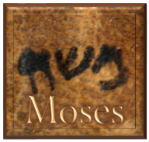
This is the name “Mosheh” (מֺשֶׁה – Moses) as seen in the Dead Sea Scrolls, written over two thousand years ago.
This winter we’ve been studying God’s commands for the building of the Tabernacle. The children of Israel began gathering everything needed for its construction during the autumn and worked to have it all completed by springtime. Their deadline? The first day of the first month of the springtime. Nisan 1.
Today we’ll study the bronze laver. After God gave Israel the Ten Commandments, He called Moses up the mountain and into the cloud covering it. Moses was there for 40 days and, during that time, he was given the following instructions for the bronze laver. When thinking about the furnishings of the Tabernacle, we may give little thought to the laver; but it was of great significance in that it was integral in keeping the priests alive. Two times in the following verses, God stated that the priests must wash their hands and feet so that they may “not die.”
“You shall also make a laver of bronze, with its base also of bronze, for washing. You shall put it between the tabernacle of meeting and the altar. And you shall put water in it, for Aaron and his sons shall wash their hands and their feet in water from it.
“When they go into the tabernacle of meeting, or when they come near the altar to minister, to burn an offering made by fire to the LORD, they shall wash with water, lest they die. So they shall wash their hands and their feet, lest they die. And it shall be a statute forever to them– to him and his descendants throughout their generations.” – Exodus 30:18-21 (NKJ)
Perhaps Jesus’ act of washing His disciples’ feet (John 13:5-17) is an allusion to these verses?
After the Israelites began building the Tabernacle, the text recounts the construction of the laver. This time there is very little description. Just one little verse.
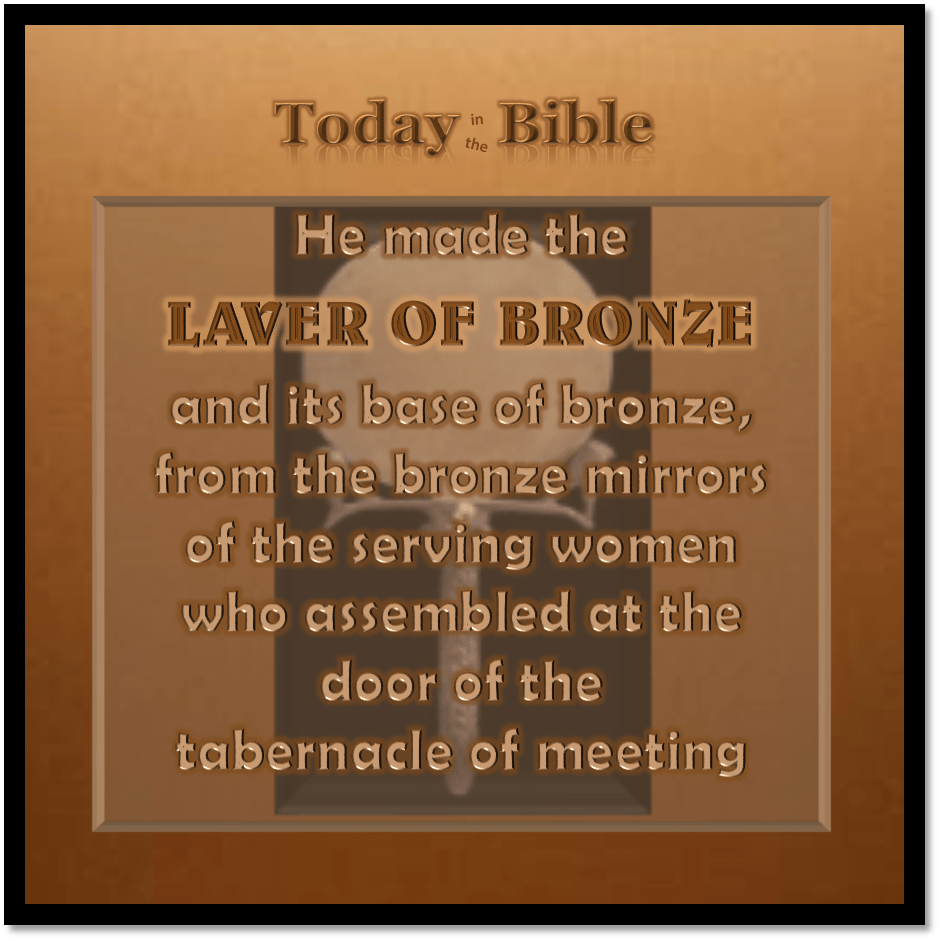
He made the laver of bronze and its base of bronze, from the bronze mirrors of the serving women who assembled at the door of the tabernacle of meeting. – Exodus 38:8 (NKJ)
We are told that he made it out of bronze, both the laver and its pedestal; however, even in the sparse description given, we still can scratch out a few new details. The text tells us they were made from “the mirrors of the serving women who served at the doorway of the tent of meeting.” Let’s dig a little deeper into the Hebrew of these verses.
The laver and its pedestal were made of “nechoshet” (נְח֗שֶׁת – “neh-khoh-shet”). Nechoshet comes from the verb-root “nachash” (נחש). This verb means “to learn by experience, diligently observe, divine, practice divination, practice fortune telling, or take as an omen.” Scholars tend to split words stemming from this root into four categories.
| Group 1 | נַחַשׁ | nachash | divination |
| Group 2 | נְח֗שֶׁת | nechoshet | copper |
| Group 2 | נָחוּשׁ | nachush | bronze |
| Group 2 | נְחוּשָׁה | nechushah | copper, bronze |
| Group 3 | נָחָשׁ | nachash | serpent, snake |
| Group 4 | נְחוֹשֶׁת | nechoshet | lust, harlotry |
Another word of interest is translated as “mirror” (מַרְא֗ת – “mar’ot”). It comes from the verb “ra’ah” (ראה) which means “to see, look at, or inspect.” Mar’ot is only used once in the Bible. This means that the mirrors were not mentioned in the list of free-will offerings donated by the people for the building of the Tabernacle (Exodus 35). Some commentators read into this that the mirrors were later confiscated from the women. They strengthen their argument by pointing out that the bronze censers used by Korah, and those who joined him in his rebellion, were also confiscated, hammered out, and used as a covering on the altar (Numbers 16:39).
Mirrors were made from copper or bronze and polished to a shine so that a reflection could be seen. Apparently, there is a possible association between mirrors and goddesses and cultic activities in some ancient near-eastern cultures. Our root-word “nachash” does have a connotation with divination and harlotry.
The word translated as “serving women” is “tzov’ot” (צ֗בא֗ת). This word comes from the verb root “tzava” (צבא) meaning “to fight or serve.” Most of the words stemming from this root are used in connection with the army; it is often translated as “hosts.” A familiar name of God is, “LORD of Hosts” or “ADONAI Tzeva’ot.” This descriptor is used 285 times in the Bible.
The “serving women” at the door of the tent of meeting are only mentioned one other time, that is in 1 Samuel 2:22. The sons of Eli, who was high priest at the time, were lying with these women. Some understand that the women were cultic prostitutes – others see it as an abuse of power by the sons of Eli. Indeed, in the verses preceding, his boys are described as “sons of worthlessness” (benei beli’al) and they knew not the LORD.
Maybe the women were called “tzov’ot” because they were fighting a spiritual warfare? Women are oftentimes convinced their worth comes from their beauty and sexuality rather than simply the person whom God created them to be. In this world, there is a lot of pressure to “look” a certain way or to be open to sexual activity to be accepted and “loved.” Whereas those things can be a part of the joys in life, they are frequently used to abuse and denigrate women. Perhaps these women chose to cast all that aside and voluntarily gave up their mirrors to become the original prayer “warriors.” The first in a long line of women who have devoted themselves to fasting and praying. Anna, the prophetess, followed in their footsteps, she “did not depart from the Temple, but served God with fastings and prayers night and day.” (Luke 2:37 NKJ)
Favour is deceitful, and beauty is vain: but a woman that feareth the LORD, she shall be praised. – Proverbs 31:30 (KJV)
Perhaps we can see another connection between the mirrors and the laver. The women saw (ra’ah) their image in the mirrors (mar’ot). The laver could have provided a reflection of anyone who looked into the water. Certainly, one could see their own image in a shiny metal pan full of water located out in the sunny desert. Did these women see that they were spiritually unclean and were in need of the cleansing that can only be obtained through the LORD? Was it the same for the priests? While washing their hands and feet, did they take a good, long look at themselves before entering the Holy Place to serve the LORD?
Of course, all of the furnishings of the Tabernacle are a reflection of our Messiah, Jesus. The book of Hebrews tells us that He cleansed us (Hebrews 1:3) and that we may now confidently approach the throne of grace (4:16) – i.e. “not die” – just as the priests who, after washing with the water in the laver, were able to approach the LORD – we are washed clean by the blood of Jesus and may confidently approach the throne.
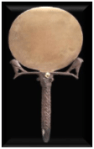
Example of an ancient Egyptian bronze mirror.
Portions of the above were taken from: https://www.thetorah.com/article/a-copper-laver-made-from-womens-mirrors.
To read all of our posts on the building of the Tabernacle, click on the image above.

© 2026 Today in the Bible

 Today in the Bible
You must be logged in to post a comment.