

Tevet 25, 5785; from sunset January 24, 2025, to sunset January 25, 2025
(The twenty-fifth day of the tenth month)
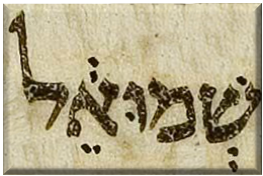
This is the name “Shemu’el” (שְׁמוּאֵל – Samuel) as seen in the Aleppo Codex, written over one thousand years ago.
Last fall, we began studying the story of Eli and Samuel and the battle that resulted in the Philistines capture of the Ark of the Covenant. It was placed in the temple of Dagon in Ashdod – which did not bode well for Dagon. After this, the heavy hand of the LORD was upon the residents of Ashdod and they were inflicted with tumors. The Ark was then sent to Gath whose residents experienced the same plague. Now the Ark has been moved to Ekron, where we pick up the story again.
So it was, as the Ark of God came to Ekron, that the Ekronites cried out, saying, “They have brought the ark of the God of Israel to us, to kill us and our people!”
So they sent and gathered together all the lords of the Philistines, and said, “Send away the ark of the God of Israel, and let it go back to its own place, so that it does not kill us and our people.” For there was a deadly destruction throughout all the city; the hand of God was very heavy there.
And the men who did not die were stricken with the tumors, and the cry of the city went up to heaven. – 1 Samuel 5:10b-12 (NKJ)
In our studies of the time that the Ark of the LORD was in possession of the Philistines, we’ve focused on the verb root “kabed” meaning “to be heavy, grievous, hard, rich, honorable, or glorious” and the many words found in the story which stem from this root.
- Chavod (kavod) is a word meaning “honor” or “glory.” It is to describe the throne of glory and the honor Eli shows to his sons rather than to God.
- Ichabod is the name given to Phinehas’ son by his dying wife.
- Chaved is the word used to describe the heaviness of Eli’s body.
- Chabad is used to describe the “heavy” hand of the LORD.
The theme is continued in Ekron where, once again, we see that the hand of the LORD was heavy. This time it was “kavdah me’od” – “very heavy.” It was so heavy that their cries went up to the heavens. The TWOT lexicon relates the intensity of the word used to describe the cries of the people – shav’ah. It says, “Shav’ah is used to describe the cry of anguish, the cry of the oppressed, the cry of those who are approaching the breaking point.”
The NOBSE Study Bible defines the name Ekron as “Extermination.” Ekron makes its first appearance in the Bible during the days of Joshua. It has a quick mention in Judges chapter one, which brings us to the book of 1 Samuel where it appears seven times. Apparently, the plague did not completely exterminate Ekron, because it makes an appearance again in 1 Kings chapter one, where we learn that Ba’al-Zebub (the “lord of the flies” and the god of Ekron) was inquired upon by King Ahaziah of Israel.
Now Ahaziah fell through the lattice of his upper room in Samaria, and was injured; so he sent messengers and said to them, “Go, inquire of Baal-Zebub, the god of Ekron, whether I shall recover from this injury.” – 2 Kings 1:2 (NKJ)
As Ahaziah finds out, this was the wrong thing to do, for the God of Israel sent Elijah to intercept the messengers sent by the king and returned His own answer instead.
Then he said to him, “Thus says the LORD: `Because you have sent messengers to inquire of Baal-Zebub, the god of Ekron, is it because there is no God in Israel to inquire of His word? Therefore you shall not come down from the bed to which you have gone up, but you shall surely die.’” – 2 Kings 1:16 (NKJ)
The remaining mentions of Ekron are scattered throughout prophecies of doom in the books of Jeremiah, Amos, Zephaniah, and Zechariah – all which foretell its “extermination.”
The Philistines held the Ark for seven months and returned it sometime during the wheat harvest, which corresponds to May or early June on the calendar most of us use today. The events we read about today are the last mentioned before the Philistines make the decision to return the Ark to Israel. We’ll pick up the story next spring and finish up our series of articles revolving around the Philistines’ capture of the Ark of the Covenant then.
To read all of our posts on Samuel, the Philistines, and the Ark of the Covenant, click on the name Shemu’el above.

© 2026 Today in the Bible

 Today in the Bible
You must be logged in to post a comment.