Shevat 3, 5785; from sunset January 31, 2025, to sunset February 1, 2025
(The third day of the eleventh month)

Our featured image for today is the mountains of Edom. Photo credit: Today in the Bible.
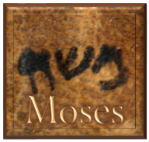
This is the name “Mosheh” (מֺשֶׁה – Moses) as seen in the Dead Sea Scrolls, written over two thousand years ago.
Moses Repeats the Torah
We’re continuing our look at Moses’ last words to Israel before his death. The Bible tells us that he sat down with the children of Israel on the first day of this month and – according to tradition – he spent the next 37 days reviewing the journey of the children of Israel over the past 40 years. These words were recorded in the book of Deuteronomy. Today we’re reading Deuteronomy chapter 2 where Moses recaps the journey of the children of Israel as they pass through neighboring lands. The theme of this chapter seems to be, “God has blessed you; you lack nothing. Do not take for yourselves that which He has given to someone else.”
Historical Prologue
“Then we turned and journeyed into the wilderness of the Way of the Red Sea, as the LORD spoke to me, and we skirted Mount Seir for many days. And the LORD spoke to me, saying: `You have skirted this mountain long enough; turn northward. And command the people, saying, “You are about to pass through the territory of your brethren, the descendants of Esau, who live in Seir; and they will be afraid of you. Therefore watch yourselves carefully. Do not meddle with them, for I will not give you any of their land, no, not so much as one footstep, because I have given Mount Seir to Esau as a possession. You shall buy food from them with money, that you may eat; and you shall also buy water from them with money, that you may drink. For the LORD your God has blessed you in all the work of your hand. He knows your trudging through this great wilderness. These forty years the LORD your God has been with you; you have lacked nothing.”‘
Seir (שֵׂעִיר – “say-ear”) was the name of a portion of the land given to Esau and his descendants. Seir comes from a verb root which means “to be hairy.” When Esau was born, the Bible says, “he came out all red and like he had a cloak of hair (שֵׂעָר – “say-are”).” The cities of Elath (“Terebinths” or “Grove of Trees”) and Ezion Geber (“Backbone of a Man” – said to be from its geographical attributes – “the spine of a mountain”) also belonged to the descendants of Esau.
“And when we passed beyond our brethren, the descendants of Esau who dwell in Seir, away from the road of the plain, away from Elath and Ezion Geber, we turned and passed by way of the Wilderness of Moab.
Moab was one of the sons of Abraham’s nephew, Lot. He was born to Lot’s elder daughter after the cities of Sodom and Gomorrah were destroyed. Because of her experiences, one supposes that she may have thought, “Any man left from those cities would not be interested in marrying me!” Or maybe, “All men have been destroyed!” And her only hope lay in bearing a child through her father. (Their story can be found in Genesis 19.)
“Then the LORD said to me, `Do not harass Moab, nor contend with them in battle, for I will not give you any of their land as a possession, because I have given Ar to the descendants of Lot as a possession.’” (The Emim had dwelt there in times past, a people as great and numerous and tall as the Anakim. They were also regarded as giants, like the Anakim, but the Moabites call them Emim. The Horites formerly dwelt in Seir, but the descendants of Esau dispossessed them and destroyed them from before them, and dwelt in their place, just as Israel did to the land of their possession which the LORD gave them.)
Ar was the name of a city, the name “Ar” actually means “city.” The Emim translates to “The Terrible Men.” The Anakim were giants, “Anak” means “Long Neck.” And the Horites translates to “The Cavemen.” It seems there were some pretty scary people dwelling there in ancient times!
“`Now rise and cross over the Valley of the Zered.’ So we crossed over the Valley of the Zered. And the time we took to come from Kadesh Barnea until we crossed over the Valley of the Zered was thirty-eight years, until all the generation of the men of war was consumed from the midst of the camp, just as the LORD had sworn to them. For indeed the hand of the LORD was against them, to destroy them from the midst of the camp until they were consumed. So it was, when all the men of war had finally perished from among the people, that the LORD spoke to me, saying: `This day you are to cross over at Ar, the boundary of Moab.
The name Zered probably has something to do with trees, perhaps willows or the act of pruning a tree.
`And when you come near the people of Ammon, do not harass them or meddle with them, for I will not give you any of the land of the people of Ammon as a possession, because I have given it to the descendants of Lot as a possession.’” (That was also regarded as a land of giants; giants formerly dwelt there. But the Ammonites call them Zamzummim, a people as great and numerous and tall as the Anakim. But the LORD destroyed them before them, and they dispossessed them and dwelt in their place, just as He had done for the descendants of Esau, who dwelt in Seir, when He destroyed the Horites from before them. They dispossessed them and dwelt in their place, even to this day. And the Avim, who dwelt in villages as far as Gaza– the Caphtorim, who came from Caphtor, destroyed them and dwelt in their place.)
The Ammonites were descendants of Lot’s younger daughter, who followed in her sister’s footsteps and slept with her father in order to bear a child. Another race of giants formerly lived in their region, called Zamzummim – perhaps “Murmurers”? Another train of thought translates as “Schemers.” The Avim may mean “Desert Dwellers” and Gaza means “strong.” The meaning for Caphtor is unknown and scholars do not have any sort of a consensus on it.
“`Rise, take your journey, and cross over the River Arnon. Look, I have given into your hand Sihon the Amorite, king of Heshbon, and his land. Begin to possess it, and engage him in battle. This day I will begin to put the dread and fear of you upon the nations under the whole heaven, who shall hear the report of you, and shall tremble and be in anguish because of you.’
For this paragraph, we’ll try something new and insert the meanings of the names into the text itself.
“`Rise, take your journey, and cross over the “River Swift, Agile.” Look, I have given into your hand “The One Who Strikes Out” the “Talker,” king of “Intelligence,” and his land. Begin to possess it, and engage him in battle. This day I will begin to put the dread and fear of you upon the nations under the whole heaven, who shall hear the report of you, and shall tremble and be in anguish because of you.’
That was kind of fun! If the meaning of Sihon’s name and location was any indication of his personality, I can see how God would want to put him in his place. The text makes him seem like a man who was a bit of a braggart and ready to fight.
“And I sent messengers from the Wilderness of Kedemoth to Sihon king of Heshbon, with words of peace, saying, `Let me pass through your land; I will keep strictly to the road, and I will turn neither to the right nor to the left. You shall sell me food for money, that I may eat, and give me water for money, that I may drink; only let me pass through on foot, just as the descendants of Esau who dwell in Seir and the Moabites who dwell in Ar did for me, until I cross the Jordan to the land which the LORD our God is giving us.’
“But Sihon king of Heshbon would not let us pass through, for the LORD your God hardened his spirit and made his heart obstinate, that He might deliver him into your hand, as it is this day. And the LORD said to me, `See, I have begun to give Sihon and his land over to you. Begin to possess it, that you may inherit his land.’
“Then Sihon and all his people came out against us to fight at Jahaz (“Down Trodden”). And the LORD our God delivered him over to us; so we defeated him, his sons, and all his people. We took all his cities at that time, and we utterly destroyed the men, women, and little ones of every city; we left none remaining. We took only the livestock as plunder for ourselves, with the spoil of the cities which we took. From Aroer (“Naked, Stripped”), which is on the bank of the River Arnon, and from the city that is in the ravine, as far as Gilead (“Hill of Testimony”), there was not one city too strong for us; the LORD our God delivered all to us.
“Only you did not go near the land of the people of Ammon– anywhere along the River Jabbok (“Poured Out”), or to the cities of the mountains, or wherever the LORD our God had forbidden us.” – Deuteronomy 2 (NKJ)
We invite you to join us again tomorrow as we continue to remember these days in the Bible. The days when Moses sat down with the children of Israel before he died.
To read all of our posts on the book of Deuteronomy, click on the image above.

© 2026 Today in the Bible

 Today in the Bible
You must be logged in to post a comment.