
Shevat 7, 5785; from sunset February 4, 2025, to sunset February 5, 2025
(The seventh day of the eleventh month)
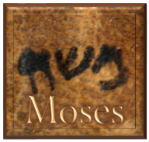
This is the name “Mosheh” (מֺשֶׁה – Moses) as seen in the Dead Sea Scrolls, written over two thousand years ago.
Moses Repeats the Torah
We’ve been remembering the words of Moses that he spoke to the people before they entered into the Promised Land. Today we’re studying Deuteronomy 6 which contains the central prayer of Judaism, the Shema. The name of the prayer comes from its first Hebrew word. Shema means to hear, listen, or obey. We’ll dig into the Shema a little deeper at the end of this article.
Moses continues to stress the importance of hearing, keeping, doing, teaching, and learning the commandments, statutes, and judgments of the LORD. We’ll keep highlighting the number of times that he says these words.
Stipulations of the Covenant
“Now this is the commandment, and these are the statutes and judgments which the LORD your God has commanded to teach you, that you may observe them in the land which you are crossing over to possess, that you may fear the LORD your God, to keep all His statutes and His commandments which I command you, you and your son and your grandson, all the days of your life, and that your days may be prolonged. Therefore hear, O Israel, and be careful to observe it, that it may be well with you, and that you may multiply greatly as the LORD God of your fathers has promised you–`a land flowing with milk and honey.’
Shema Yisra’el
“Hear, O Israel: The LORD our God, the LORD is one!
“You shall love the LORD your God with all your heart, with all your soul, and with all your strength.
“And these words which I command you today shall be in your heart.
“You shall teach them diligently to your children, and shall talk of them when you sit in your house, when you walk by the way, when you lie down, and when you rise up.
“You shall bind them as a sign on your hand, and they shall be as frontlets between your eyes.
“You shall write them on the doorposts of your house and on your gates.
“So it shall be, when the LORD your God brings you into the land of which He swore to your fathers, to Abraham, Isaac, and Jacob, to give you large and beautiful cities which you did not build, houses full of all good things, which you did not fill, hewn-out wells which you did not dig, vineyards and olive trees which you did not plant– when you have eaten and are full–then beware, lest you forget the LORD who brought you out of the land of Egypt, from the house of bondage.
“You shall fear the LORD your God and serve Him, and shall take oaths in His name. You shall not go after other gods, the gods of the peoples who are all around you (for the LORD your God is a jealous God among you), lest the anger of the LORD your God be aroused against you and destroy you from the face of the earth.
“You shall not tempt the LORD your God as you tempted Him in Massah.
“You shall diligently keep the commandments of the LORD your God, His testimonies, and His statutes which He has commanded you.
“And you shall do what is right and good in the sight of the LORD, that it may be well with you, and that you may go in and possess the good land of which the LORD swore to your fathers, to cast out all your enemies from before you, as the LORD has spoken.
“When your son asks you in time to come, saying, ‘What is the meaning of the testimonies, the statutes, and the judgments which the LORD our God has commanded you?’ then you shall say to your son: ‘We were slaves of Pharaoh in Egypt, and the LORD brought us out of Egypt with a mighty hand; and the LORD showed signs and wonders before our eyes, great and severe, against Egypt, Pharaoh, and all his household.
`Then He brought us out from there, that He might bring us in, to give us the land of which He swore to our fathers. `And the LORD commanded us to observe all these statutes, to fear the LORD our God, for our good always, that He might preserve us alive, as it is this day. Then it will be righteousness for us, if we are careful to observe all these commandments before the LORD our God, as He has commanded us.’ – Deuteronomy 6 (NKJ)
It is out of these verses that the Shema originated. We’re beginning to see how Moses emphasizes, not just believing the word of God, but the importance of doing and carefully guarding it. The importance of learning it and teaching it to others…especially to our children.
‘when you lie down and when you rise up’
The Shema is a prayer that is recited at least twice a day — “when you lie down and when you rise up.” Start and end your day thinking about the commandments of God.
‘bind them as a sign upon your arm and let them be a sign between your eyes’
When men say their daily prayers, it is customary to wear tefillin, which are small leather boxes containing the verses of the Shema. These are attached to the arm and forehead with leather straps — “bind them as a sign upon your arm and let them be a sign between your eyes.” Many women wear necklaces with the first portion of the Shema on it. You may also find it on keychains, rings, or other works of art.
Binding them as a sign upon your hand or arm is a reminder to let these commandments guide the things that you do. Binding them between your eyes means to let them guide your thoughts, what you see, how you think. Do your thoughts and actions line up with the commandments of God?
There may be a correlation between this commandment and the mark of the antichrist that is found in Revelation 13.
He causes all, both small and great, rich and poor, free and slave, to receive a mark on their right hand or on their foreheads… – Revelation 13:16 (NKJ)
Jesus, who is the Christ-the Messiah-the Anointed One, also teaches us to do the commandments of God. Perhaps the mark of the beast will be someone who teaches us “not” do the commandments of God? Who is the real Christ? This may be one of the ways we will know.
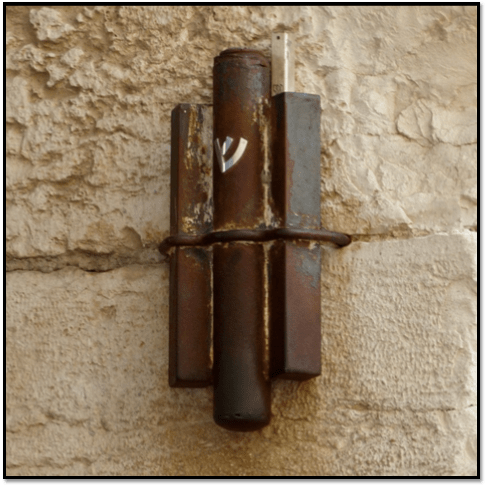
‘write them on the doorposts of your house and upon your gates’
Jewish (and more and more Christian) homes contain a mezuzah for each doorway into the home and, oftentimes, on doorways inside of the home — “write them on the doorposts of your house and upon your gates.” A mezuzah is some sort of a box or container, usually highly decorative and frequently made from pure silver. The mezuzah contains the verses of the Shema. The word mezuzah means doorpost in Hebrew. The mezuzah acts as a reminder to keep these commandments when you leave your home and go out into the world for the day. It’s a reminder to keep these commandments when you return home and spend time with your family. It is customary to reach out and touch the mezuzah and then kiss your fingers. City gates in Israel also have a mezuzah affixed to them — a reminder to keep these commandments when you are in our city.
The Shema
Shema Yis-ra-el. ADONAI, Eloheinu. ADONAI e-chad.
Baruch shem k-vode, malchuto le-olam va-ed.
Hear, Oh Israel! The LORD is our God.
The LORD is One.
Blessed be His Name, whose glorious Kingdom is forever and ever.
And you shall love the LORD your God with all your heart, and with all your soul, and with all your might. Let these matters that I command you today be upon your heart. Teach them diligently to your children and speak of them while you sit in your home, while you walk on the way, when you lie down and when you rise up. Bind them as a sign upon your arm and let them be a sign between your eyes. And write them on the doorposts of your house and upon your gates. And you shall love your neighbor as yourself. I am the LORD.
(Deuteronomy 6:4-9, Leviticus 19:18b)
To read all of our posts on the book of Deuteronomy, click on the image above.
© 2026 Today in the Bible
 Today in the Bible
You must be logged in to post a comment.