Shevat 9, 5785; from sunset February 6, 2025, to sunset February 7, 2025
(The ninth day of the eleventh month)
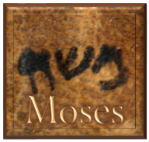
This is the name “Mosheh” (מֺשֶׁה – Moses) as seen in the Dead Sea Scrolls, written over two thousand years ago.
Moses Repeats the Torah
We’ve been remembering the words of Moses that he spoke to the people before they entered into the Promised Land. The Bible tells us that this happened during the eleventh month. Today he speaks of the good land that the LORD, their God, is bringing them into and issues words of warning not to become arrogant; but to remember that it was because of the LORD that they were brought here.
Stipulations of the Covenant
“Every commandment which I command you today you must be careful to observe, that you may live and multiply, and go in and possess the land of which the LORD swore to your fathers.
“And you shall remember that the LORD your God led you all the way these forty years in the wilderness, to humble you and test you, to know what was in your heart, whether you would keep His commandments or not.
“So He humbled you, allowed you to hunger, and fed you with manna which you did not know nor did your fathers know, that He might make you know that man shall not live by bread alone; but man lives by every word that proceeds from the mouth of the LORD. Your garments did not wear out on you, nor did your foot swell these forty years.
“You should know in your heart that as a man chastens his son, so the LORD your God chastens you. Therefore you shall keep the commandments of the LORD your God, to walk in His ways and to fear Him.
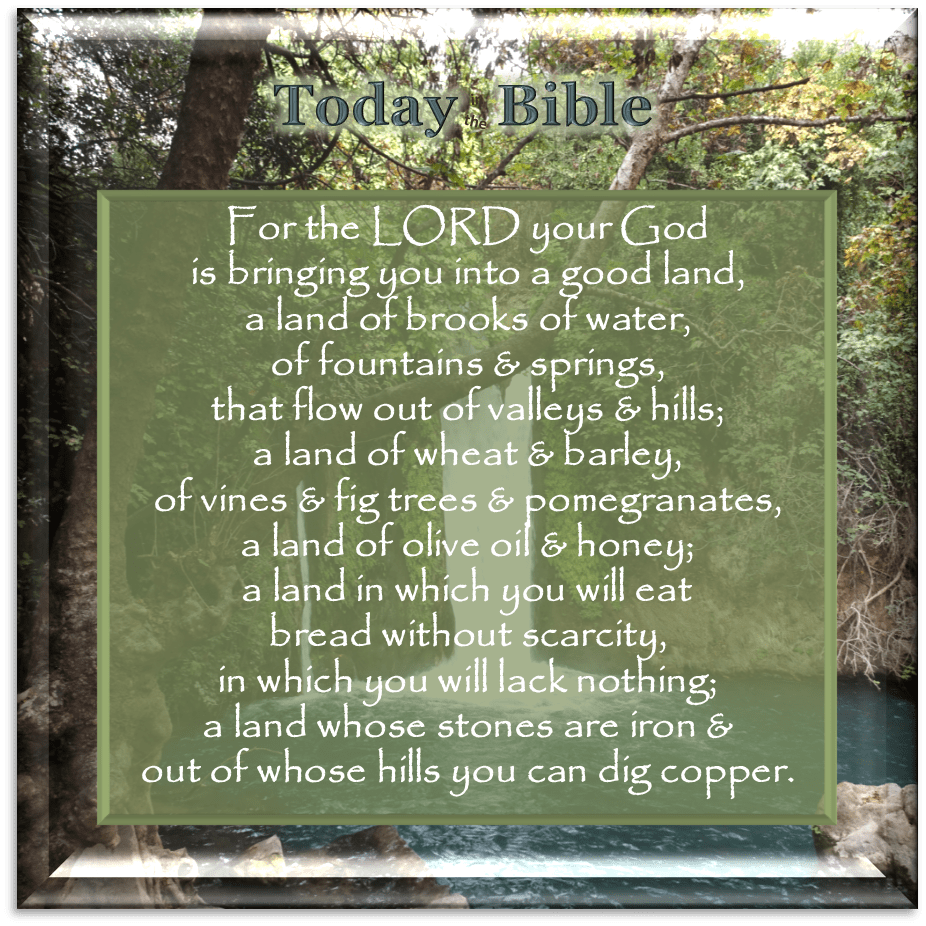
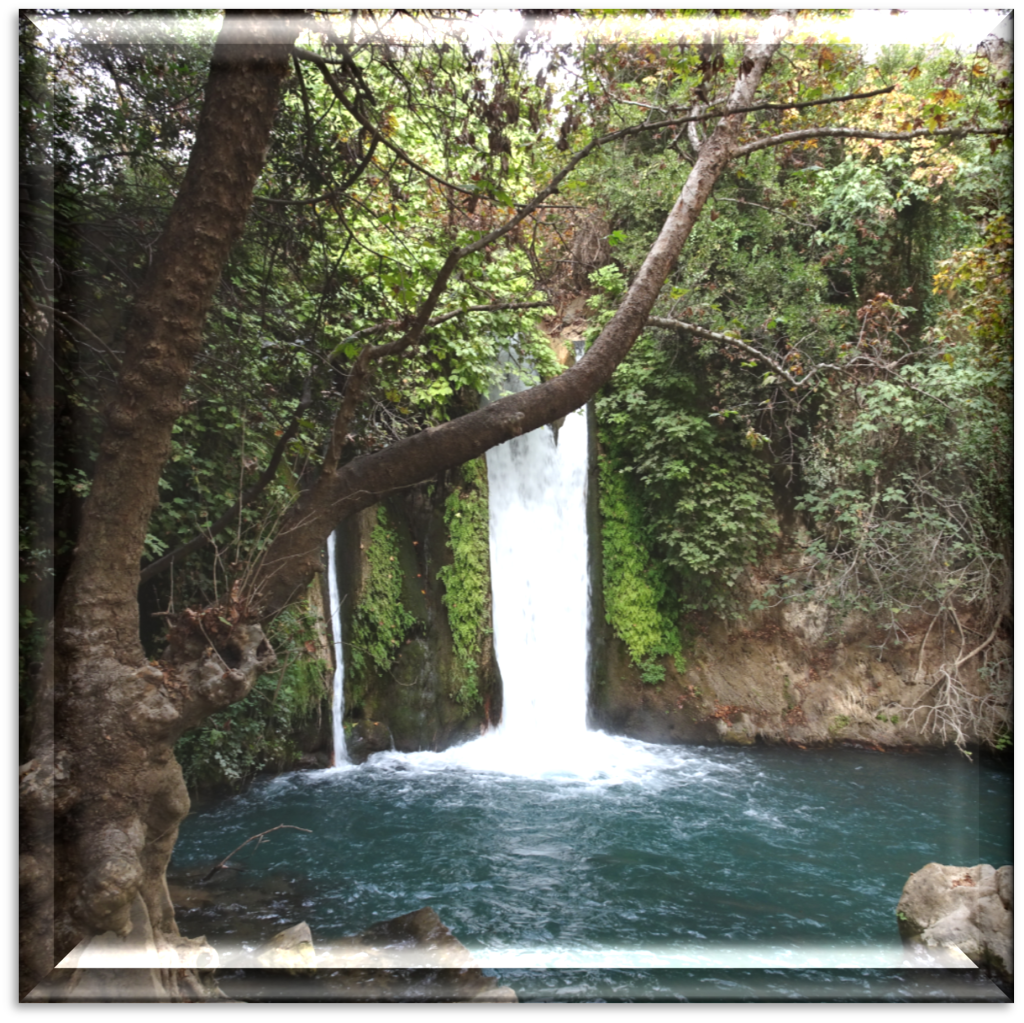
“For the LORD your God is bringing you into a good land, a land of brooks of water, of fountains and springs, that flow out of valleys and hills; a land of wheat and barley, of vines and fig trees and pomegranates, a land of olive oil and honey; a land in which you will eat bread without scarcity, in which you will lack nothing; a land whose stones are iron and out of whose hills you can dig copper.
“When you have eaten and are full, then you shall bless the LORD your God for the good land which He has given you.“
“Beware that you do not forget the LORD your God by not keeping His commandments, His judgments, and His statutes which I command you today, lest– when you have eaten and are full, and have built beautiful houses and dwell in them; and when your herds and your flocks multiply, and your silver and your gold are multiplied, and all that you have is multiplied; when your heart is lifted up, and you forget the LORD your God who brought you out of the land of Egypt, from the house of bondage; who led you through that great and terrible wilderness, in which were fiery serpents and scorpions and thirsty land where there was no water; who brought water for you out of the flinty rock; who fed you in the wilderness with manna, which your fathers did not know, that He might humble you and that He might test you, to do you good in the end–then you say in your heart, `My power and the might of my hand have gained me this wealth.’ And you shall remember the LORD your God, for it is He who gives you power to get wealth, that He may establish His covenant which He swore to your fathers, as it is this day.
“Then it shall be, if you by any means forget the LORD your God, and follow other gods, and serve them and worship them, I testify against you this day that you shall surely perish. As the nations which the LORD destroys before you, so you shall perish, because you would not be obedient to the voice of the LORD your God. – Deuteronomy 8 (NKJ)
Birkat HaMazon
A couple of days ago we learned about the prayer called, “The Shema,” which originates in Deuteronomy chapter six. There is another prayer in Judaism that comes out of chapter eight. It is called the “Birkat HaMazon” — the Grace After Meals” or “Grace After Bread.” Based upon Deuteronomy 8:10, its focus is to remind us that, when we are full and satisfied, we should remember to bless the LORD our God. There are various versions of this blessing, depending upon the type of food eaten. The full text is used after a meal containing bread and covers all types of food eaten during that meal. Grace After Bread consists of four primary blessings — the first composed by Moses when the manna came down from heaven in the desert, the second by Joshua when the Children of Israel ate from the first harvest after entering the Holy Land, the third by Kings David and Solomon, and the fourth by the Sages in Mishnaic times.1
In its simplest form, the prayer is very concise, yet fulfills the commandment, “When you have eaten and are satisfied, then you shall bless the LORD your God for the good land which He has given you.“ It goes something like this…
“Blessed are You, O LORD, our God, King of the Universe,
Who brings bread out of the earth.”
This is known as “HaMotzi.” By saying this, you have blessed the LORD for the food that has satiated you and for the land that He has given you and from which the food comes.
The full Birkat HaMazon is more thorough and can take 5-10 minutes to complete. It may start with introductory readings from Psalm 126 and 137.
The first portion is attributed to Moses, who composed it when the manna came down from heaven in the desert. It blesses God for His goodness and provision – the nourishment that He gives to all of the creatures of the entire world.
The second portion is attributed to Joshua who composed it when the children of Israel ate from the first harvest after entering the Promised Land. Joshua was the one who led them into the Land. This portion blesses God for the Land, the inheritance given to them. It remembers His deliverance from Egypt, the Torah He taught them, and the nourishing food and drink provided for them.
The third portion is attributed to Kings David and Solomon. It is a blessing for the city of Jerusalem. It blesses the LORD for establishing Jerusalem as His city, the place of His dwelling glory, and the place where Abraham offered up Isaac as a sacrifice. As Christians, we may also include Jerusalem as the place where God sacrificed His only Son, to take away the sin of the world and protect us from the one who destroys.
The fourth portion of the blessing was composed by the Sages to bless the LORD, Himself, for being good and beneficent.
The prayer’s form may vary from congregation to congregation and is meant to fully bless God, not just for food, not just for land, but for all of His provisions – both physical and spiritual. If you don’t have time to speak the full blessing, I encourage you to at least consider adding the shorter one to your daily routine…
“Blessed are You, O LORD, our God, King of the Universe,
Who brings bread out of the earth.”
To read all of our posts on the book of Deuteronomy, click on the image above.

© 2026 Today in the Bible

 Today in the Bible
You must be logged in to post a comment.