Shevat 17, 5785; from sunset February 14, 2025, to sunset February 15, 2025
(The seventeenth day of the eleventh month)
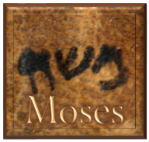
This is the name “Mosheh” (מֺשֶׁה – Moses) as seen in the Dead Sea Scrolls, written over two thousand years ago.
The first six plagues in Egypt aren’t easy to place on a calendar. We know that all of the plagues occurred within a one-year timeframe (or less) because Moses was 80 when he first appeared before Pharaoh (Exodus 7:7), and he died at the age of 120 (Deuteronomy 34:7) after spending 40 years in the wilderness; thus, they must have occurred within a year or less to make the math work out. The last four plagues, however, are a little easier to mark.
The timing of the seventh plague, hail, may be roughly dated to late January or mid-February. (Today’s date was chosen at random.) This is the period in Egypt when “the barley is in the head and the flax is in bud.” Subsequently, this can help us roughly place the eighth plague, locusts, during the next couple of weeks. Tradition holds that the ninth plague (darkness) occurred on the first of Adar (the 12th month) and the final plague, the death of the first born, is commemorated each year at Passover.
If you’ve been following us, you know that from time to time we like to learn a little Hebrew. The chart below contains a few words that we’ll target and plug into the story.
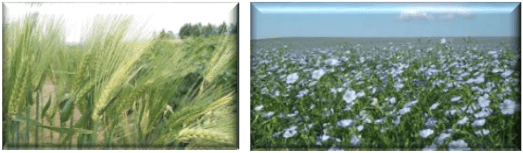
| barley | se’orah | from a verb root meaning “to be hairy” (see photo above) |
| Egypt | Mitzra’im | “doubly fortified,” son of Ham, grandson of Noah |
| fire | esh | pronounced like “aish” |
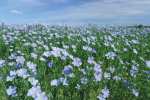
| flax | pishtah | a blue-flowering plant grown for its seed (linseed) and textile fiber made from its stalk |
| hail | barad | used 29 times in the Bible; 22 of those to describe the 7th plague in Egypt |
| heavy (also hardened) | kaved | pronounced like “kavaid” it shares a root with “kavod” which refers to the “Glory” of God. We’ve been studying this word in connection with the Philistines’ abduction of the Ark and the plague that afflicted them because of it. |
| land, earth | eretz, ha’aretz | eretz = “land of” – ha’aretz = “the land” |
| thunder | kol, kolot | literally means “voice,” kolot is plural (voices) |
| very | me’od | also translated as great, much, forceful, or abundant – exceedingly |
Now let’s see how these words fall into our story:
Then the LORD said to Moses, “Rise early in the morning and stand before Pharaoh, and say to him,
`Thus says the LORD God of the Hebrews: “Let My people go, that they may serve Me, for at this time I will send all My plagues to your very heart, and on your servants and on your people, that you may know that there is none like Me in all ha’aretz (the earth).
“Now if I had stretched out My hand and struck you and your people with pestilence, then you would have been cut off from ha’aretz (the earth). But indeed, for this purpose I have raised you up, that I may show My power in you, and that My name may be declared in all ha’aretz. As yet you exalt yourself against My people in that you will not let them go.
“Behold, tomorrow about this time I will cause barad kaved me’od (very heavy hail) to rain down, such as has not been in Mitzra’im (Egypt) since its founding until now. Therefore, send now and gather your livestock and all that you have in the field, for the barad (hail) shall come down on every man and every animal which is found in the field and is not brought home; and they shall die.”‘”
He who feared the word of the LORD among the servants of Pharaoh made his servants and his livestock flee to the houses. But he who did not regard the word of the LORD left his servants and his livestock in the field.
Then the LORD said to Moses, “Stretch out your hand toward heaven, that there may be barad in all eretz Mitzra’im (the land of Egypt) — on man, on beast, and on every herb of the field, throughout eretz Mitzra’im.”
And Moses stretched out his rod toward heaven; and the LORD sent kolot (thunder, literally “voices”) and barad (hail), and esh (fire) darted to the gound. And the LORD rained barad on eretz Mitzra’im. So, there was barad, and esh mingled with the barad, so kaved me’od (very heavy) that there was none like it in all eretz Mitzra’im since it became a nation. And the barad struck throughout the whole eretz Mitzra’im, all that was in the field, both man and beast; and the barad struck every herb of the field and broke every tree of the field. Only in the land of Goshen, where the children of Israel were, there was no barad.
And Pharaoh sent and called for Moses and Aaron, and said to them, “I have sinned this time. The LORD is righteous, and my people and I are wicked. Entreat the LORD, that there may be no more mighty kolot Elohim (voices of God – i.e. “thunder”) and barad, for it is enough. I will let you go, and you shall stay no longer.”
So, Moses said to him, “As soon as I have gone out of the city, I will spread out my hands to the LORD; the kolot (voices, thunder) will cease, and there will be no more barad, that you may know that ha’aretz (the land) is the LORD’s. But as for you and your servants, I know that you will not yet fear the LORD God.”
Now the pishtah (flax) and the se’orah (barley) were struck, for the se’orah was in the head and the pishtah was in bud. But the wheat and the spelt were not struck, for they are late crops.
So, Moses went out of the city from Pharaoh and spread out his hands to the LORD; then the kolot and the barad ceased, and the rain was not poured on the ground. And when Pharaoh saw that the rain, the barad, and the kolot had ceased, he sinned yet more; and he keved (hardened) his heart, he and his servants.
So the heart of Pharaoh was hard; neither would he let the children of Israel go, as the LORD had spoken by Moses. – Exodus 9:13-35
It seems that God is a bit of a weather forecaster. He predicted hail and it hailed and hailed and hailed and hailed and hailed. But the hail did not fall upon the children of Israel who were living in Goshen. And, in his vision of the Revelation of Jesus Christ, John envisions that it will hail again when the first angel blows his trumpet.
The first angel sounded: And hail and fire followed, mingled with blood, and they were thrown to the earth. And a third of the trees were burned up, and all green grass was burned up. – Revelation 8:7 (NKJ)
Many of the plagues found in the book of Revelation are echoes of the plagues that were unleashed upon Egypt. Hail is mentioned again in two other places in Revelation. In fact, it’s called a great hail and a plague that was exceedingly great…more echoes of words used to describe the plague in Egypt.
Then the temple of God was opened in heaven, and the ark of His covenant was seen in His temple. And there were lightnings, noises, thunderings, an earthquake, and great hail. – Revelation 11:19 (NKJ)
And great hail from heaven fell upon men, each hailstone about the weight of a talent. Men blasphemed God because of the plague of the hail, since that plague was exceedingly great. – Revelation 16:21 (NKJ)
So, what’s the weather forecast for the future? 100% chance of hail!
But let’s not just talk about the hail; another fascinating piece to this story is that Pharaoh heard the “voices of God.” I realize that this is probably appropriately translated as “thunder.” But Pharaoh heard the “kolot Elohim” (the voices of God) and, in a few months, the people of Israel will see the “kolot” of God when He speaks the Ten Commandments at Mount Sinai. See Exodus 20:18 below as translated by the New King James version.
Now all the people witnessed the thunderings, the lightning flashes, the sound of the trumpet, and the mountain smoking; and when the people saw it, they trembled and stood afar off. – Exodus 20:18 (NKJ)
Now let’s look at the Young’s Literal Translation of this verse:
And all the people are seeing the voices (kolot), and the flames (“torches”), and the sound of the trumpet, and the mount smoking; and the people see, and move, and stand afar off, – Exodus 20:18 (YLT)
They saw the voices (kolot) and the flames (torches). Wouldn’t you have liked to have been there? What was it like to “see the voices” of God? I can only try to imagine.
Returning to our story, one wonders why the flax and barley crops were targeted for destruction. There are lots of commentaries revolving around this question. Many say that these crops weren’t as important as the wheat and the spelt, thus showing God’s mercy. Others point out the usefulness of the barley to feed cattle and to make strong ale or beer. As for the flax, they call out the textile industry, for which Egypt is still famous to this day. We don’t really know why these two crops were chosen.
On a sidenote, I remember hearing family stories of my grandfather growing flax in northwest Iowa during World War II. My mother, who was about 10 years old at the time, says she can remember how beautiful the fields were when its blue flowers were in bloom. If a breeze blew across the fields, she said the flax looked like oceans, like waves of water. The U. S. government encouraged farmers to grow flax during the war due to an increased demand for domestic fats and oils needed for the war effort – flaxseed and linseed oil in particular. This need was heightened due to the inability to import vegetable oils from enemy-occupied territories.
I hope you’ve enjoyed learning a few Hebrew words (and a little bit of WWII history) in our post for today. Thanks for studying with us!
Did you know that you can view any of our posts whenever you’d like?
Visit our home page at https://todayinthebible.com
where you can find them organized by month
in the “Archives” section on the right side of the page.
© 2026 Today in the Bible
 Today in the Bible
You must be logged in to post a comment.