
Adar 7, 5785; from sunset March 6, 2025, to sunset March 7, 2025
(The seventh day of the twelfth month)
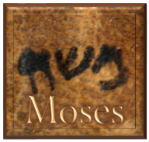
This is the name “Mosheh” (מֺשֶׁה – Moses) as seen in the Dead Sea Scrolls, written over two thousand years ago.
Today, according to Jewish tradition, is the date of Moses’ death. Let’s read what the Bible has to say.
Then Moses went and spoke these words to all Israel. And he said to them: “I am one hundred and twenty years old today. I can no longer go out and come in. Also the LORD has said to me, `You shall not cross over this Jordan.’ The LORD your God Himself crosses over before you; He will destroy these nations from before you, and you shall dispossess them. Joshua himself crosses over before you, just as the LORD has said. And the LORD will do to them as He did to Sihon and Og, the kings of the Amorites and their land, when He destroyed them. The LORD will give them over to you, that you may do to them according to every commandment which I have commanded you.
“Be strong and of good courage, do not fear nor be afraid of them; for the LORD your God, He is the One who goes with you. He will not leave you nor forsake you.” – Deuteronomy 31:1-6
Now Moses went up from the plains of Moab to Mount Nebo, to the top of Pisgah, which is opposite Jericho. And the LORD showed him all the land, Gilead as far as Dan, and all Naphtali and the land of Ephraim and Manasseh, and all the land of Judah as far as the western sea, and the Negev and the plain in the valley of Jericho, the city of palm trees, as far as Zoar.
Then the LORD said to him, “This is the land which I swore to Abraham, Isaac, and Jacob, saying, ‘I will give it to your descendants’; I have let you see it with your eyes, but you shall not pass over to it.”
So Moses the servant of the LORD died there in the land of Moab, according to the word of the LORD. And He buried him in the valley in the land of Moab, opposite Beth-peor; but no man knows his burial place to this day. Although Moses was one hundred and twenty years old when he died, his eye was not dim, nor his vigor abated. So the sons of Israel wept for Moses in the plains of Moab thirty days; then the days of weeping and mourning for Moses came to an end.
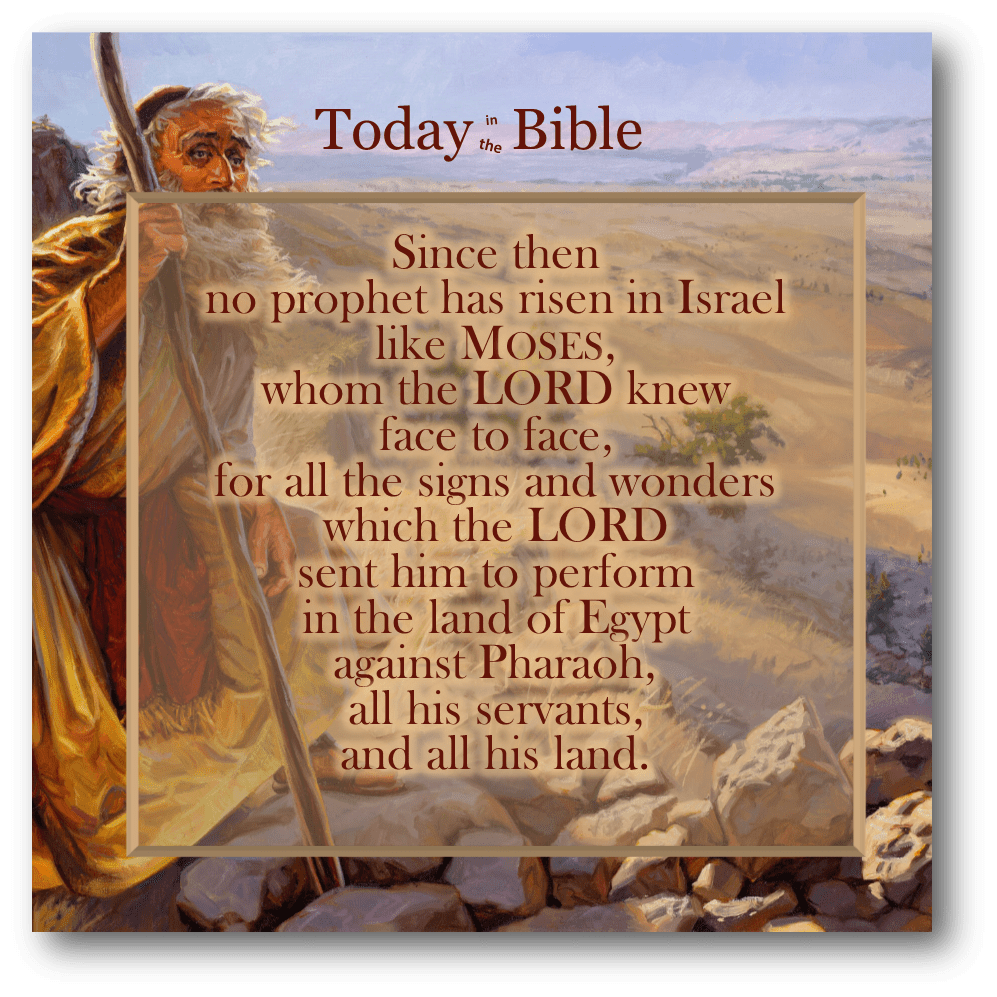
Now Joshua the son of Nun was filled with the spirit of wisdom, for Moses had laid his hands on him; and the sons of Israel listened to him and did as the LORD had commanded Moses. Since then no prophet has risen in Israel like Moses, whom the LORD knew face to face, for all the signs and wonders which the LORD sent him to perform in the land of Egypt against Pharaoh, all his servants, and all his land, and for all the mighty power and for all the great terror which Moses performed in the sight of all Israel. – Deuteronomy 34

The map above shows the northern-most tip of the Dead Sea. To the east is Mt. Nebo (circled). The LORD took Moses to the summit of Mt. Nebo. Mt. Nebo, as with many proper names in the Bible, has some disagreement as to what it means. It appears to be narrowed down to two possibilities. The first, from the root “nabah” which is an unused verb root in the Bible – in sister-languages it means “to be high or prominent.” The second, from the verb root “naba,” which is used in the Bible…it means “to prophesy.” The word “navi” comes from this root, it means “prophet,” and is the word used to describe Moses in the verse below.
“Since then no prophet (navi) has risen in Israel like Moses.”
So, maybe, the LORD took the “prophet” who was “higher or more prominent” than all others (no prophet has risen in Israel like Moses) to a mountain that He had named in his honor. But, wait, there’s more. Yesterday when we studied the song of Moses and his commissioning of Joshua in Deuteronomy 32, the chapter ended with these words:
Then the LORD spoke to Moses that very same day, saying: “Go up this mountain of the Abarim, Mount Nebo…” – Deuteronomy 32:48 (NKJ)
So what does “this mountain of the Abarim” mean? Wikipedia defines it as follows:
Abarim is a mountain range across Jordan, to the east and south-east of the Dead Sea, extending from Mount Nebo — its highest point — in the north, perhaps to the Arabian desert in the south. – Wikipedia
Mt. Nebo is a part of the Abarim mountain range. The name Abarim comes from the Hebrew verb meaning, “to pass over.” This is the same root that the name “Hebrew” comes from. In Deuteronomy 34:4 God says to Moses, “but you shall not pass over [abar] to it.” So this “most prominent prophet” (Nebo] was not allowed to pass over [Abarim] into the Promised Land.
One website, which I visit often for information and commentary on the meanings of biblical names, is called Abarim Publications. The words below describe how they settled upon the name of their website:
We have chosen the name Abarim Publications because we understand that neither our work, nor what we have seen, nor that we have seen, is salvific. What we do belongs to the wilderness years; no one has ever been reasoned into either the Promised Land, heaven, or the New Creation.
The First Fruits of Zion ministry has made a similar statement in one of their Torah Club studies. It goes something like this:
Moses (signifying obedience to the Law of God) can bring you up to the Promised Land, but only Joshua (whose name means “the LORD saves”) can bring you into the Promised Land.
So it’s only the work of our Messiah, Yeshua – Jesus (whose name is a shorted form of Joshua, Yehoshua) – that lets us “abar” or “cross over” into the Promised Land. I like Abarim Publications’ statement “What we do belongs to the wilderness years.” Even though all this is true, that our works do not merit our salvation, we’ve just spent the last month reading over and over and over again how the LORD implores us to “do” His commands. It’s our source of blessing.
In a few short weeks, we’ll be studying Joshua, who led the children of Israel as they “crossed over” into the Promised Land – leaving those wilderness years behind them.
Thank you for sticking with us as we studied through the book of Deuteronomy. We hope you’ll continue on with us as we work through this coming month and remember Purim, the completion of the Tabernacle, the Second Temple, and Herod’s renovation of the Temple. There are a lot more exciting biblical events waiting for us.
Did you know that our posts are categorized and tagged by content?
When you visit our home page at https://todayinthebible.com and select any post,
you can find the associated categories and tags just to the right of the title.
Simply click on any tag and you will be taken to all related posts.

© 2026 Today in the Bible

 Today in the Bible
You must be logged in to post a comment.