
Adar 12, 5785; from sunset March 11, 2025, to sunset March 12, 2025
(The twelfth day of the twelfth month)
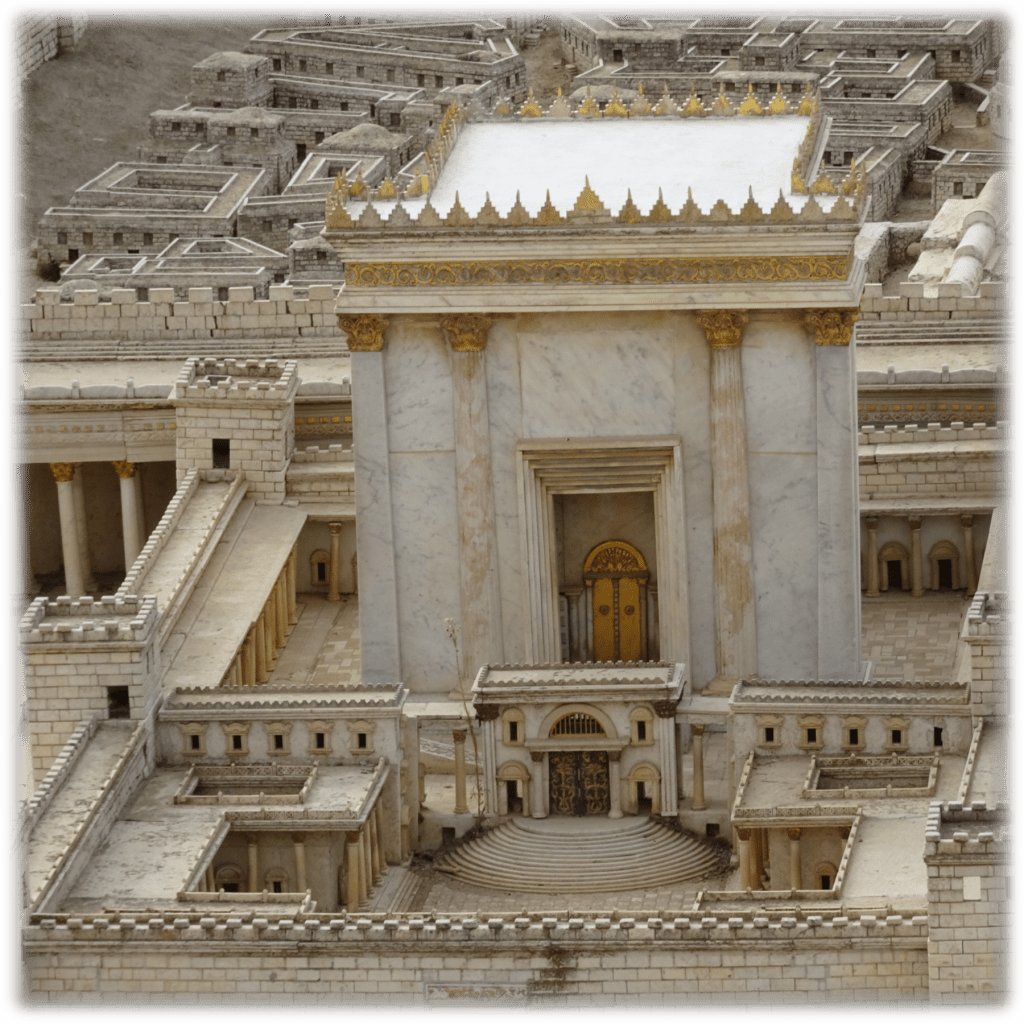
Photo credit: Today in the Bible

This is the name “Horodos” (“Herod”) as seen in a Hebrew version of Luke 1:5 from the Vatican online library; it is of unknown age and origin.
Herod’s Temple Dedicated (11 BCE)
A little over a week ago, we remembered the completion of the Second Temple by the exiles who had returned from Babylonia. Three hundred years later, it was in disrepair. In the year 19 BCE, King Herod I floated the idea of rebuilding and renovating that Temple. Though many Jews were wary of Herod’s motives, the renovation was completed eight years later. The new structure was magnificent, causing the Talmud to state: “He who has not seen Herod’s building has not seen a magnificent building!” Below are some excerpts from the writings of Josephus surrounding this event, including the speech that Herod gave to his subjects in order to encourage them to agree to the rebuild.
And now Herod, in the eighteenth year of his reign, and after the acts already mentioned, undertook a very great work, that is, to build by himself the temple of God, and make it larger in size, and to raise it to a most magnificent height, as esteeming it to be the most glorious of all his actions, as it really was, to bring it to perfection, and that this would be sufficient for an everlasting memorial of him; but as he knew the multitude were not ready nor willing to assist him in so vast a design, he thought to prepare them first by making a speech to them, and then set about the work itself; so he called them together, and spoke thus to them:–
“I think I need not speak to you, my countrymen, about such other works as I have done since I came to the kingdom, although I may say they have been performed in such a manner as to bring more security to you than glory to myself; for I have neither been negligent in the most difficult times about what tended to ease your necessities, nor have the buildings I have made been so proper to preserve me as yourselves from injuries; and I imagine that, with God’s assistance, I have advanced the nation of the Jews to a degree of happiness which they never had before; and for the particular edifices belonging to your own country, and your own cities, as also to those cities that we have lately acquired, which we have erected and greatly adorned, and thereby augmented the dignity of your nation, it seems to me a needless task to enumerate them to you, since you well know them yourselves; but as to that undertaking which I have a mind to set about at present, and which will be a work of the greatest piety and excellence that can possibly be undertaken by us, I will now declare it to you.
Our fathers, indeed, when they were returned from Babylon, built this temple to God Almighty, yet does it is not sixty cubits in its height; for so much did that first temple which Solomon built exceed this temple: nor let anyone condemn our fathers for their negligence or want of piety herein, for it was not their fault that the temple was no higher; for they were Cyrus, and Darius, the son of Hystaspes, who determined the measures for its rebuilding; and it has been by reason of the subjection of those fathers of ours to them and to their posterity, and after them to the Macedonians, that they had not the opportunity to follow the original model of this sacred edifice, nor could raise it to its ancient height; but since I am now, by God’s will, your governor, and I have had peace a long time, and have gained great riches and large revenues, and, what is the principal thing of all, I am at amity with, and well regarded by the Romans, who, if I may so say, are the rulers of the whole world, I will do my endeavour to correct that imperfection, which has arisen from the necessity of our affairs, and the slavery we have been under formerly, and to make a thankful return, after the most pious manner, to God, for what blessings I have received from him, by giving me this kingdom, and that by rendering his temple as complete as I am able.”
And this was the speech which Herod made to them: but still this speech frightened many of the people, as being unexpected by them; and because it seemed incredible, it did not encourage them, but put a damper on them, for they were afraid that he would pull down the whole edifice, and not be able to bring his intentions to perfection for its rebuilding; and this danger appeared to them to be very great, and the vastness of the undertaking to be such as could hardly be accomplished.
But while they were in this disposition, the king encouraged them, and told them he would not pull down their temple till all things were gotten ready for building it up entirely again. And since he promised them this beforehand, he did not break his word with them, but got ready a thousand wagons, that were to bring stones for the building, and chose out ten thousand of the most skillful workmen, and bought a thousand sacerdotal garments for as many of the priests, and had some of them taught the arts of stone cutters, and others of carpenters, and then began to build; but not till everything was well prepared for the work.
So Herod took away the old foundations, and laid others, and erected the temple upon them, being in length a hundred cubits, and in height twenty additional cubits, which [twenty], upon the sinking of their foundations fell down; and this part it was that we resolved to raise again in the days of Nero.
Now the temple was built of stones that were white and strong, and each of their length was twenty-five cubits, their height was eight, and their breadth about twelve; and the whole structure, as also the structure of the royal cloister, was on each side much lower, but the middle was much higher, till they were visible to those who dwelt in the country for a great many miles, but chiefly to such as lived opposite them, and those who approached to them.
The temple had doors also at the entrance, and lintels over them, of the same height with the temple itself. They were adorned with embroidered veils, with their flowers of purple, and pillars interwoven; and over these, but under the crown work, was spread out a golden vine, with its branches hanging down from a great height, the size and fine workmanship of which was a surprising sight to the spectators, to see what vast materials there were, and with what great skill the workmanship was done.
He also surrounded the entire temple with very large cloisters, contriving them to be in a due proportion thereto; and he laid out larger sums of money upon them than had been done before him, till it seemed that no one else had so greatly adorned the temple as he had done. There was a large wall to both the cloisters; which wall was itself the most prodigious work that was ever heard of by man.
The hill was a rocky ascent, that declined by degrees toward the east parts of the city, till it came to an elevated level. This hill it was which Solomon, who was the first of our kings, by divine revelation, surrounded with a wall; it was of excellent workmanship upwards, and round the top of it. He also built a wall below, beginning at the bottom, which was surrounded by a deep valley; and, at the south side he laid rocks together, and bound them one to another with lead, and included some of the inner parts, till it proceeded to a great height, and till both the size of the square edifice and its height were immense, and till the vastness of the stones in the front were plainly visible on the outside, yet so that the inward parts were fastened together with iron, and preserved the joints immovable for all future times.
When this work [for the foundation] was done in this manner, and joined together as part of the hill itself to the very top of it, he wrought it all into one outward surface, and filled up the hollow places which were about the wall, and made it a level on the external upper surface, and a smooth level also. This hill was walled all around, and in length half a mile, [the distance of] each angle containing in length an eighth of a mile: but within this wall, and on the very top of all, there ran another wall of stone also, having, on the east quarter, a double cloister, of the same length with the wall; in the midst of which was the temple itself. This cloister looked to the gates of the temple; and it had been adorned by many kings in former times; and around the entire temple were fixed the spoils taken from barbarous nations; all these had been dedicated to the temple by Herod, with the addition of those he had taken from the Arabians.
Now, on the north side [of the temple] was built a citadel, whose walls were square, and strong, and of extraordinary firmness. This citadel was built by the kings of the Asamonean family, who were also high priests before Herod, and they called it the Tower, in which were deposited the vestments of the high priest, which the high priest only put on at the time when he was to offer sacrifice. These vestments King Herod kept in that place; and after his death they were under the power of the Romans, until the time of Tiberius Caesar… – Josephus, Antiquities of the Jews 15:380-404
Now, in the western quarters of the enclosure of the temple there were four gates; the first led to the king’s palace, and went to a passage over the intermediate valley; two more led to the suburbs of the city; and the last led to the other city, where the road descended down into the valley by a great number of steps, and there up again by the ascent; for the city lay opposite the temple in the manner of a theatre, and was surrounded with a deep valley along the entire south quarter; but the fourth front of the temple, which was southward, had indeed itself gates in its middle, as also it had the royal cloisters, with three walks, which reached in length from the east valley to that on the west, for it was impossible it should reach any farther: and this cloister deserves to be mentioned better than any other under the sun; for while the valley was very deep, and its bottom could not be seen, if you looked from above into the depth, this further vastly high elevation of the cloister stood upon that height, insomuch, that if anyone looked down from the top of the battlements, or down both those heights, he would be giddy, while his sight could not reach to such an immense depth.
This cloister had pillars that stood in four rows, one opposite the other all along, for the fourth row was interwoven into the wall, [which also was built of stone;] and the thickness of each pillar was such, that three men might, with their arms extended, fathom it round, and join their hands again, while its length was twenty-seven feet, with a double spiral at its basis; and the number of all the pillars [in that court] was a hundred and sixty-two. Their capitals were made with sculptures after the Corinthian order, and caused an amazement [to the spectators], by reason of the grandeur of the whole.
These four rows of pillars included three intervals for walking in the middle of this cloister; two of which walks were made parallel to each other, and were contrived after the same manner; the breadth of each of them was thirty feet, the length was about six hundred feet, and the height fifty feet; but the breadth of the middle part of the cloister was one and a half of the other, and the height was double, for it was much higher than those on each side; but the roofs were adorned with deep sculptures in wood, representing many sorts of figures. The middle was much higher than the rest, and the wall of the front was adorned with beams, resting upon pillars, that were interwoven into it, and that front was all of polished stone, insomuch that its fineness, to such as had not seen it, was incredible, and to such as had seen it, was greatly amazing.
Thus was the first enclosure. In the midst of which, and not far from it, was the second, to be gone up to by a few steps: this was surrounded by a stone wall for a partition, with an inscription, which forbade any foreigner to go in under pain of death.
Now this inner enclosure had on its southern and northern quarters three gates [equally] distant one from another; but on the east quarter, toward the sunrising, there was one large gate through which such as were pure came in, together with their wives; but the temple further inward in that gate, was not allowed to the women; but still more inward was there a third [court of the] temple, whereinto it was not lawful for any but the priests alone to enter. The temple itself was within this; and before that temple was the altar, upon which we offer our sacrifices and burnt offerings to God.
Into none of these three did King Herod enter, for he was forbidden, because he was not a priest. However, he took care of the cloisters and the outer enclosures, and these he built in eight years.
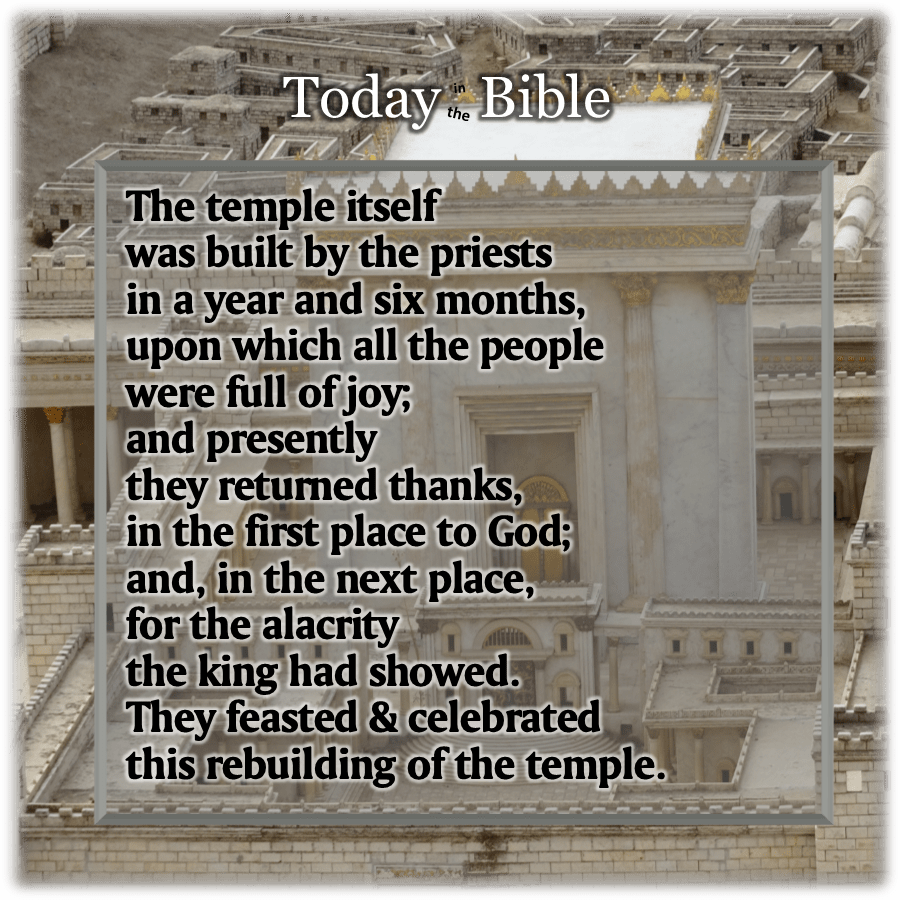
But the temple itself was built by the priests in a year and six months, upon which all the people were full of joy; and presently they returned thanks, in the first place, to God; and, in the next place, for the alacrity the king had showed. They feasted and celebrated this rebuilding of the temple: and for the king, he sacrificed three hundred oxen to God, as did the rest, everyone according to his ability: the number of which sacrifices is not possible to set down; for it cannot be that we should truly relate it; for at the same time with this celebration for the work about the temple fell also the day of the king’s inauguration, which he kept of an old custom as a festival, and it now coincided with the other, which coincidence of them both made the festival most illustrious.
There was also an occult passage built for the king: it led from Antonia to the inner temple, at its eastern gate; over which he also erected for himself a tower, that he might have the opportunity of a subterranean ascent to the temple, in order to guard against any sedition which might be made by the people against their kings.
It is also reported, that during the time that the temple was building, it did not rain in the daytime, but that the showers fell in the nights, so that the work was not hindered. And this our fathers have delivered to us; nor is it incredible, if anyone have regard to the manifestations of God. And thus was performed the work of the rebuilding of the temple. – Josephus, Antiquities of the Jews 15:410-425
Did you know that you can view any of our posts whenever you’d like?
Visit our home page at https://todayinthebible.com
where you can find them organized by month
in the “Archives” section on the right side of the page.

© 2026 Today in the Bible

 Today in the Bible
You must be logged in to post a comment.