
Adar 26, 5785; from sunset March 25, 2025, to sunset March 26, 2025
(The twenty-sixth day of the twelfth month)

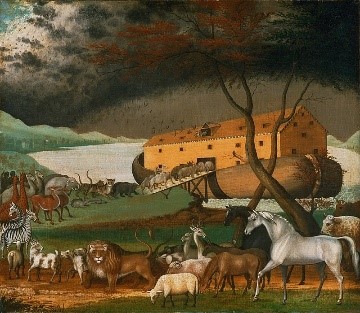
Noah’s Ark (1846), by the American folk painter Edward Hicks.
During the COVID19 lock down, we might have been able to empathize a little with Noah and his family. Isolated. Stuck inside. At least we could go to the grocery store or out for a walk. They were cramped in with seven other people and who knows how many animals. I’m sure their nerves were probably shot. And, when they looked outside, all they could see was water and sky.
But God remembered Noah and all the beasts and all the cattle that were with him in the ark; and God caused a wind to pass over the earth, and the water subsided. Also the fountains of the deep and the floodgates of the sky were closed, and the rain from the sky was restrained; and the water receded steadily from the earth, and at the end of one hundred and fifty days the water decreased. – Genesis 8:1-3 (NAS)
It’s been three months since it stopped raining (on Kislev 27 way back in December). Noah and his family and all of the animals have been confined on the ark for almost five months now. They entered in just seven days before the rains started falling. They’ve still got a ways to go before the 150 days of receding water is complete. If you think about it, they didn’t even have a reference point to see that the waters were actually receding.

Photo credit: Today in the Bible
There was no yardstick (or even a cubit-stick!) painted on a wall where they could watch the waters decrease. Above is a photo from the lock and dam at Guttenberg, Iowa, on the Mississippi River. It is located inside the lock so you can see the water rise and fall as the barges pass through the lock to go up or down the river. For Noah and his family, they had no perspective until they came to rest upon the mountains of Ararat; and even then, it was over a month before the mountain tops became visible.
Below is a reckoning of Noah’s timeline, according to Rashi. Rashi is an acronym for “Rabbi Shlomo Yitzḥaqi.” He was born in 1040 AD, in Troyes, France, and died July 13, 1105 AD. Rashi was a renowned medieval commentator on the Bible and the Talmud. (Wikipedia)
- 11 Cheshvan – Noah enters the ark (Oct/Nov)
- 17 Cheshvan – The windows of heaven are opened
- 27 Kislev – 40 days later the windows of heaven are closed and the waters begin receding
Now let’s do the math for the 150 days.
| 27 Kislev | The windows of heaven are closed: |
| plus | |
| 3 days | to finish out the month of Kislev |
| 29 days | in the month of Tevet |
| 30 days | in the month of Shevat |
| 29 days | in the month of Adar |
| 30 days | in the month of Nisan |
| 29 days | in the month of Iyyar |
| 150 days | of receding waters, 1 Sivan (May/June) |
And in the seventh month, on the seventeenth day of the month, the ark rested upon the mountains of Ararat. – Genesis 8:4 (NAS)
Rashi explains that “the seventh month” is not the seventh month of the calendar, but the seventh month from when the rains stopped. He calculates the 17th of Sivan as the day that the ark rested upon the mountains of Ararat (late May/mid-June on our calendar). According to Rabbi Joshua’s (second century AD) interpretation, the flood began on Iyyar 17, and all above dates should be moved ahead six months.
Though we don’t know the exact calendar layout for Noah – it’s fun to try to put ourselves in his sandals and think about the experiences that he and his family had during their one solar year in the ark.
If you’d like to read all of our posts on Noah, please click on the image above.

© 2026 Today in the Bible

 Today in the Bible
You must be logged in to post a comment.